






Che cos'è la permeabilità magnetica
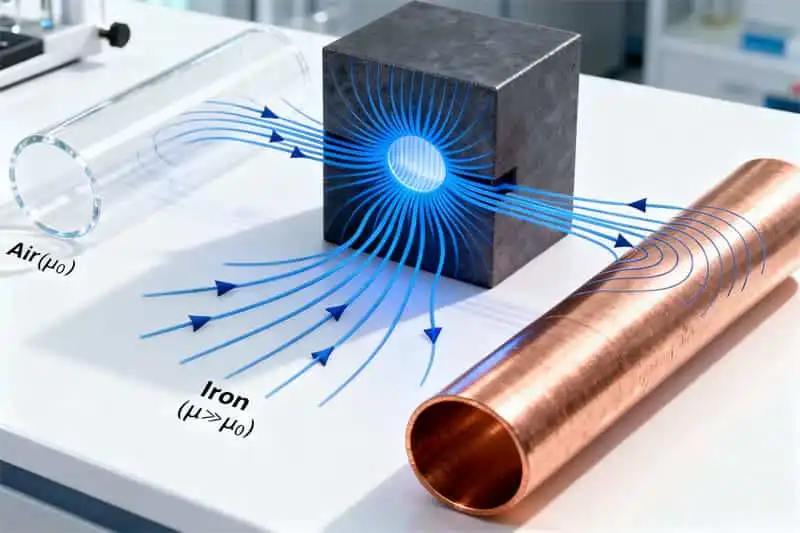
Il concetto di permeabilità magnetica indica la velocità con cui un materiale consente alle linee del campo magnetico di attraversarlo. In termini meno tecnici, è una misura della facilità con cui un materiale può condurre il magnetismo al suo interno, analogamente a come la conducibilità elettrica misura la facilità con cui l’elettricità può essere condotta.
Questo spiega perché materiali come il ferro possono diventare potenti magneti, mentre il legno o la plastica no. I materiali altamente permeabili sono in grado di concentrare le linee del campo magnetico, una proprietà utile nei motori, nei trasformatori e negli induttori.
Definizione di permeabilità magnetica
L’entità con cui un materiale trasporta al suo interno un campo magnetico è chiamata permeabilità magnetica. Essa descrive la risposta del materiale all’applicazione di un campo magnetico.
Si possono considerare le linee del campo magnetico come l’acqua in un tubo; un materiale altamente permeabile è simile a un tubo di grande diametro, che consente al magnetismo di passare facilmente. La permeabilità è indicata con μ (mu) ed è un parametro significativo nei calcoli magnetici.
Permeabilità magnetica dello spazio libero
La permeabilità magnetica dello spazio libero, comunemente indicata come μ₀ (mu con pedice zero), è una proprietà del magnetismo nel vuoto. Ha un valore costante pari a 4π × 10⁻⁷ H/m (henry per metro).
Questo valore può essere utilizzato per confrontare il comportamento magnetico di altri materiali. Nel caso della permeabilità relativa, essa è sempre misurata rispetto a μ₀.
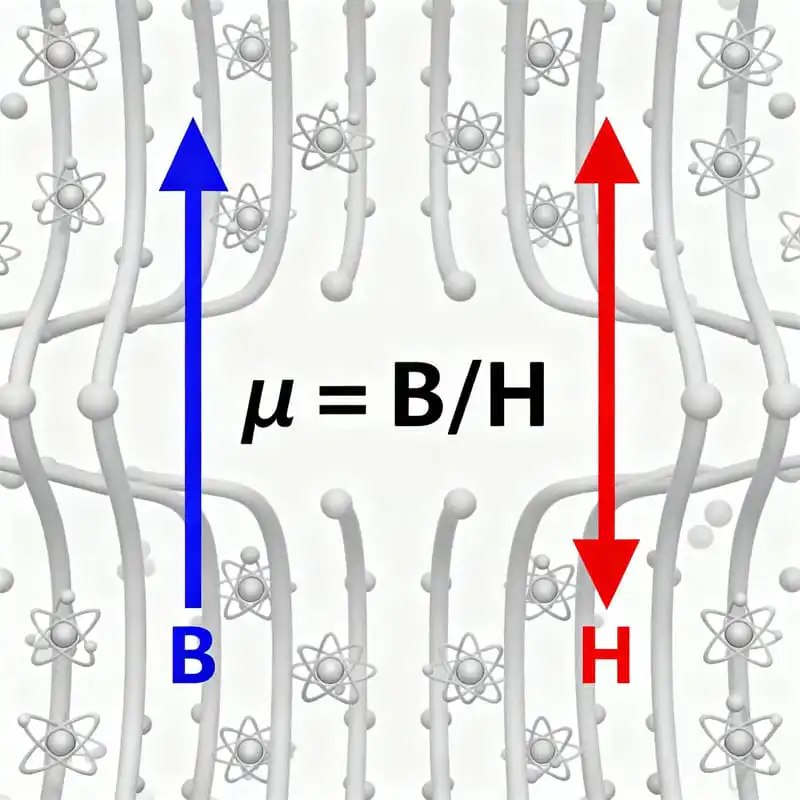
Relazione tra B e H; definizione della permeabilità μ
La permeabilità mette in relazione due termini importanti del magnetismo, la densità del flusso magnetico (B) e l’intensità del campo magnetico (H), mediante l’equazione:
B = μH
In questo caso, B rappresenta la densità complessiva del flusso magnetico all’interno del materiale, H è il campo applicato e μ rappresenta l’intensità della risposta del materiale.
Quando m è elevato, il materiale si magnetizza facilmente; quando è basso, il materiale non si magnetizza facilmente.
Visione microscopica e macroscopica; permeabilità incrementale
Su scala microscopica, la permeabilità magnetica è determinata dall’allineamento di piccoli magneti atomici (dipoli) con un campo esterno. In sostanze come il ferro, un gran numero di atomi si orienta nella direzione del campo, determinando una permeabilità molto elevata.
Su scala macroscopica, la permeabilità descrive il comportamento complessivo del materiale considerato come un’unica entità e può variare in funzione dell’intensità del campo, della temperatura o della frequenza.
Il rapporto tra la piccola variazione del flusso magnetico e la piccola variazione del campo applicato è la permeabilità incrementale. Può inoltre essere utile per analizzare il comportamento dei materiali in presenza di campi magnetici alternati o variabili, ad esempio nei trasformatori e nei circuiti elettronici.
Formula della permeabilità magnetica
Per studiare la permeabilità magnetica nelle applicazioni reali si utilizzano formule che consentono di calcolare il comportamento dei campi magnetici all’interno di materiali diversi. Mediante queste equazioni, gli ingegneri possono confrontare i materiali, progettare dispositivi magnetici più efficienti e prevedere la capacità di una sostanza di convogliare il flusso magnetico.
Simboli/unità e variabili
Nelle equazioni magnetiche si utilizzano tre simboli principali: B, H, e μ.
- B indica l’induzione magnetica, misurata in tesla (T). Indica il campo magnetico totale all’interno del materiale.
- H rappresenta l’intensità del campo magnetico, misurata in ampere per metro (A/m). Indica l’intensità del campo magnetico applicato.
- μ è la permeabilità magnetica, che indica quanto flusso magnetico viene prodotto all’interno del materiale per un determinato campo applicato.
Insieme, formano l’equazione fondamentale B = μH.
Unità di misura della permeabilità magnetica
L’unità standard del SI della permeabilità magnetica è l’ henry per metro (H/m). Può anche essere espressa come tesla metro per ampere (T·m/A) poiché 1 henry equivale a 1 tesla metro per ampere.
Questa unità descrive l'intensità del campo magnetico (in tesla) generato da una determinata intensità di corrente per metro di materiale.
Formula dimensionale
La formula dimensionale della permeabilità magnetica può essere ricavata dall'equazione B = μH.
Sappiamo che:
- B ha dimensioni [M¹ L⁰ T⁻² I⁻¹]
- H ha dimensioni [I L⁻¹]
Pertanto,
μ = B / H = [M¹ L¹ T⁻² I⁻²]
Di conseguenza, la formula dimensionale della permeabilità magnetica è M¹ L¹ T⁻² I⁻², che ne esprime la dipendenza da massa, lunghezza, tempo e corrente elettrica.
Unità della permeabilità magnetica relativa
La permeabilità magnetica relativa (μᵣ) è una è una grandezza adimensionale. Rappresenta il rapporto tra la permeabilità del materiale (μ) e la permeabilità del vuoto (μ₀):
μᵣ = μ / μ₀
Poiché μ e μ₀ hanno le stesse unità di misura, il loro rapporto non ha alcuna unità di misura. μᵣ è quindi un numero puro che consente di confrontare facilmente i materiali.
Permeabilità relativa e suscettività magnetica
La permeabilità relativa e la suscettività magnetica descrivono la risposta dei materiali ai campi magnetici. Permeabilità indica con quanta facilità un campo magnetico attraversa un materiale, mentre la suscettività indica quanto intensamente il materiale si magnetizza. Insieme, spiegano il comportamento magnetico di diverse sostanze.
μᵣ = μ/μ₀; χₘ = μᵣ − 1
La permeabilità relativa (μᵣ) è il rapporto tra la permeabilità di un materiale (μ) e la permeabilità del vuoto (μ₀). Indica se un materiale conduce il flusso magnetico meglio o peggio rispetto al vuoto.
La suscettività magnetica (χₘ) misura la magnetizzazione prodotta all’interno del materiale. Le due grandezze sono legate dalla relazione χₘ = μᵣ − 1, pertanto a un valore più elevato di μᵣ corrisponde un valore più elevato di χₘ.
Suscettività magnetica
La suscettività magnetica (χₘ) indica la facilità con cui un materiale si magnetizza. Se χₘ è positiva, il materiale è attratto dai magneti (come il ferro — paramagnetico o ferromagnetico). Se χₘ è negativa, viene leggermente respinto (diamagnetico). Questo aiuta a determinare come gli atomi si allineano rispetto a un campo magnetico.
Relazione con la suscettività e μ₀
La permeabilità e la suscettività sono correlate dalla formula μ = μ₀(1 + χₘ). Ciò indica che la permeabilità totale dipende sia dalla permeabilità del vuoto sia dalla suscettività del materiale. All’aumentare di χₘ aumenta anche μ, il che significa che il materiale favorisce un campo magnetico più intenso.
Relazione tra χ e μᵣ
La semplice relazione tra le due grandezze è μᵣ = 1 + χₘ.
Se Se χₘ = 0, allora μᵣ = 1 (come nell’aria o nel vuoto).
I materiali ferromagnetici presentano una χₘ elevata e una μᵣ molto grande, mentre i materiali diamagnetici hanno una χₘ negativa di piccolo valore e una μᵣ appena inferiore a 1. Questa relazione consente di classificare i materiali in base al loro comportamento magnetico.
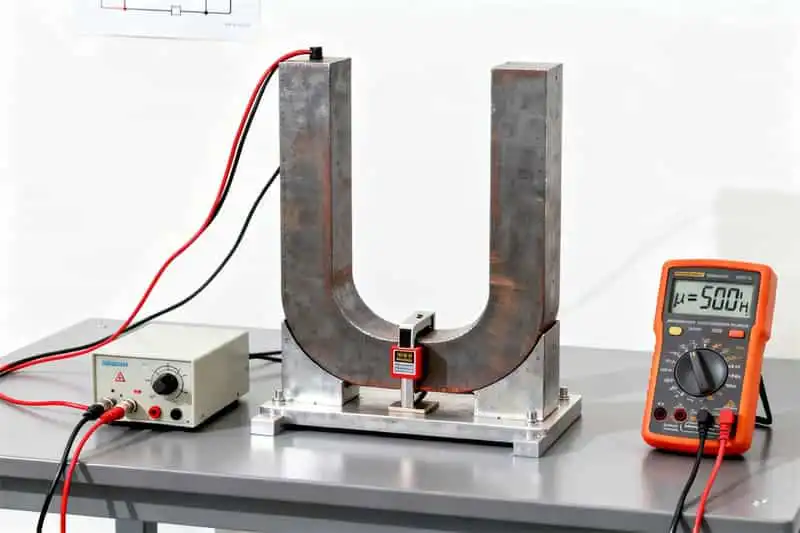
Tipi di permeabilità magnetica
La permeabilità magnetica non è un valore costante. Varia in funzione del materiale, del campo applicato, della sua intensità e di altre condizioni, come la temperatura o la frequenza. Di seguito sono definite diverse classi di permeabilità, che descrivono il comportamento dei materiali in presenza di determinati campi magnetici o condizioni di segnale, sia con campi magnetici statici sia alternati.
Permeabilità assoluta (μ)
The actual permeability of a material in henry per meter (H/m) is known as the absolute permeability (μ). It is the sum of all the conducting abilities of that material to the magnetic flux. Absolute permeability contains the effect of atomic structure as well as external field conditions of the material.
It is useful for the base of calculation, and then compared with free space or relative measures.
Relative Permeability (μᵣ)
Relative permeability (μᵣ) is a ratio of the permeability of a material to the permeability of free space. It is the ratio of the amount of magnetic field that a substance can carry than what the vacuum can carry.
As an example, when μᵣ equals 1000 for soft iron, then it means soft iron would be able to conduct magnetic flux 1000 times better than air.
Amplitude, maximum, initial, incremental, reversible, complex
The different types of permeability help scientists understand how materials behave under different environmental conditions.
Amplitude permeability is the value that appears when the magnetic field undergoes sinusoidal changes.
Initial permeability – the permeability at very low magnetic fields.
Maximum permeability is the topmost value measured before the materials become saturated.
Incremental permeability is the small-signal permeability around a specific bias point.
Reversible permeability value is the behavior of materials in cases where the direction of the magnetic fields entirely reverses.
La complex permeability model is applicable in alternating fields that have power losses and phase shifts.
Types of Magnetic Materials
The magnetic materials are arranged according to their responses to the magnetic field by scientists. The materials exhibit varying resistance to the magnetic field, with some materials being highly resistant and others having weak resistance, and others being highly attractive. Understanding of permeability and susceptibility is used in the selection of suitable materials for their magnetic and electronic work, depending on the behavior of the materials.
Categories of Magnetic Permeability
Scientists group magnetic materials into three major categories. Such as:

Ferromagnetic materials
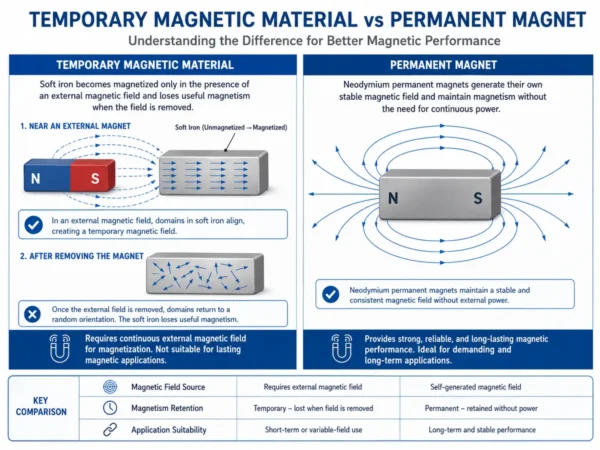
The ferromagnetic materials exhibit the greatest degree of permeability since it is strongly attracted to a magnetic field.
The atomic dipoles in such materials are parallel to each other and thus lead to a vastly large value of permeability, thousands of times larger than free space values.
These materials are used in motor construction and transformer applications and magnetic core development, but their permeability characteristics decrease with increasing temperature or an increasing magnetic field. The materials become non-magnetic at temperatures beyond the Curie point.

Paramagnetic Materials
Paramagnetic materials have a small, positive susceptibility and a relative permeability slightly greater than one. Examples include aluminum, platinum, and magnesium. The materials exhibit a certain attraction to magnets, but the attraction is lost on the removal of the magnetic field.
The materials have a scientific research application and can work in a weak magnetic field environment.
Diamagnetic Materials
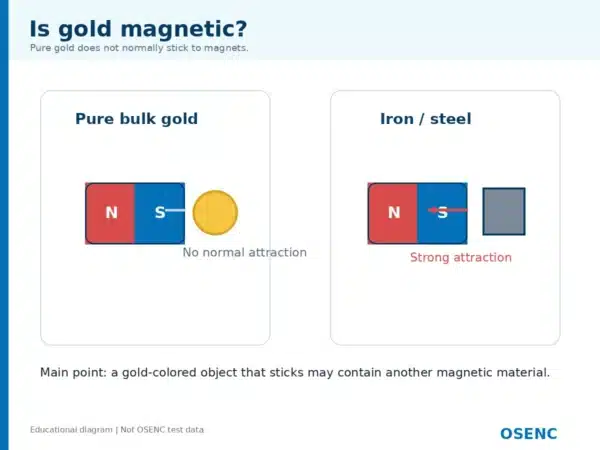
The diamagnetic materials, such as copper and gold, and bismuth, are pushed off by the magnetic fields. These materials’ magnetic moments of electrons cause a weak repelling effect as they resist the external magnetic field.
Complex Permeability
When there are some time-dependent changes in the magnetic fields applied to materials, the permeability becomes complicated in the cases of alternating currents or microwave functions. Storage or loss of energy under an alternating magnetic field is given by the two components of complex permeability, which encompass the actual and imaginary components.
μ′ and μ″; loss tangent tan δ = μ″/μ′
In complex permeability, μ′ (mu prime) represents the real part, showing how much magnetic energy is stored, while μ″ (mu double prime) represents the imaginary part, showing how much energy is lost as heat.
La loss tangent (tan δ = μ″ / μ′) indicates how efficiently a magnetic material operates at alternating frequencies. A lower tan δ means fewer losses and better performance.
This concept is critical in designing materials for high-frequency transformers, antennas, and shielding, where both energy storage and loss matter.
Magnetic Hysteresis
Magnetic hysteresis refers to the lag between changes in magnetic field power and the resulting magnetization of a material. It shows that permeability isn’t regular, however depends on magnetic records, how the material changes into previously magnetized or demagnetized during repeated magnetic cycles.
Permeability Changes with B–H Loop
Within the B-H curve (loop of magnetic hysteresis), permeability remains constant with an increase and a decrease in magnetization. First, the permeability increases violently with the alignment of atomic dipoles with the sphere.
Once the field reaches its saturation point, additional increasing field strength makes insignificant additional magnetization. At the reversal point, it is not completely reversed and therefore, hysteresis loss occurs.
This loop allows the determination of the efficiency of cycles of magnetic substances to store and release energy.
Saturation and Core Materials
When a magnetic core has become saturated, all magnetic domains have aligned, and the permeability reduces greatly. At this stage, the material is not able to hold more magnetic flux.
The major materials used as core, such as silicon metal, ferrite, and iron alloys, are chosen entirely with respect to their ability to handle saturation effectively.
It is important to maintain high permeability below saturation in transformers, inductors, and other electromagnetic devices to ensure that clean magnets are operating and the least losses are being incurred.
Factors affecting Permeability
The magnetic permeability is not fixed but varies depending on the temperature, material structure, impurities, and power of the magnetic field. The awareness of the said factors helps in creating magnetic and electronic devices.
Temperature, Microstructure, Impurities
The high temperature causes the magnetic alignment to be perturbed by atomic vibrations, and this lowers the permeability.
The microstructure (such as grain size and crystal orientation) can also be critical; finer grains oftentimes will yield better results.
Most of the impurities, such as carbon or oxygen, interfere with the motion of the domains; hence, magnetic alloys are heat-treated and purified to balance.
Nonlinearity; saturation effects
In high magnetic fields, the domains align, which leads to nonlinear permeability behaviour. The material becomes resistant to permeability after which its value reduces swiftly. Transformers are designed based on saturation prevention, which prevents the loss of energy and the degradation of the signal.
Magnetic Permeability can Change
Magnetic permeability of the materials is subject to change with time due to stress application and various magnetization cycles, and mechanical pressure. The magnetic alignment of the domains undergoes slight variation, due to which magnetic materials require special treatment to maintain their homogeneous properties.
Example of Magnetic Permeability in Mild Steel
Mild steel has high magnetic permeability since its relative permeability lies between 2000 and 5000, which allows the magnetic lines to pass through the material thousands of times compared to air. The material has been used as a great substitute for transformer cores and electromagnets due to its high permeability.
Example of Magnetic Permeability in Wood
The values of relative permeability of wood are in the range of 1, meaning it does not pull or push away the magnetic fields. The material is a nonmagnetic base on scientific experiments that do not to interfere with a magnetic field.
Applications of High Permeability Materials
The functioning of electrical and electronic systems also relies on high magnetic permeable materials. These materials minimize energy waste, enhance performance, and stabilize magnetic circuits in transformers, motors, and shielding devices that have to work under heavy or variable magnetic conditions.
Transformers and Inductors
Transformers and inductors have high-permeability cores constructed of silicon steel or ferrite, which permits easy transmission of magnetic flux. The system has improved energy transfer with low power loss and leakages of magnetic fields. A suitable choice of core materials makes it possible to provide stable and efficient work in power supply systems and circuits of signal transmission.
Magnetic Storage
Hard drives and tapes are magnetic storage devices that store digital data using materials with highly regulated permeability. Binary information is represented by the magnetic orientation of small regions. The material facilitates the effective writing and reading of the data, besides expanding storage space.
Electromagnetic Shielding
Electromagnetic shielding is done with high-permeability material like mu-metal. The magnetic field lines are absorbed and redirected by them, therefore, avoiding interference with sensitive electronics. The material shields medical equipment and communication systems, and laboratory equipment against electromagnetic interference.
Extraneous Magnetic Fields
High-permeability materials function as protective barriers that redirect magnetic fields toward safe areas when strong or uncontrolled magnetic fields exist. The materials protect MRI facilities and aerospace operations, and precision scientific equipment from interference while ensuring operational precision and safety.
Conclusione
Magnetic permeability is one of the main properties that describes the behavior of materials in the presence of a magnetic field. It bridges atom-level interactions with large-signal magnetic performance, which leads to an understanding of the different kinds of materials in the context of magnetic fields. To put it more simply, some materials will enhance the magnetic field while others will weaken it. The study of permeability is very helpful in grasping the behavior of magnetic domains and their role in determining the efficiency of magnetic devices.
The ability to control permeability is one of the most important factors for the creation of trustworthy and energy-saving systems in modern-day technology. By knowing how temperature, impurities, and saturation affect permeability, engineers can come up with magnetic components that are not only smarter but also more stable for real-world applications.
FAQ
Is High Magnetic Permeability Good?
High magnetic permeability values create positive effects in most situations. The material enables better magnetic flux transmission, which leads to improved operational efficiency in transformers and motors, and inductors.