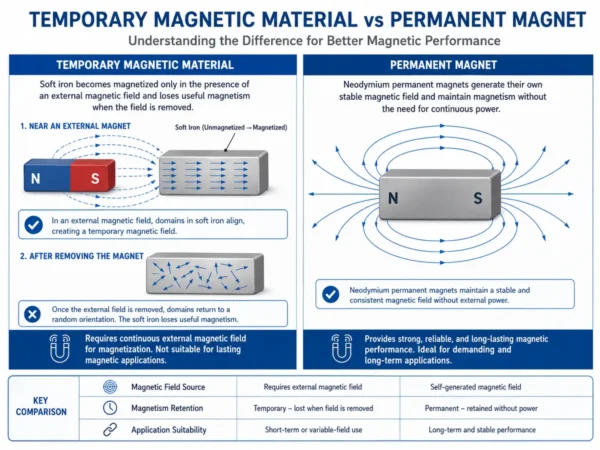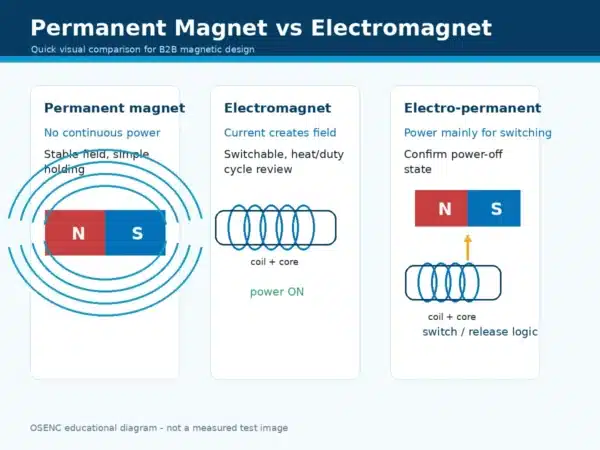







Quanto è potente un magnete al neodimio? Questi magneti sono davvero potenti! Il comune grado N42 presenta un’induzione magnetica superficiale di 13 200 Gauss (1,32 Tesla), mentre i gradi più elevati, come N54 raggiungono 14 800 Gauss (1,45-1,50 Tesla). Ecco una rapida panoramica:
| Grado magnetico | Induzione magnetica superficiale (Gauss) | Induzione magnetica superficiale (Tesla) |
|---|---|---|
| N42 | 13,200 | 1.32 |
| N54 | 14 500 – 15 000 | 1.45-1.50 |
I magneti al neodimio sono i più potenti in assoluto: superano nettamente i magneti ceramici o in alnico! Mi affido alle soluzioni personalizzate di Osenc perché mi forniscono esattamente ciò di cui ho bisogno, sia per piccoli dispositivi sia per macchinari di grandi dimensioni. Conoscere la potenza dei magneti mi aiuta a scegliere quello più adatto a ogni applicazione. 🚀
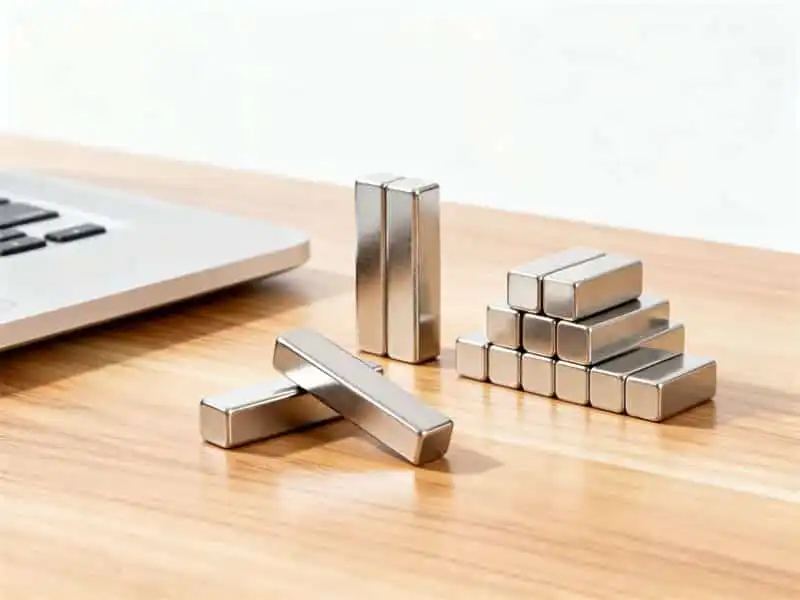
Quanto sono potenti i magneti al neodimio?
Quanto sono potenti i magneti al neodimio? Questi sono i magneti più potenti disponibili sul mercato. I magneti al neodimio sono estremamente potenti. La loro induzione magnetica superficiale può raggiungere 1,45-1,50 Tesla. Il prodotto energetico magnetico arriva fino a 54 MGOe. Per questo li scelgo per le applicazioni più impegnative. 💪
Potenza dei magneti al neodimio
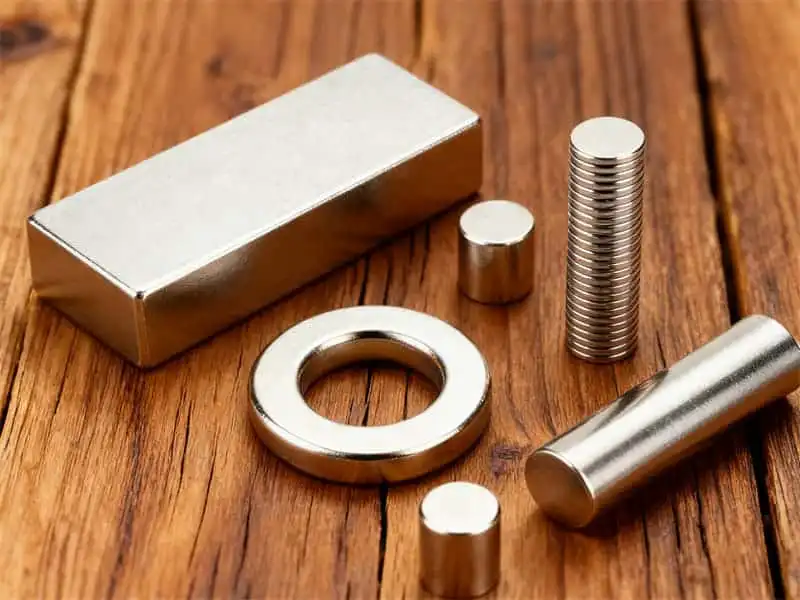
Induzione magnetica superficiale (Tesla/Gauss)
Quando mi chiedo “quanto è potente un magnete al neodimio?”, controllo l’induzione magnetica superficiale. La maggior parte dei magneti al neodimio presenta valori compresi tra 0,5 e 1,4 Tesla. Ciò equivale a 5 000-14 800 Gauss. Il grado N54 è il più potente e raggiunge 1,45-1,50 Tesla. Uso questi magneti quando mi occorre una presa salda.
Suggerimento: un grado più elevato indica un magnete più potente. N54 è più potente rispetto a N42.
Prodotto energetico (MGOe)
Il prodotto energetico indica quanta energia può immagazzinare un magnete. La potenza dei magneti al neodimio viene misurata in MGOe. I magneti N42 hanno un prodotto energetico di circa 42 MGOe. I magneti N54 raggiungono 541 MGOe. Per questo, i magneti al neodimio sono i più potenti a parità di dimensioni.
| Grado | Induzione magnetica superficiale (Tesla) | Prodotto energetico (MGOe) |
|---|---|---|
| N42 | 1.32 | 42 |
| N54 | 1.45-1.50 | 54 |
Forza di distacco
La forza di distacco indica il peso che un magnete può sostenere. Magneti più grandi e una maggiore superficie di contatto comportano una forza di distacco superiore. Un magnete spesso esercita una forza maggiore e agisce a una distanza più elevata. Un magnete largo aderisce meglio al metallo. Verifico sempre la forza di distacco prima di scegliere un magnete.
| Modifica del magnete | Effetto sulla forza di distacco | Impiego ideale |
|---|---|---|
| Magnete più spesso | Maggiore distanza d'azione | Motori, sensori |
| Magnete più largo | Maggiore tenuta | Sollevamento e tenuta |
| Volume maggiore | Massima forza | Impieghi gravosi |
Quali fattori influenzano le prestazioni dei magneti al neodimio?
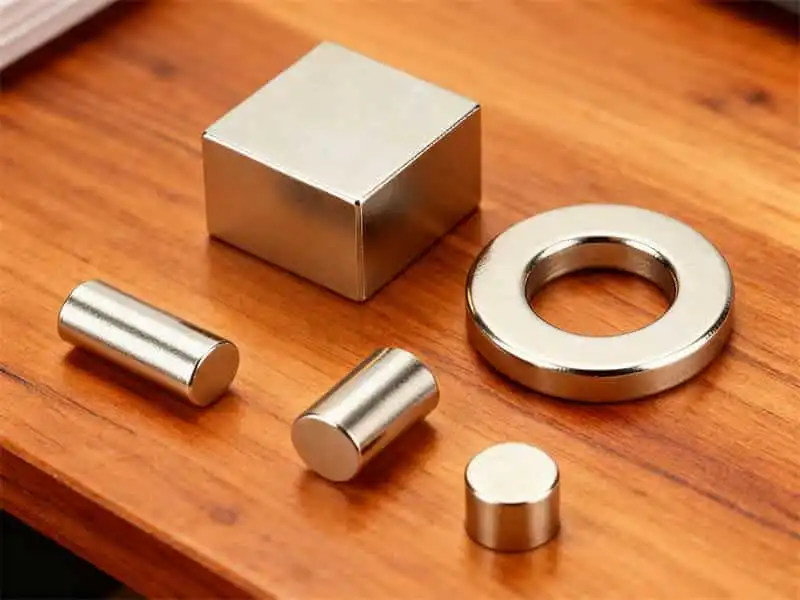
In Osenc, quando parliamo di “prestazioni magnetiche” (campo magnetico superficiale, forza di distacco ecc.), consideriamo questi fattori:
1) Grado e composizione
I gradi superiori (N35 → N54) offrono valori potenziali più elevati di Br/BHmax; i suffissi H/SH/UH/EH/TH indicano una maggiore resistenza alle alte temperature. L'aggiunta di Dy/Tb aumenta la coercitività, ma può ridurre Br. Osenc seleziona il grado e la composizione più adatti all'applicazione.
2) Temperatura
Il calore riduce le prestazioni del magnete. Indicativamente −0,1%/°C su Br; in prossimità della temperatura massima di esercizio, si rischia una smagnetizzazione irreversibile. Osenc prevede un margine e seleziona il grado termico adeguato (SH/UH/EH…).
3) Dimensioni e forma (soprattutto lo spessore)
A parità di materiale, lo spessore lungo la direzione di magnetizzazione incide più del semplice aumento della superficie polare, finché i benefici non iniziano a ridursi. Dischi, blocchi, anelli, segmenti ad arco, smussi e fori modificano tutti il percorso del flusso. Osenc ottimizza le proporzioni in funzione dello spazio disponibile per il montaggio.
4) Qualità della magnetizzazione
Assiale, radiale, multipolare, nonché il livello di saturazione completa. Una magnetizzazione parziale o campi esterni possono penalizzare le prestazioni. Osenc test di produzione per verificare una magnetizzazione effettiva e stabile.
5) Circuito magnetico e ambiente circostante
Il traferro è il principale nemico di #1: rivestimenti, rugosità e polvere generano microdistanze che influiscono sulle prestazioni. L'acciaio del pezzo deve essere sufficientemente spesso da non saturarsi. Il ferro di ritorno e i gioghi chiudono il circuito e concentrano il flusso. La presenza nelle vicinanze di acciaio, schermature o campi modifica il punto di lavoro. Osenc può modellare tutti questi fattori.
6) Distanza
Il campo diminuisce rapidamente con la distanza, approssimativamente secondo ~1/r³. A few millimeters matter. Osenc designs to squeeze that effective gap down.
7) Surfaces & assembly
Flatter, smoother, more parallel = more force. Thick coatings = extra gap. Chips/cracks reduce effective volume. Osenc machining and finishing keep these in check.
8) Stacks & arrays
Stacking along the magnetization ≈ making it “thicker,” but gains aren’t linear. Halbach arrays can make one side super strong and the other side quiet. Osenc can design arrays for tight spaces.
9) Process & tolerances
Sintering density, grain alignment, recipe control, and dimensional tolerance all drive batch-to-batch consistency. Osenc focuses on stable, repeatable production.
10) Environment & lifetime
Moisture/salt spray corrodes; long-term heat, external fields, and shock degrade performance. Use NiCuNi, Zn, epoxy, or full encapsulation as needed—Osenc recommends coatings per environment.
Confronto delle prestazioni magnetiche
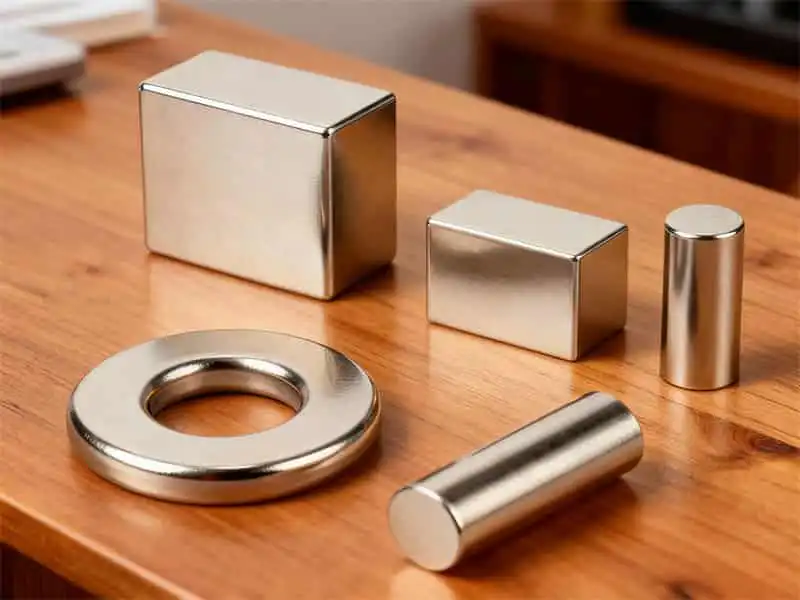
Ferrite Magnets
People ask, “how strong are magneti al neodimio compared to ferrite?” Neodymium magnets are up to 20 times stronger for their size. Ferrite magnets only reach 0.5 to 1 Tesla. Neodymium magnets reach 1.4 Tesla. That is why I use neodymium for small designs that need power.
| Fattore | Magneti al neodimio | Ferrite Magnets |
|---|---|---|
| Forza magnetica | Up to 1.4 Tesla | 0.5–1 Tesla |
| Prodotto energetico | Up to 54 MGOe | Much lower |
Ceramic Magnets
Ceramic magnets work well in high heat. But they are not as strong as neodymium magnets. Neodymium magnets are best for tight spaces. They give a stronger magnetic field. I use ceramic magnets for easy jobs. I pick neodymium for the strongest grip.
- Neodymium magnets work better in small sizes.
- Ceramic magnets handle heat and do not lose magnetism easily.
- I choose based on space, heat, and strength needed.
Magneti in AlNiCo
Alnico magnets are older, but neodymium magnets are stronger. Their magnetic energy product is much higher. I can use smaller magnets for the same job. Neodymium magnets can be coated to stop rust. This makes them good for tough places.
- Neodymium magnets have the highest magnetic energy product.
- I use them for small, light devices.
- Coated neodymium magnets last longer in harsh places.
Osenc’s Magnet Range and Quality
I trust Osenc for my magnets. They offer:
| Tipo di magnete | Descrizione |
|---|---|
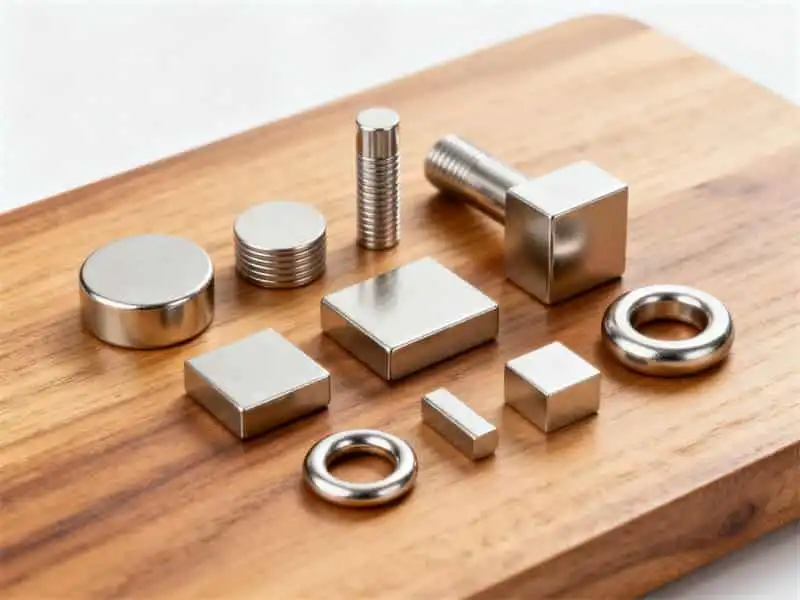
| Magneti al neodimio su misura | High quality in discs, rings, blocks |
| Forme irregolari | Special shapes for unique projects |
| Magneti di grandi dimensioni | Sizes up to 300 mm for heavy jobs |
| Micro magneti | Tiny magnets with +/- 0.005 mm tolerance |
Osenc’s magnets meet ISO 9001 and ISO 16949 standards. I know I get top quality every time. Their neodymium magnets come in many shapes and sizes. I always find the right magnet for my project. 🧲
Note: When I pick a magnet, I look at strength, size, shape, heat tolerance, coating, and brittleness. Stronger magnets cost more, but they are worth it.
Measuring Strength
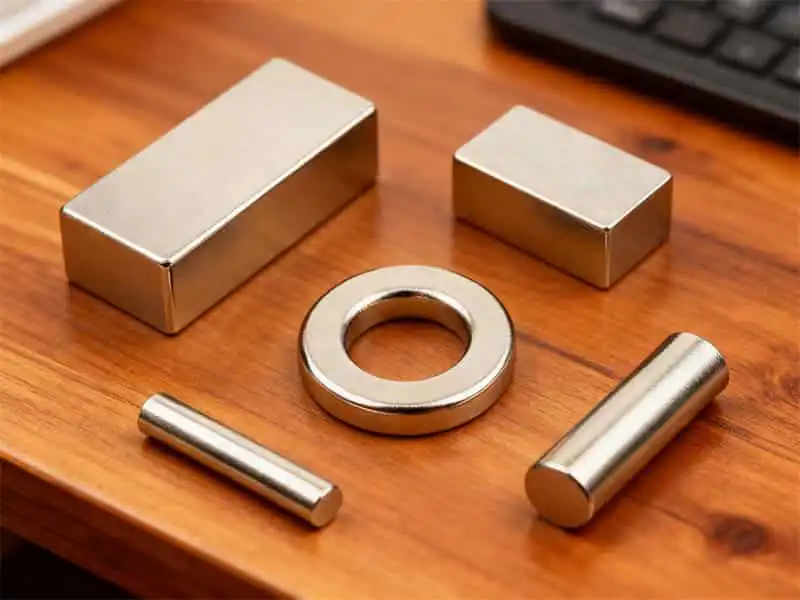
Intensità del campo
How do I measure the field strength of a neodymium magnet? I use special tools to check how strong the magnetic field is. The most common units are Tesla (T) and Gauss (G). One Tesla equals 10,000 Gauss. I like to use these methods:
- Hall effect sensors: These tiny gadgets give me quick and accurate readings.
- Fluxgate magnetometers: I use these when I want to measure very small or very strong fields.
- Magnetic field meters: These are easy to use and show the field strength right away.
I often test Osenc’s micro magnets with these tools because their small size needs precise checks. For big magnets, I use the same tools, but I have to be careful because the field is much stronger! 🧲
Tip: Always measure at the magnet’s surface for the most accurate result.
Prodotto energetico
What is the energy product, and why does it matter? The energy product (measured in MGOe) tells me how much energy the magnet can store. Higher numbers mean a stronger magnet. For example, Osenc’s N54 magnets reach up to 54 MGOe. That’s a lot of power in a small package!
Here’s a quick table to show what I mean:
| Grado magnetico | Prodotto energetico (MGOe) |
|---|---|
| N42 | 42 |
| N54 | 54 |
I use this number to pick the right magnet for my project. If I need a tiny but strong magnet, I go for a high energy product. For big jobs, I choose large magnets with high MGOe from Osenc.
Forza di distacco
How do I measure how much weight a magnet can hold? I check the pull force. This tells me how much weight the magnet can lift or hold before it lets go. I use different tools for this:
| Tool/Technique | Descrizione |
|---|---|
| Pull Test Equipment | Measures the force needed to separate a magnet from a surface. |
| Force Gauge | Suspends the magnet and measures the force to detach it. |
| Pull Tester | Uses a platform and load cell to check pull force. |
| Digital Force Gauge | Shows pull force in real time. |
| Magnetic Field Meter | Measures the field and helps guess the pull force. |
I use these tools with Osenc’s micro magnets for tiny gadgets and with their large magnets for heavy lifting. Pull force is measured in pounds. I always check this when I need a magnet for things like magnetic doors or lifting tools. 💪
Note: Pull force is super important for safety. Always test before using magnets in real life!
Neodymium Magnets in Use

Neodymium magnets are everywhere in my life and work because they are super strong and reliable! 🧲
I see neodymium magnets working in factories and big machines. They help make cars smarter and safer. Here is a quick list of how they help in cars and electronics:
- Electric Power Steering (EPS) makes driving easier 🚙
- Micro-motors move car seats and windows
- Safety control systems help prevent crashes
- Driverless car technology helps smart driving
- Multimedia systems give fun and information
Osenc gives me custom neodymium magnets for special jobs. Their magnetic assemblies mix magnets with other materials. This makes strong and cost-saving devices. I can ask Osenc for any shape or size. They make tiny micro magnets or huge ones for heavy lifting.
Safety Tips
Magneti al neodimio have amazing magnetic strength, but I always stay careful when I use them. Here are my top safety tips:
- Wear gloves and eye protection to avoid pinching or flying pieces 🧤👓
- Keep magnets away from phones, computers, and pacemakers
- Store magnets in a dry, cool place so they stay strong
- Never let magnets break or chip—dust can catch fire!
- Use coated magnets if I need them in wet places
Tip: I always test the holding strength before using magnets in real life. Safety comes first!
I remember that neodymium magnets can pinch my fingers if I am not careful. They can break and make sharp pieces. I keep them away from little kids and pets. I never put them near my electronics or medical devices. I store them in a safe box when I am not using them.
Strength Demo
Simple Experiments
How can I show the strength of a neodymium magnet? I like to use easy experiments that anyone can try at home or in class. Here are some fun ways I use Osenc’s micro and large magnets to see their power in action:
- Test Tube Bubble Trick 🧪: I fill a test tube with alcohol and watch what happens when I bring a neodymium magnet close. The air bubble inside moves! This shows how the magnet affects the liquid, even without touching it.
- Manganese Solution Attraction 💧: I mix a 25% solution of manganese (II) chloride in ethanol. When I hold a strong Osenc magnet near the test tube, the liquid moves toward the magnet. This shows how some liquids can be pulled by a magnet.
- Liquid Surface Shape 🧲: I place a neodymium magnet above a test tube filled with liquid. The surface of the liquid forms a little hill, pulled up by the magnet’s force. It looks like magic, but it’s just science!
Tip: I always use gloves and keep my fingers away from the magnets. Neodymium magnets snap together fast and can pinch hard!
Visualising Pull Force
How do I see the pull force of a neodymium magnet? I use simple tools and tricks to make the invisible force visible. Here are my favorite ways:
- Iron Filings Magic ✨: I sprinkle iron filings on a piece of paper and slide an Osenc magnet underneath. The filings line up and show the magnet’s field. It looks like a spiky pattern!
- Water Flow Test 💦: I fill a clear container with water and move a big Osenc magnet near the side. Sometimes, I see the water swirl or tiny bubbles move. The magnet’s pull can even change how water flows.
- Compass Reaction 🧭: I place a compass near a neodymium magnet. The needle jumps and spins, showing how strong the magnet’s field is. It’s a cool way to see magnetic power in action.
Note: I always keep magnets away from electronics and medical devices. I never let kids or pets play with strong magnets. Safety comes first!
If you want more ideas, you can find many fun magnet tricks online. I love using Osenc’s micro magnets for small science projects and their big magnets for heavy-duty demos. These experiments help me see and feel just how strong neodymium magnets are!
Tip: I always ask Osenc for advice when I need a neodymium magnet for a new idea. They help me find the perfect fit!
How strong is neodymium magnet? These magnets are very powerful and reliable. I see them used in many places.
- They work in MRI machines and robotic surgery. They are also in tiny medical devices. 🏥
- They help make gadgets smaller and lighter. The strength does not go away.
- They last a long time and help save money.
Osenc is my favorite for custom neodymium magnets. Here is why I choose them:
| Why I Trust Osenc | What I Get |
|---|---|
| Advanced manufacturing | I get high-precision magnets each time |
| Quality certifications | They meet top standards like ISO 9001 |
| Flexible production | I get fast delivery for any order size |
| Great customer support | They help me from start to finish |
I always use neodymium magnets. They are the strongest for every job! 💪🧲
FAQ
Can I break a neodymium magnet easily?
Neodymium magnets can break if I drop them.
They are strong but brittle. If I let two magnets snap together, they might chip or crack. I always handle them gently and keep them apart. 🚨
Are neodymium magnets safe for kids?
Neodymium magnets are not safe for small kids.
I keep them away from children and pets. If swallowed, they can cause serious harm. I always store my magnets in a safe box. ⚠️👶
What does “N54” mean on a magnet?
N54 means the magnet is very strong.
The “N” grade shows how powerful the magnet is. N54 is one of the highest grades. I use N54 magnets for tough jobs that need extra strength. 📊
Can neodymium magnets lose their strength?
Neodymium magnets keep their strength for years.
If I heat them too much or hit them hard, they might get weaker. I store my magnets in cool, dry places to keep them strong. ❄️
How do I clean a neodymium magnet?
I wipe my neodymium magnets with a dry cloth.
I never use water or chemicals. If the magnet has a coating, I clean it gently to avoid scratches. 🧼
Can I order custom-shaped neodymium magnets from Osenc?
Yes, Osenc makes custom magnets for me!
I send my sketch or idea to Osenc. They make magnets in any shape or size I need. Their team helps me pick the best magnet for my project. ✏️🧲