






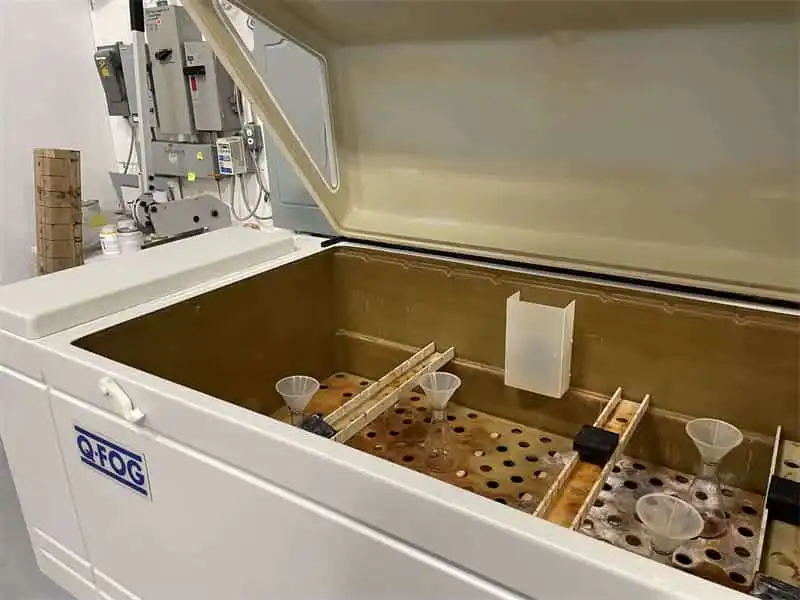
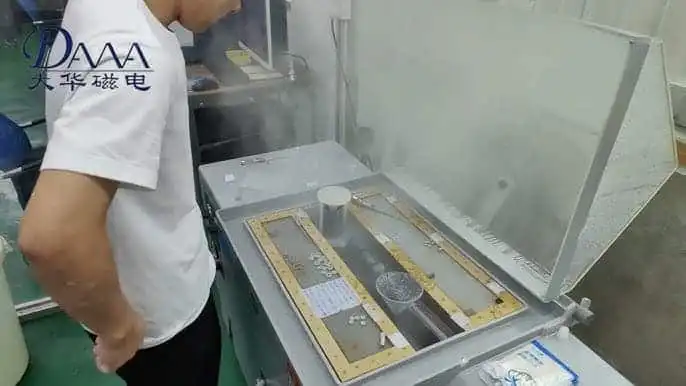
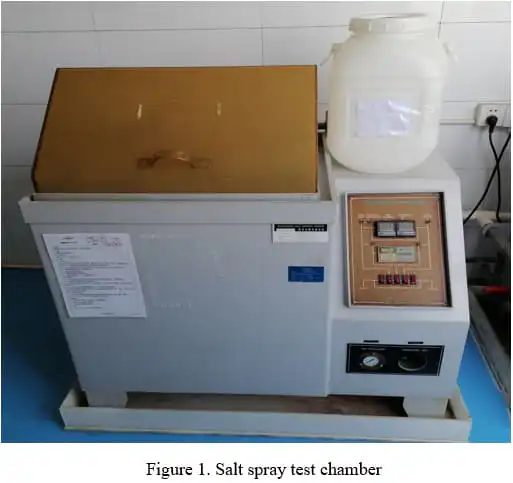
Salt spray test, or salt fog test, is a laboratory technique that is applied to test the corrosion resistance of metals, coatings, and surface finishes. The test is conducted in a special chamber, in which a constant spray of sodium chloride solution around the sample is carried out. This simulated environment accelerates the corrosion process, and the manufacturers can observe results within days that would be observed in months or years in natural conditions.
The chamber is normally heated to 35°C (95°F) and is filled with a 5 percent solution of sodium chloride and a stable pH. Samples are held for hours depending on the performance that is expected of the product. Engineers, after the test, examine the surface of the test in search of rust, pitting, blistering, peeling, or discoloration.
The use of salt spray tests is not intended to simulate all the real-life situations, but rather gives a standardized measure of comparison between the coating and materials. This is the reason why it has been adopted as one of the most common methods of evaluating corrosion in industries.
Why is salt spray testing used for?
Salt spray is performed in various industries where the rate of corrosion has a direct impact on safety, performance, and product life.
Automobile sector
In the automobile sector, the body of the car, the fasteners, exhausts, and chassis parts are tested to guarantee that they can withstand the road salt and de-icing salts. In the case of aerospace, landing gear, fasteners, and structural part finishes must be able to withstand exposure to the humidity level and salinity in the air during operations.
Marine industries
The test is applied in marine industries to test ship fittings, propellers, offshore equipment, and harbor installations exposed to continuous exposure to seawater. The durability of coated steel, pipe construction, roofing, and other construction elements is tested.
Consumer goods
The test is significant even in the case of consumer goods. The humid and corrosive home conditions expose kitchen appliances, bathroom fittings, decorative hardware, and electronics to corrosion. Salt spray testing will make such items functional and good to look at over the years.
Most importantly, this form of testing allows quality engineers to uncover any possible vulnerability in protective coatings, metal alloys, and surface treatments before going to market. In those fields, the salt spray test is an indispensable factor in material selection and design determination.
Why is salt spray testing important?
Salt spray tests are significant since corrosion has a number of destructive implications on materials.
Corrosion effect
Korozja osłabia właściwości mechaniczne materiałów. Rdzewienie i korozja wżerowa zmniejszają również nośność, co może powodować pęknięcia lub nieoczekiwane awarie. Korozja może prowadzić do nieszczelności rur oraz pękania elementów złącznych poddanych naprężeniom — odpowiednio w rurociągach i połączeniach. Z tego względu stanowi zagrożenie dla bezpieczeństwa.
Skutki elektryczne
Korozja zwiększa rezystancję elektryczną i zakłóca przewodzenie prądu. Skorodowane połączenia elektryczne, płytki drukowane i zaciski mogą się przegrzewać, powodować zwarcia lub całkowicie przestać działać. Może to prowadzić do usterek, a nawet pożarów w pojazdach i urządzeniach elektronicznych. Badania w komorze solnej służą do przewidywania takich awarii przed oddaniem produktów do użytku konsumentom.
Skutki fizyczne
Korozja powoduje również uszkodzenie produktów. Pęcherze, łuszczenie się powłoki, przebarwienia i plamy na powierzchni sprawiają, że produkty wyglądają na zużyte i zawodne. Jest to szczególnie niekorzystne w branżach, w których wartość produktu zależy od jego wyglądu, na przykład w przypadku samochodów luksusowych, sprzętu AGD i elektroniki użytkowej.
Badanie w komorze solnej pozwala również przeciwdziałać wszystkim trzem rodzajom skutków, dlatego ma zasadnicze znaczenie dla bezpieczeństwa, właściwości użytkowych i wyglądu produktów.
Jak przebiega badanie w komorze solnej?
Badanie w komorze solnej polega na poddaniu materiałów działaniu sztucznej atmosfery powodującej znacznie przyspieszoną korozję. Metoda jest znormalizowana, co zapewnia wiarygodne i powtarzalne wyniki.
Przygotowanie
Próbki są myte i pokrywane w komorze badawczej pod określonym kątem, tak aby wszystkie powierzchnie były równomiernie narażone na działanie atmosfery korozyjnej.
Roztwór
Przygotowuje się 5-procentowy roztwór chlorku sodu z dodatkiem lub bez dodatku innych substancji, takich jak kwas octowy lub chlorek miedzi, które zwiększają agresywność badania.
Rozpylanie
Roztwór jest rozpylany w sposób ciągły wewnątrz komory za pomocą sprężonego powietrza, tworząc drobną mgłę.
Warunki
Temperature is maintained at 35° C, and pH is maintained depending on the type of test.
Duration
Exposure can last from 24 hours for simple coatings to more than 1,000 hours for high-performance coatings.
Assessment
Samples are checked after testing for rusting, cracks, blistering, peeling, and pitting.
Though this type of method is not a copy of all aspects of the actual world, like UV light or temperature variations, it still gives a comparable method to test the resistance to corrosion in various materials.
Salt spray testing regulations
Salt spray tests have rigid international rules to ensure consistency and reliability of results. These rules define:
Solution Composition
Standard test: 5 % NaCl solution.
Special test adjusted solutions:
- Acetic acid (AASS).
- Copper chloride + acetic acid (CASS).
- Water has to be deionized or purified to prevent contamination.
Chamber Conditions
- Temperature: (Typically maintained at) 35° C (95°F).
- PH range: neutral tests: 6.5 to 7.2; acid tests changed.
- Spray rate: Should produce a fine and continuous spray with no large droplets.
Test Duration
- It is stated in the standards ASTM B117 and ISO 9227.
- It takes up to 24 hours to dry simple coats and over 1,000 hours to dry high-technology materials.
- Time varies according to the coating and the purpose it is meant to be used for.
Evaluation Methods
See how much rusting, blistering, peeling, and pitting there is.
Compare rating charts and photos.
Write standardized test reports.
These standards ensure that a salt spray examination performed in one lab will produce the same results as those of the other labs in the country or other parts of the world. Those would be necessary for those companies that pass on parts worldwide and require appropriate certifications.
Advantages of salt spray testing
Salt spray testing offers several benefits. For example,
Speed
When analyzing natural outdoor corrosion, it takes years, whereas with salt spray, compressed results are achieved within days or weeks.
Cost-efficiency
The cost of the testing is not as high as compared of field studies that are long-term.
Standardization
Since it is grounded in international standards, the results are predictable and dependable across the globe.
Versatility
It is suitable for metals, coatings, paint, plated surfaces, and polymers.
Quality control
It is a common practice in routine checks to ensure that the batches are consistent in coating.
Research and development
It is a tool that is used by engineers in comparing various coatings and treatments in the process of designing a product.
These are the benefits that make the test continue to be popular in industries despite the fact that it is usually coupled with other environmental tests to be more accurate.
Salt spray test standards

These are some standards of salt spray testing
ASTM B117
It is the most used standard. It was first published in 1939. It recommends a 5% salt solution, maintaining the test chamber at 35°C, and maintaining a pH of between 6.5 and 7.2. It is still regarded as the gold standard of corrosion tests in many industries.
ISO 9227
An international standard that is well known is ISO 9227. There are three types of tests: Neutral Salt Spray (NSS), Acetic Acid Salt Spray (AASS), and Copper-Accelerated Acetic Acid Salt Spray (CASS). Apply the one that suits the coating: functional, decorative, and very protective.
JIS Z 2371
It is basically the Japanese Industrial Standard. It is extensively employed in manufacturing, cars, and electronics in Japan. It is comparable to the ISO rules, only that it includes Japanese reporting and inspection rules.
DIN 50021
It is a German standard concerning neutral salt spray tests. It is commonly applied in Europe, particularly in construction, steel, and engineering.
Last word
It is an easy and efficient method of establishing the corrosion resistance of a material. The test does not simulate all the conditions of the real world, but it is quick, repeatable, and inexpensive, and hence is most beneficial in quality assurance.
Cars and airplanes, buildings, and even ordinary products are all made with the help of this test, which ensures longer durability of the materials, their safety, and their looks. The same testing rules must be applied to global trade and international supply chains to earn trust between the manufacturers and the customers.
Najczęściej zadawane pytania
What is the ASTM B117 salt spray test?
The primary regulation of salt spray testing is ASTM B117. It recommends a 5% solution of sodium chloride at 35°C and neutral pH. This was initiated in 1939 and forms the foundation of the current salt spray tests.
How to salt spray threaded bolts?
In the chamber, threaded bolts are fitted in such a way that all the threads come in contact with salt mist. To ensure that no section of the bolt remains exposed to the spray, workers ensure that there are no areas that are obscured. The bolts are also inspected after testing to ensure that there is no rust between the threads, and this is where the bolt breaks.
What is the ISO standard of the salt spray test?
The ISO standard is ISO 9227. It can be divided into three forms, namely, NSS (neutral salt spray), AASS (acetic acid salt spray), and CASS (copper-accelerated acetic acid salt spray). Both types take different coatings and materials.
How much does a salt spray test cost?
Testing costs typically range from $200-$800 per batch, depending on exposure duration, specimen quantity, and required documentation. Often, volume discounts apply for regular testing programs.
How many hours of salt spray test?
Test durations vary based on material specifications and industry requirements—ranging from 24 hours for basic screening to 3,000+ hours for high-performance coatings or critical components.
What is a neutral salt spray test?
The most popular test is the neutral salt spray (NSS). It applies a 5% sodium chloride solution, neutral pH, and a 35°C temperature of the chamber. It is the normal method to determine the degree of resistance to corrosion of a material.