






Właściwości magnetyczne stali nierdzewnej
Szybka odpowiedź
Niektóre stale nierdzewne są magnetyczne, a inne nie są silnie przyciągane przez magnes trzymany w ręku.
Zależy to przede wszystkim od struktury metalurgicznej stali i historii jej obróbki, a nie tylko od zawartości żelaza.
Stale nierdzewne ferrytyczne, martenzytyczne, duplex oraz większość stali utwardzanych wydzieleniowo zwykle wykazują wyraźną reakcję magnetyczną. W pełni wyżarzone gatunki austenityczne, takie jak 304 i 316, zazwyczaj są przyciągane w niewielkim stopniu, jednak obróbka plastyczna na zimno i spawanie mogą zwiększyć ich lokalną reakcję magnetyczną, co podsumowuje Brytyjskie Stowarzyszenie Stali Nierdzewnej.
Badanie za pomocą magnesu może pomóc we wstępnej selekcji części, ale nie pozwala potwierdzić, że element wykonano ze stali 304 lub 316. Nie umożliwia również przewidzenia wpływu tego elementu na siłę odrywania, rozkład pola magnetycznego ani zespół magnetyczny.
Dlaczego niektóre stale nierdzewne są magnetyczne?
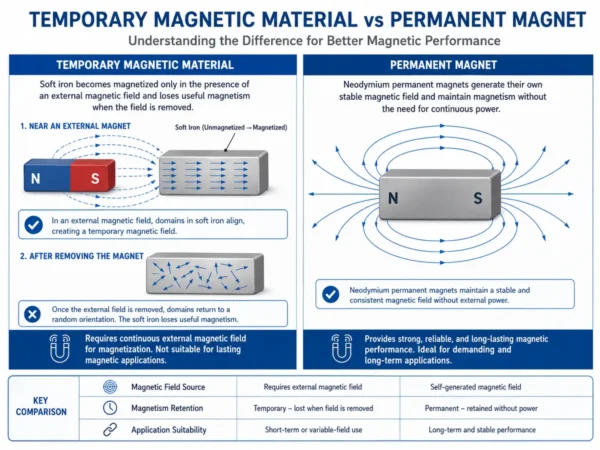
Właściwości magnetyczne stali nierdzewnej zależą w dużym stopniu od jej struktury krystalicznej. Struktury ferrytyczne i martenzytyczne są ferromagnetyczne, natomiast struktura w pełni austenityczna ma znacznie niższą przenikalność magnetyczną.
Dlatego dwie części ze stali nierdzewnej o podobnym wyglądzie mogą różnie reagować na ten sam magnes. Na wynik mogą wpływać rodzina stopu, dokładny skład chemiczny, obróbka cieplna, kształtowanie, spawanie, technologia odlewania oraz miejscowe odkształcenia.
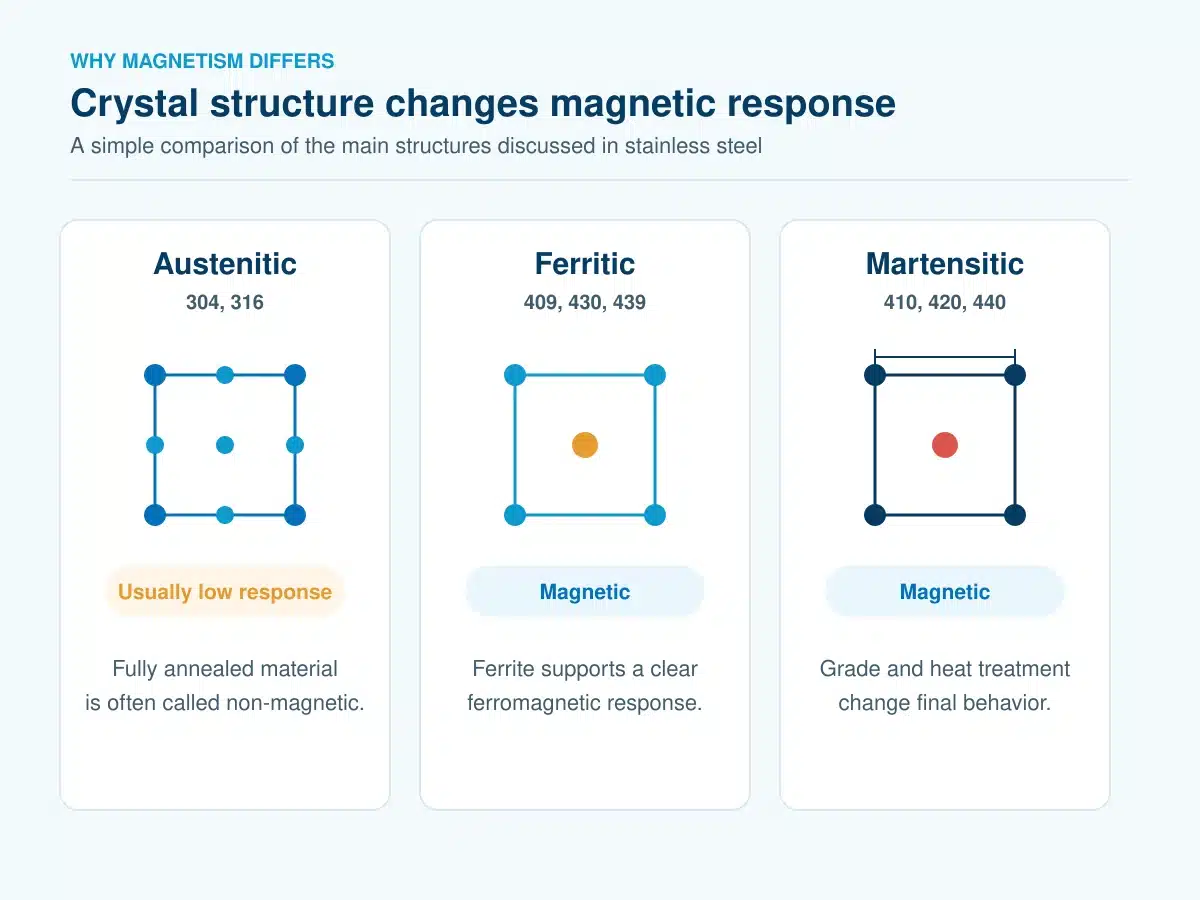
Dokument Brytyjskie Stowarzyszenie Stali Nierdzewnej podaje, że względna przenikalność magnetyczna w pełni wyżarzonych austenitycznych stali nierdzewnych wynosi zazwyczaj od 1,003 do 1,05. Wartość bliska 1 oznacza jedynie niewielką reakcję w porównaniu ze stalami o silnych właściwościach magnetycznych.
Jest to ogólny zakres referencyjny, a nie domyślne kryterium akceptacji każdej części wykonanej ze stali 304 lub 316. Kontrolowane wymaganie musi określać stan wyrobu, metodę badania, warunki pola magnetycznego oraz etap odbioru.
Które rodzaje stali nierdzewnej są magnetyczne?
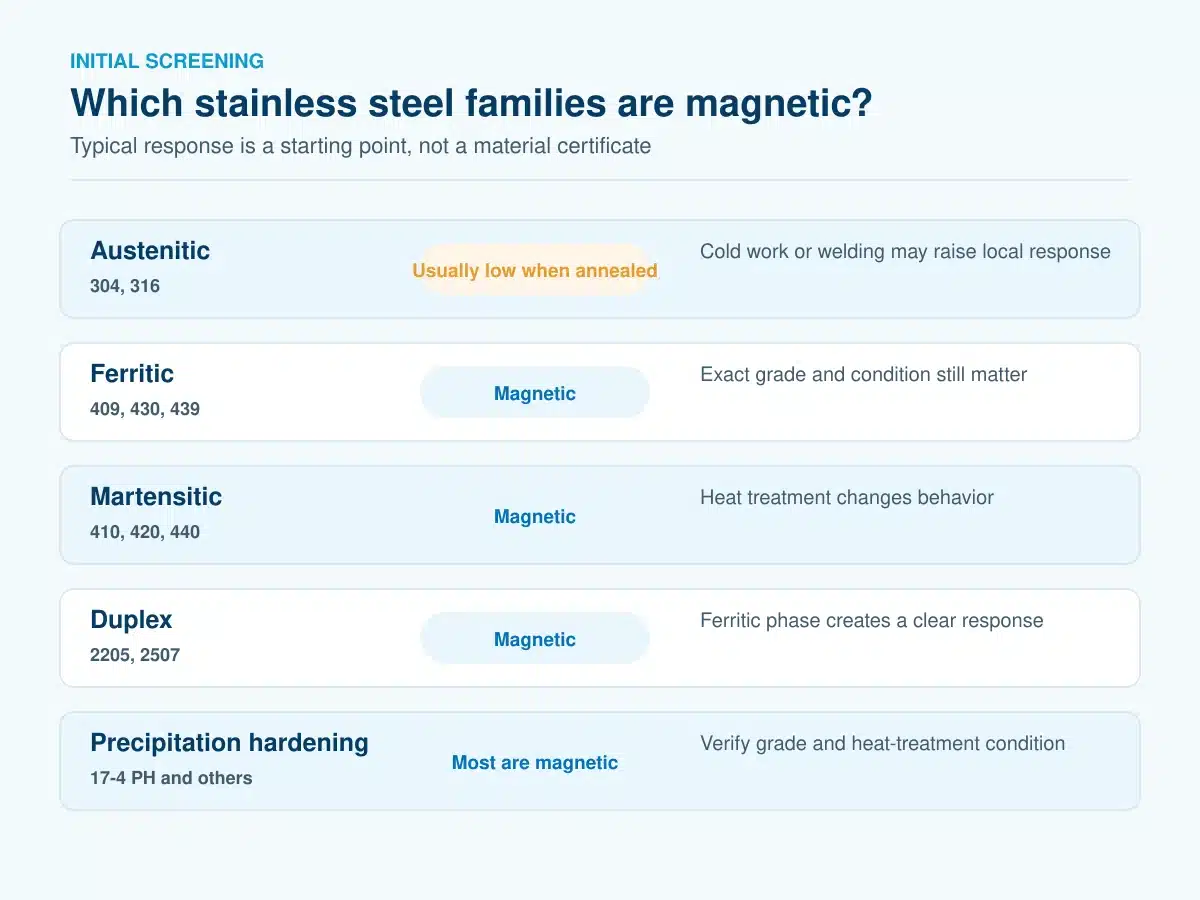
| Rodzina stali nierdzewnej | Typowe przykłady | Typowa reakcja magnetyczna | Istotne ograniczenie |
|---|---|---|---|
| Austenityczna | 304, 316 | Zwykle niewielka po pełnym wyżarzaniu | Obróbka plastyczna na zimno i spawanie mogą miejscowo zwiększyć reakcję magnetyczną. |
| Ferrytyczna | 409, 430, 439 | Magnetyczny | Reakcja magnetyczna i parametry obwodu magnetycznego nadal zależą od dokładnego gatunku i stanu materiału. |
| Martenzytyczna | Serie 410, 420 i 440 | Magnetyczny | Obróbka cieplna i gatunek wpływają zarówno na właściwości mechaniczne, jak i magnetyczne. |
| Duplex | 2205, 2507 | Magnetyczny | Faza ferrytyczna powoduje wyraźną reakcję magnetyczną. |
| Utwardzana wydzieleniowo | 17-4 PH i inne gatunki | Większość jest magnetyczna | Należy zweryfikować dokładny gatunek i stan po obróbce cieplnej. |
Tabela służy do wstępnej selekcji materiałów. Nie zastępuje specyfikacji zakupowej, analizy składu chemicznego, badania przenikalności magnetycznej ani walidacji właściwości magnetycznych w konkretnej aplikacji.
Czy stal nierdzewna 304 jest magnetyczna?
Wyżarzona stal nierdzewna 304 ma zwykle niską przenikalność magnetyczną i może być tylko nieznacznie przyciągana przez magnes ręczny. Jednak, obróbka plastyczna na zimno może przekształcić część jej struktury austenitycznej w martenzyt indukowany odkształceniem, which increases magnetic response.
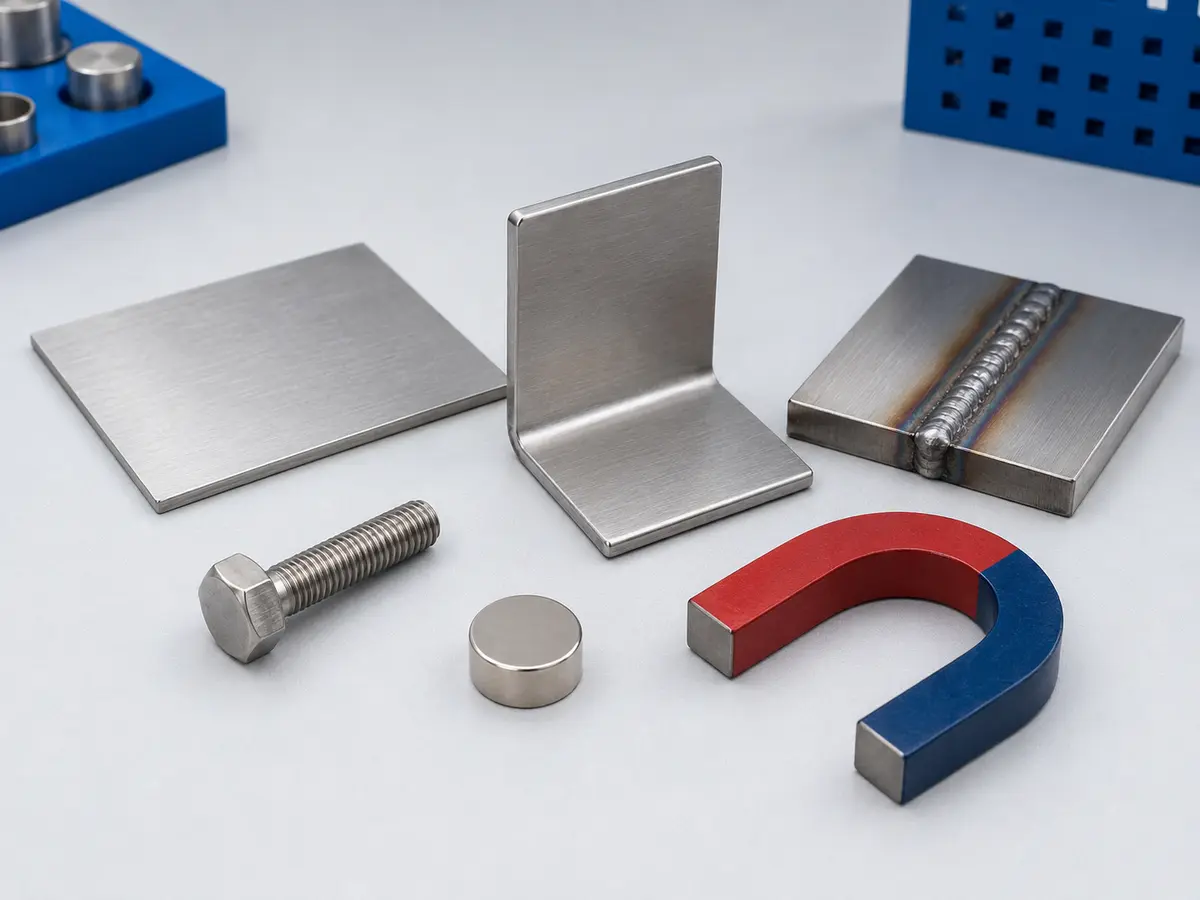
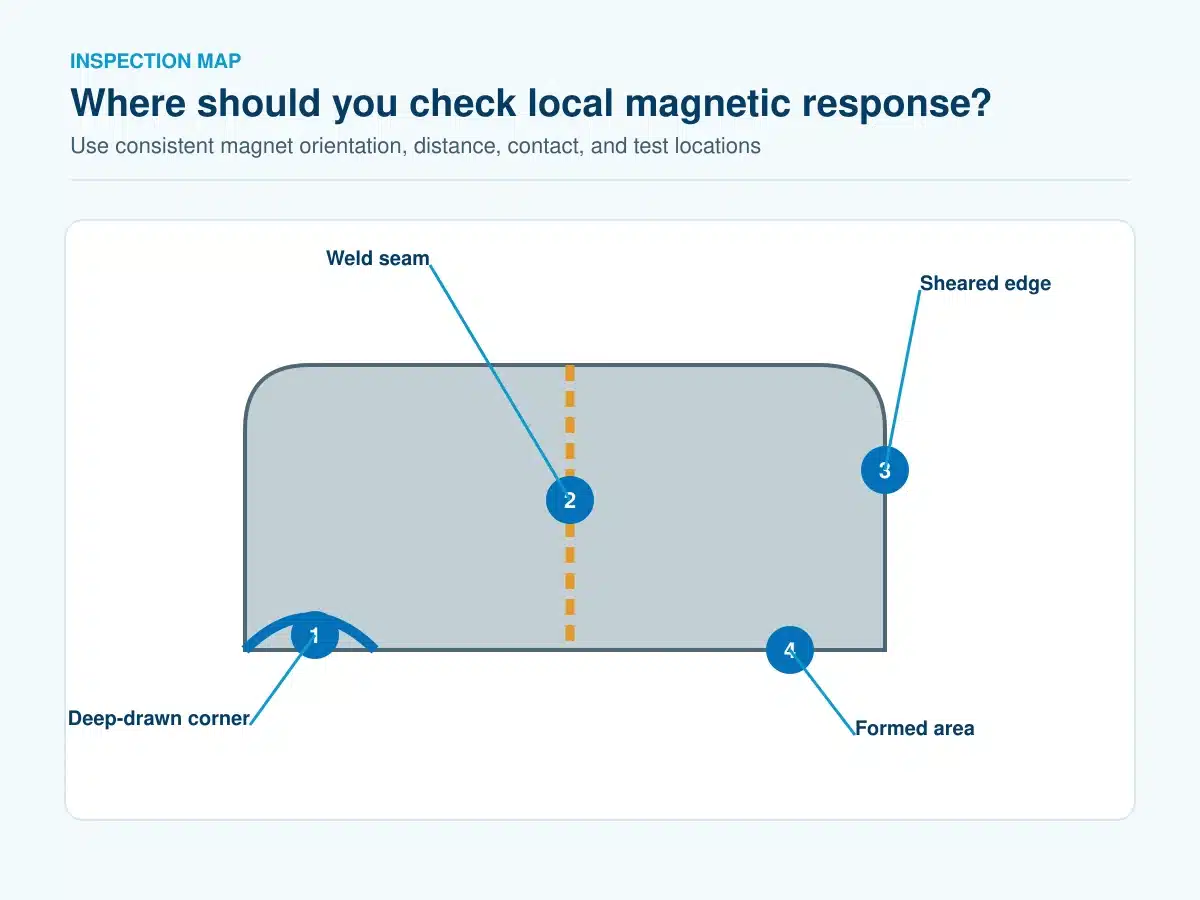
The effect is often localized. Bent corners, deep-drawn areas, rolled threads, sheared edges, stamped features, or heavily worked surfaces may attract a magnet more noticeably than an undeformed flat area from the same part.
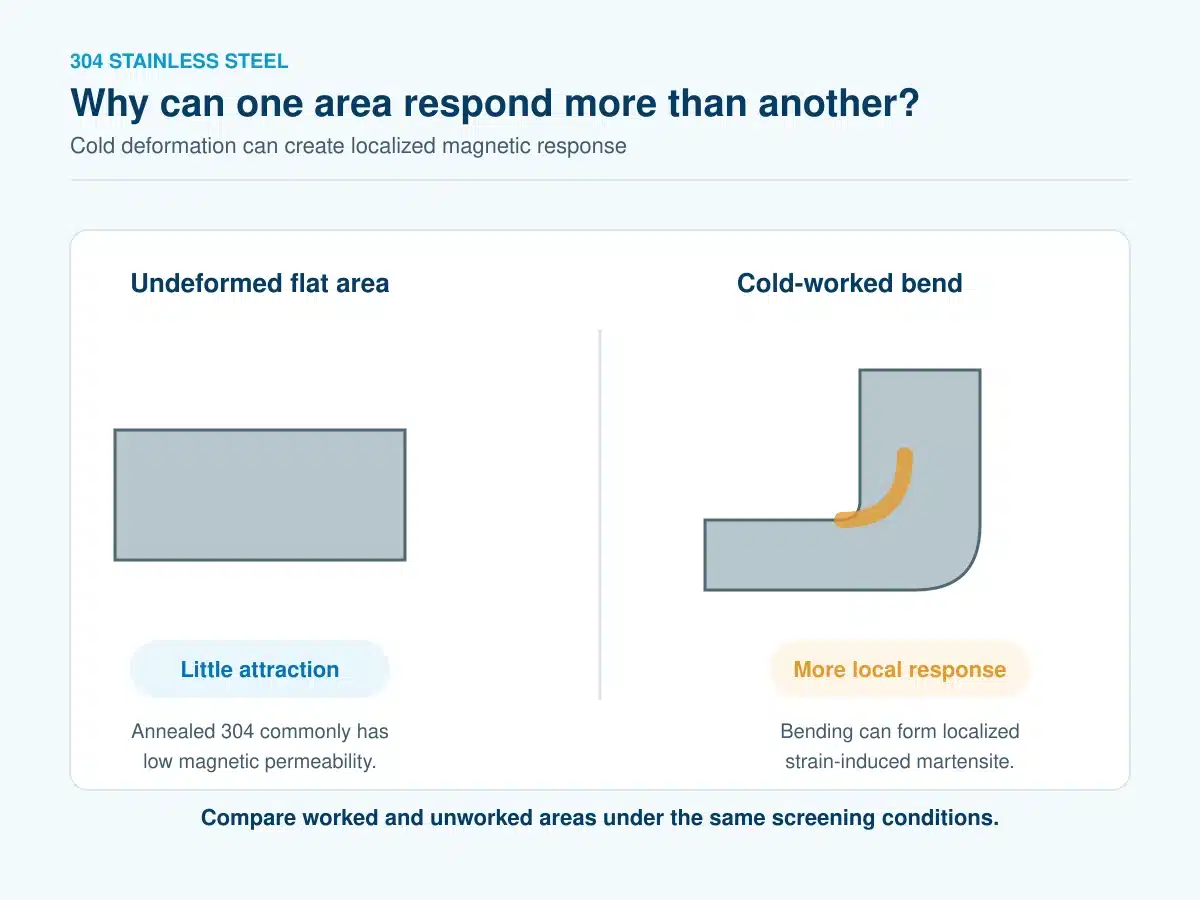
The amount of change is not fixed. It depends on the material composition, starting condition, deformation level, temperature, and processing history. A magnetic response therefore does not automatically mean that a claimed 304 component is counterfeit or out of specification.
Is 316 Stainless Steel Magnetic?
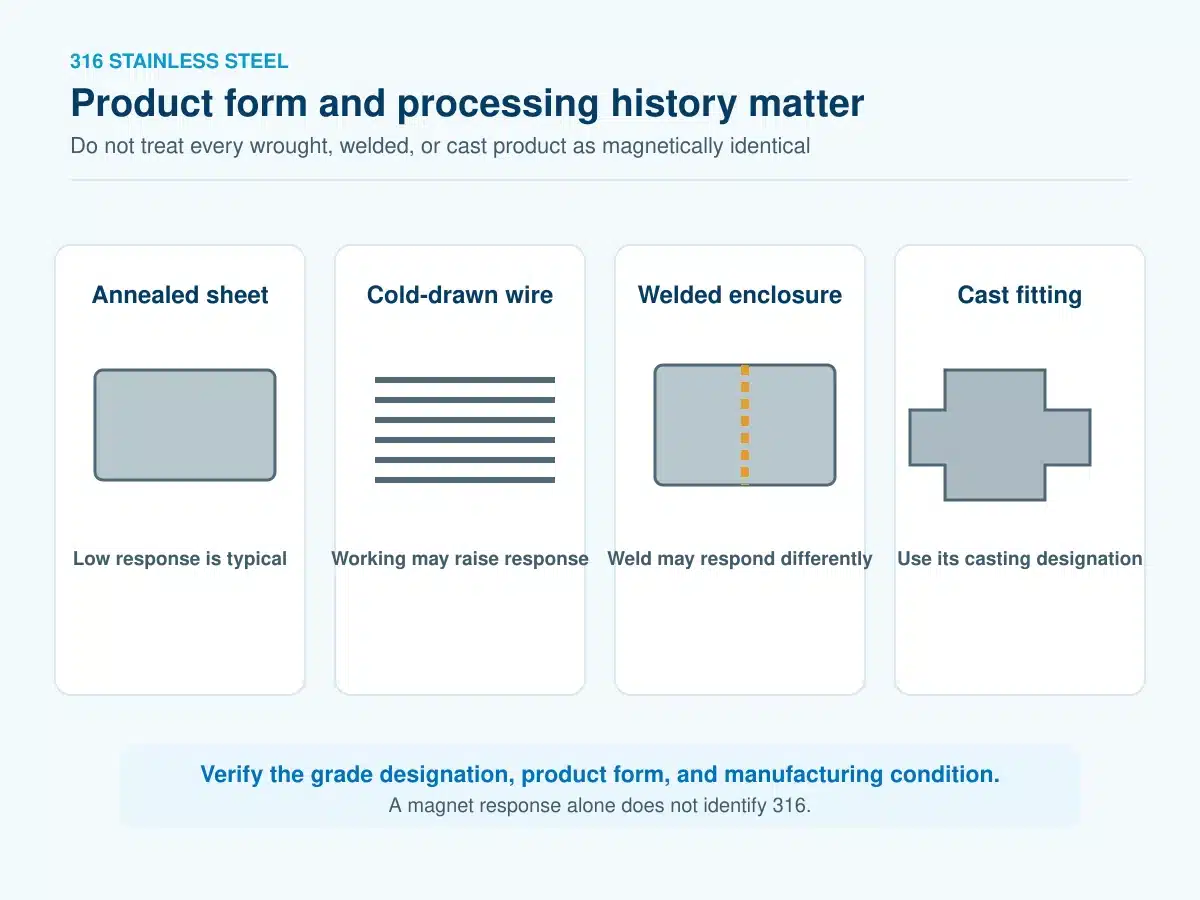
Fully annealed wrought 316 stainless steel also normally has low magnetic permeability. Cold working can increase its response, although the result varies with composition and processing.
Welding may produce a different response in the weld metal or nearby region because some austenitic weld structures retain ferrite, as explained in the BSSA composition guidance. This means a welded enclosure can respond differently at the seam than across its base sheet.
A wrought 316 sheet, cold-drawn 316 wire, forged 316 fastener, and welded 316 enclosure may therefore respond differently because they have different processing histories. A cast austenitic fitting should be evaluated under its casting-grade designation rather than assumed to be wrought Type 316; the Nickel Institute notes that cast equivalents use different designations and modified compositions.
What Can a Local Magnetic Response Tell You?
The location of the response may help identify what to investigate, but it does not provide a complete material diagnosis.
| Observation | Possible explanation | Practical next action |
|---|---|---|
| More attraction at a deep-drawn corner | Concentrated cold deformation | Compare formed and undeformed areas under the same screening conditions. |
| More attraction at a sheared or machined edge | Local deformation or altered surface condition | Review the cutting and finishing process; use a defined material-verification method if grade matters. |
| More attraction at a rolled thread or forged head | Heavy local working | Confirm the fastener specification and manufacturing condition. |
| More attraction at a weld | Retained ferrite or a local structural change | Confirm the base material, filler, welding procedure, and acceptance requirement. |
| A cast fitting responds more than a wrought sheet | Different casting composition and ferrite balance | Verify the casting-grade designation rather than treating it as wrought 304 or 316. |
| Noticeable attraction occurs across most of the part | Magnetic stainless family, extensive cold work, or material mismatch may be involved | Verify the material specification and processing history. Do not accept or reject the part by hand feel alone. |
For a repeatable screening comparison, use the same magnet, orientation, contact or distance, and inspection locations. Even then, the result remains qualitative unless the customer has defined and validated that screening method.
Can You Identify 304 or 316 With a Magnet?
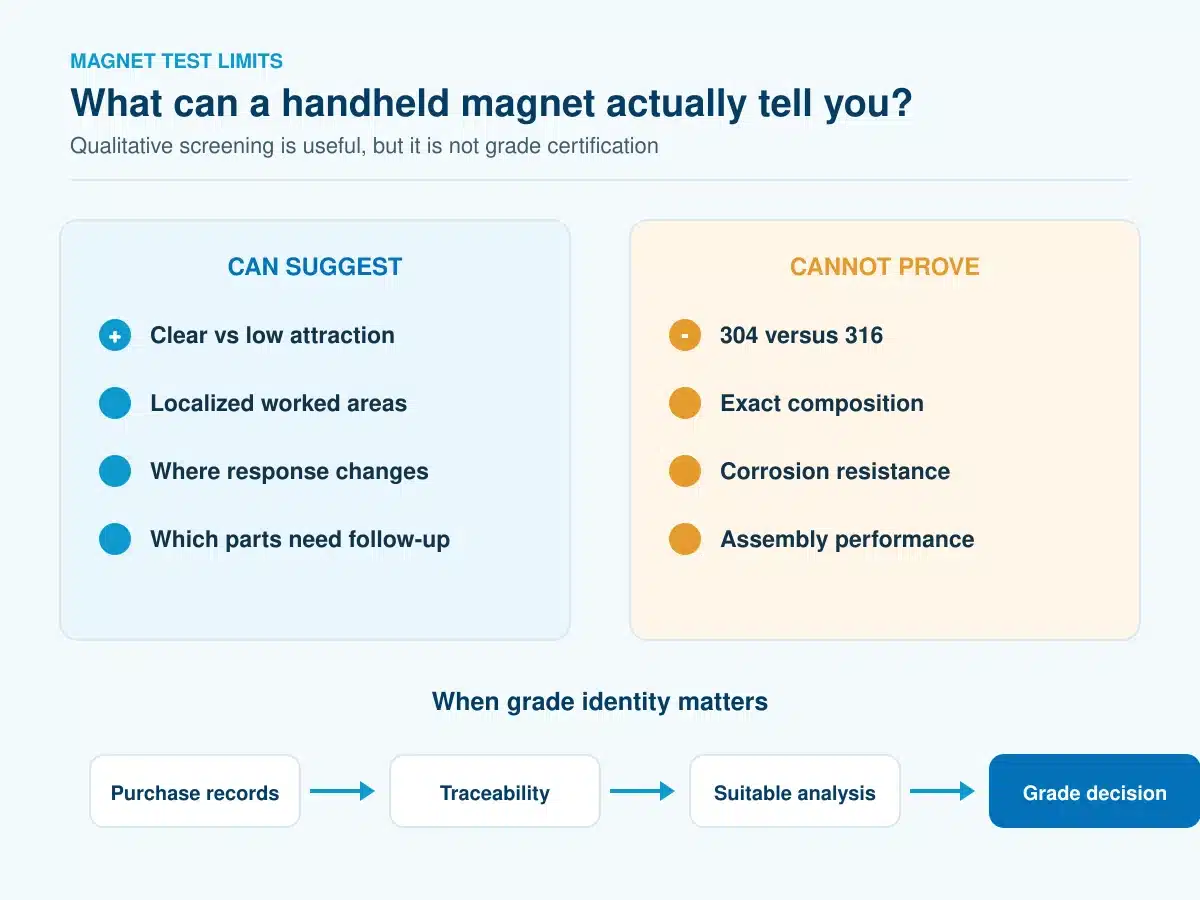
No. A handheld magnet cannot reliably distinguish 304 from 316.
It may help separate a softened austenitic product from a clearly magnetic stainless family, but cold-worked austenitic steel can complicate that comparison. Surface shape, thickness, magnet strength, distance, and test position also affect what the operator feels.
When the grade matters, verify it through the purchase records and an appropriate material-identification method. BSSA grade-sorting guidance states that chemical analysis may be required for a conclusive grade decision. Depending on the method, additional analysis may also be needed to distinguish low-carbon or nitrogen-controlled variants.
A magnet test does not establish corrosion resistance, exact composition, exact relative permeability, or suitability for a magnetic assembly.
How Can Stainless Steel Affect a Magnet Assembly?
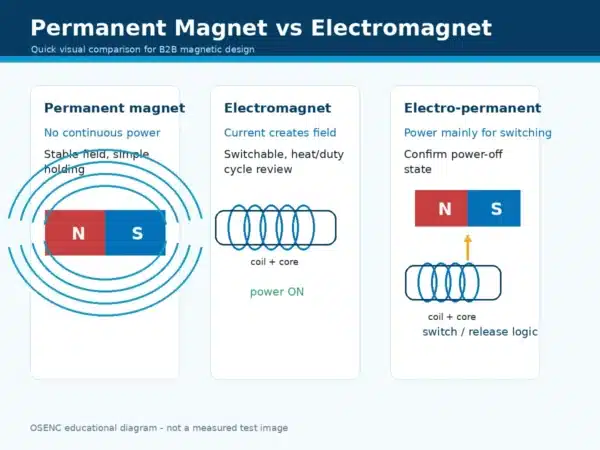
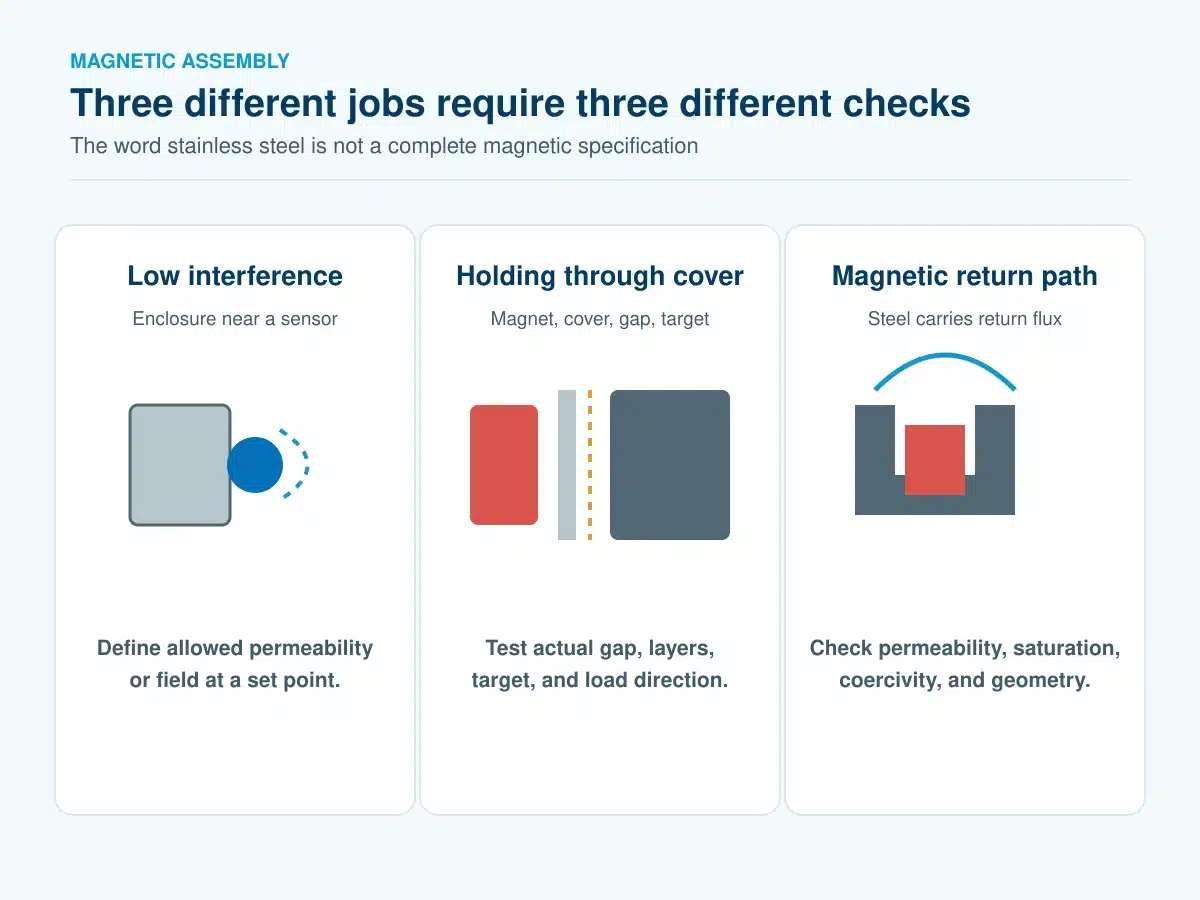
The right stainless steel depends on the part’s function. An enclosure intended to minimize magnetic interference has a different requirement from a bracket or return-path component intended to carry magnetic flux.
When Low Magnetic Interference Matters
A low-permeability austenitic stainless steel may be appropriate when a cover, enclosure, fastener, or support should not become a strong magnetic flux path. The requirement should specify the exact grade, product form, material condition, allowed permeability or field effect, test method, measurement location, and acceptance stage.
Do not select the material by family name alone. Forming and welding after material receipt may change the local response, so testing only the incoming flat sheet may not represent the finished component.
When Holding Force Matters
Any added nonmagnetic layer or physical separation between a magnet and its target can reduce pull force. The magnitude depends on the magnet, target material and thickness, gap, geometry, coatings, contact condition, and test setup, which are also central variables in specialist pull-force test guidance.
For a useful comparison, define the magnet dimensions and magnetization direction, target material and size, target thickness, coatings or intervening layers, actual working gap, load direction, and whether the load is static, cyclic, or subject to shock.
When Stainless Steel Is Intended as a Return Path
A clear response to a handheld magnet does not prove that a stainless grade will be an efficient magnetic return-path material. Magnetic-circuit performance also depends on permeability at the relevant field, saturation flux density, coercivity, geometry, and section thickness, as outlined in this soft-magnetic materials application guide.
The part should be evaluated in the intended magnetic circuit. A material that attracts a magnet may still create excessive reluctance or reach saturation in the proposed geometry.
How Should You Specify and Test the Stainless Component?
Start with the application’s real goal rather than asking only whether the steel is magnetic.
| Application goal | Specify | Verify |
|---|---|---|
| Minimize magnetic interference | Grade, product form, condition, manufacturing route, maximum allowed permeability or field effect, measurement point | Test the relevant production stage and finished geometry when processing can change the response. |
| Maintain pull force through a stainless cover | Cover material, thickness, coatings, actual gap, magnet and target details, load direction | Test a representative assembly under the intended gap and contact conditions. |
| Use stainless steel as a magnetic target or return path | Exact grade, magnetic properties, geometry, thickness and operating field | Review the magnetic circuit and check for permeability and saturation limitations. |
| Confirm material identity | Purchase specification and required grade distinction | Use traceability records and an appropriate material-identification method; do not rely on a magnet alone. |
ASTM A342/A342M-26 provides methods for measuring the relative permeability of weakly magnetic materials up to a relative permeability of 6.0. Specimen geometry, selected method, and magnetic field conditions affect the result, and the standard is often applied to suitable semifinished specimens. Agree on the applicable method and acceptance stage before using it for a finished component.
What Information Should You Send for a Magnetic Assembly Review?
Provide the following information when stainless steel is close to a permanent magnet or forms part of the magnetic circuit:
- Stainless steel grade, product form, condition, and manufacturing process.
- Component drawing, wall thickness, critical dimensions, and tolerances.
- Magnet material, grade, dimensions, coating, and magnetization direction.
- Actual working gap, air spaces, coatings, adhesives, and other intervening layers.
- Target or return-path material, size, thickness, and surface condition.
- Required pull force, field level, torque, sensing result, or positioning function.
- Load direction and whether loading is static, cyclic, impact, or vibration-related.
- Required safety factor and acceptance limits.
- Operating temperature, environment, and corrosion exposure.
- Measurement method, test stage, and measurement locations.
- For low-interference designs, the maximum permitted field or disturbance at a defined point.
- Available samples and whether representative physical testing is required.
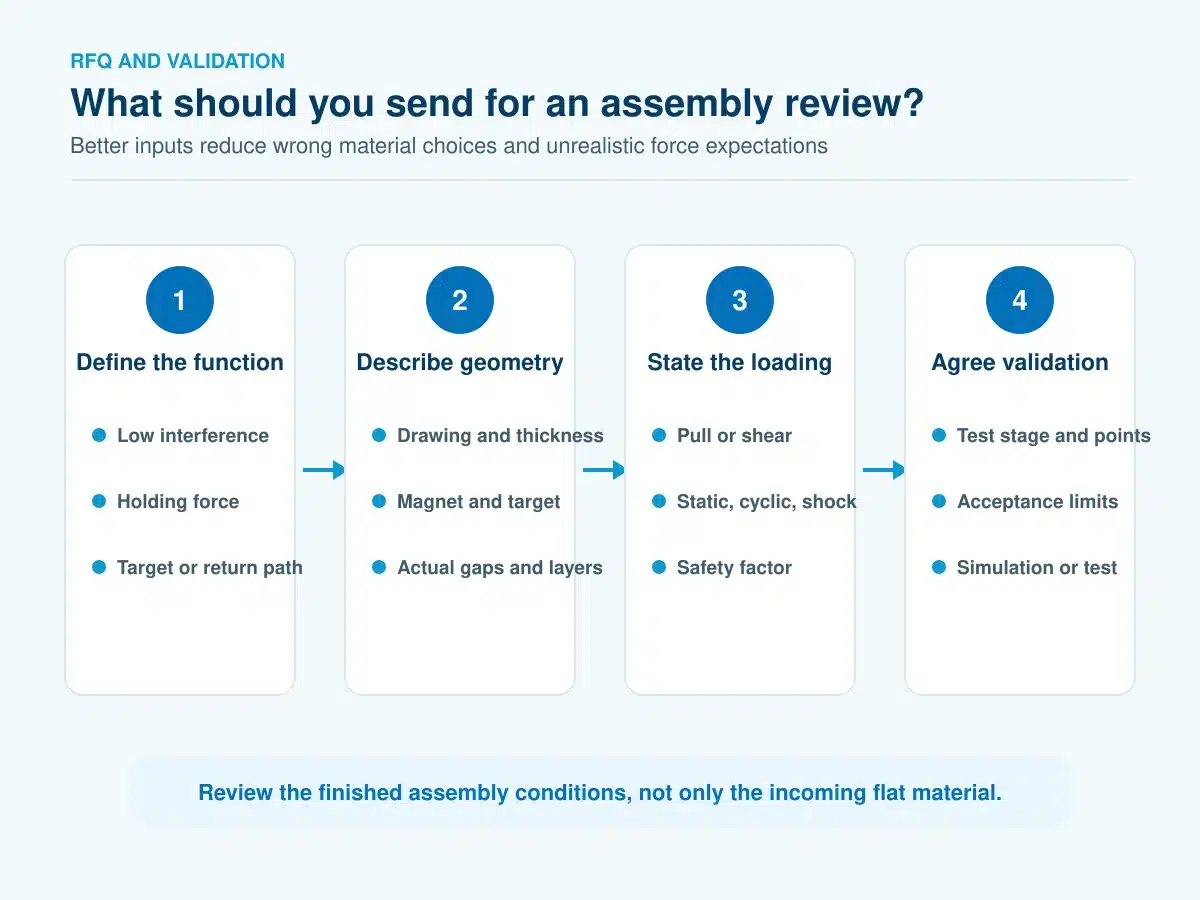
Osenc can use these inputs to review magnet geometry, magnetization direction, working gap, target conditions, and an appropriate validation approach for a niestandardowych magnesów neodymowych or magnetic assembly. Depending on the design risk, validation may require magnetic-field simulation or representative physical testing under the intended assembly conditions. No Osenc project result is claimed in this article.
Discuss Your Magnetic Assembly
Send your drawing, material condition, working gap, load direction, and acceptance requirement for an engineering review.
Contact OsencNajczęściej zadawane pytania
Czy każda stal nierdzewna jest niemagnetyczna?
Nie. Stale nierdzewne ferrytyczne, martenzytyczne, duplex oraz większość stali utwardzanych wydzieleniowo wykazują właściwości magnetyczne. W pełni wyżarzone gatunki austenityczne, takie jak 304 i 316, mają zwykle znacznie niższą przenikalność magnetyczną.
Dlaczego moja stal nierdzewna 304 przyciąga magnes?
Formowanie na zimno, gięcie, walcowanie, tłoczenie, cięcie nożycowe lub inne miejscowe odkształcenie może prowadzić do powstania martenzytu odkształceniowego. Należy porównać obszary poddane obróbce z obszarami niepoddanymi obróbce, a następnie zweryfikować materiał odpowiednią metodą, jeśli identyfikacja gatunku lub przenikalność magnetyczna ma znaczenie krytyczne.
Czy stal nierdzewna 316 jest całkowicie niemagnetyczna?
Nie. Stal 316 po przeróbce plastycznej, w stanie wyżarzonym, zwykle wykazuje niewielkie przyciąganie magnetyczne, jednak obróbka plastyczna na zimno i spawanie mogą miejscowo zwiększyć jej reakcję na pole magnetyczne. Jej właściwości należy opisywać z uwzględnieniem stanu materiału i procesu technologicznego, a nie wyłącznie oznaczenia gatunku.
Czy badanie magnesem pozwala potwierdzić, że stal nierdzewna jest gatunku 304 lub 316?
Nie. Magnes służy wyłącznie do jakościowej oceny przesiewowej. Do jednoznacznego określenia gatunku materiału potrzebna jest dokumentacja materiałowa oraz odpowiednie metody analizy chemicznej lub identyfikacji materiału.
Jakiej stali nierdzewnej użyć w pobliżu magnesu neodymowego?
Zależy to od tego, czy element ma minimalizować zakłócenia magnetyczne, utrzymywać kontrolowaną szczelinę, pełnić funkcję elementu docelowego czy przewodzić strumień powrotny. Przed doborem stali należy określić funkcję elementu, gatunek i stan materiału, geometrię, szczelinę roboczą, wymagania magnetyczne oraz metodę walidacji.
Materiały źródłowe
- British Stainless Steel Association, Magnetic Properties of Austenitic Stainless Steels.
- British Stainless Steel Association, Composition Effects on the Magnetic Permeability of Austenitic Stainless Steels.
- British Stainless Steel Association, Effect of Cold Work and Heat Treatment on Magnetic Permeability.
- British Stainless Steel Association, On-Site Methods for Stainless Steel Grade and Product Sorting.
- Nickel Institute, The Nickel Advantage in Stainless Steel.
- ASTM International, ASTM A342/A342M-26: Standard Test Methods for Permeability of Weakly Magnetic Materials.
- K&J Magnetics, Testing Magnet Strength.
- Arnold Magnetic Technologies, Soft Magnetic Materials Application Guide.
Evidence limitation: No Osenc customer case, project drawing, simulation result, physical test record, or named technical reviewer is presented in this article. The diagrams are educational visuals, not first-hand project evidence.