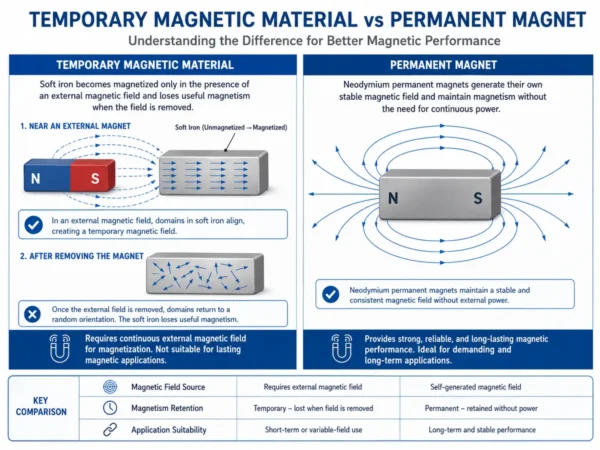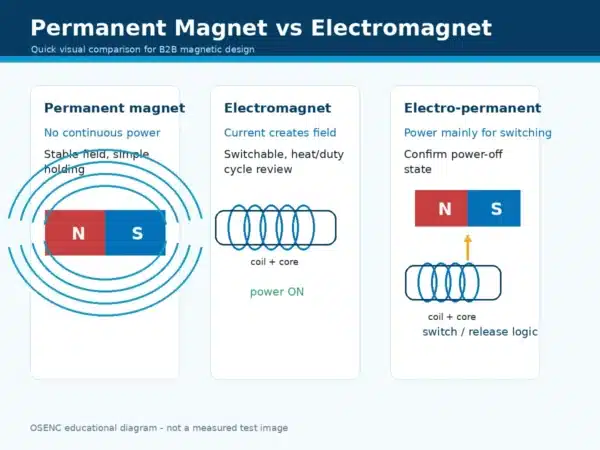







Temperatura wpływa na siłę magnesu, zmieniając uporządkowanie jego wewnętrznych domen magnetycznych. W niskiej temperaturze siła wzrasta, a w wysokiej maleje. Pod wpływem ogrzewania atomy magnesu poruszają się intensywniej, wskutek czego pole magnetyczne słabnie, a domeny magnetyczne tracą uporządkowanie.
Chłodzenie magnesu może natomiast zwiększyć jego siłę przez stabilizację uporządkowania domen. W części dotyczącej wpływu temperatury na magnesy omówiono definicję temperatury Curie, wpływ ciepła na siłę magnetyczną oraz zjawiska zachodzące w najniższej temperaturze.
Czym jest temperatura Curie?
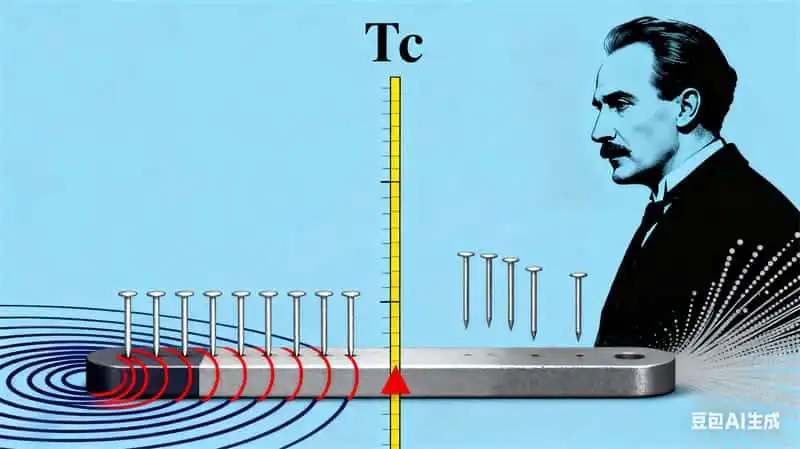
Temperatura Curie (Tc) to temperatura, w której substancja magnetyczna traci wszystkie swoje właściwości magnetyczne.
Temperatura Curie określa maksymalną temperaturę, w której uporządkowanie momentów magnetycznych może zostać zaburzone, i stanowi miarę zależności między magnetyzmem a temperaturą. Nazwa tej temperatury pochodzi od nazwiska fizyka Pierre’a Curie.
Na przykład:,
- Dla magnesu neodymowego jest to około 310 stopni Celsjusza.
- Dla usmażonego magnesu jest to około 450 °C.
- Dla magnesu samarowo-kobaltowego — około 750 °C.
- Dla magnesów Alnico — około 880 °C.
Po osiągnięciu punktu Curie magnes traci swoje właściwości, a jego schłodzenie nie przywraca mu siły.
Jak niska temperatura wpływa na magnesy?
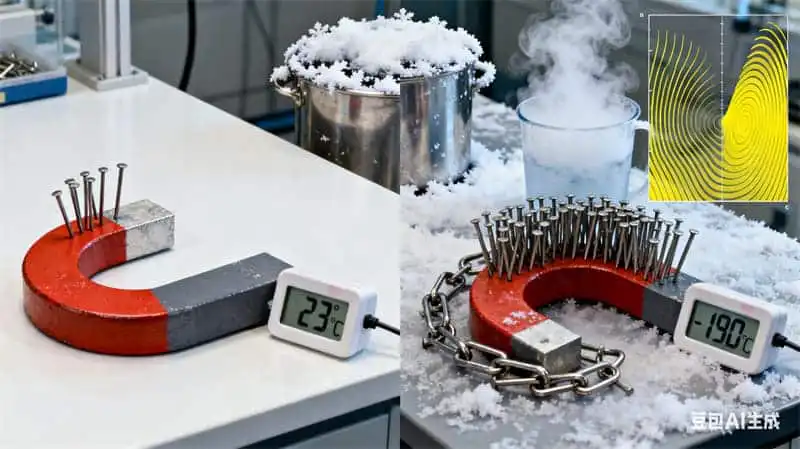
Ogólnie rzecz biorąc, niższa temperatura zwiększa siłę magnetyczną, ponieważ spowalnia ruch atomów, co sprzyja przywróceniu ich uporządkowania. W skrajnych temperaturach magnesy mogą jednak stać się kruche, zwłaszcza gdy są wykonane z takich materiałów jak neodym.
W laboratoriach magnesy nadprzewodzące są często utrzymywane w temperaturach kriogenicznych. Większość magnesów jest w rzeczywistości nieco silniejsza i stabilniejsza w niższej temperaturze; jeśli temperatura spadnie poniżej 125 stopni Celsjusza, siła magnetyczna będzie stopniowo maleć.
Gdy temperatura spada do 196 stopni Celsjusza, siła magnetyczna wzrasta do 85–90 procent.
How Does Heat Affect Magnets?
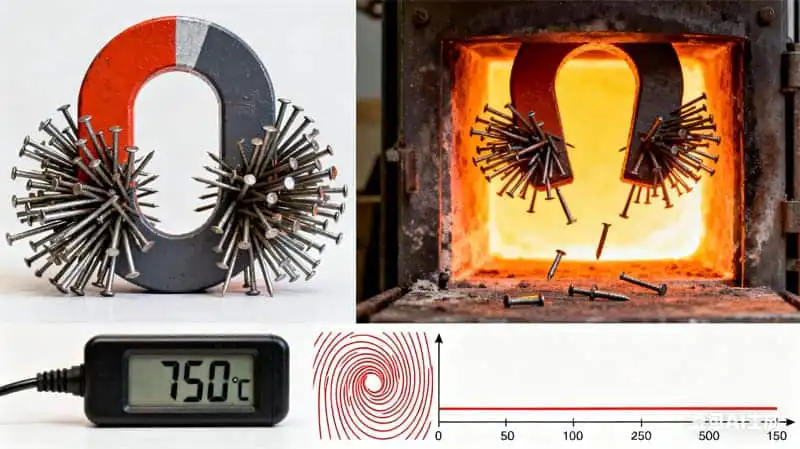
Magnetic domains, which are small sections of bonded atoms, become misaligned when the temperature increases due to thermal energy. As a result, the magnetic strength gradually decreases. Magnets can hardly lose their magnetic properties if the temperature rises too much.
The process is a bit like how heat melts ice. Once it reaches a certain point, it is difficult to reverse the shift. Heat causes the molecules of the wax to move faster and with more kinetic energy, causing them to become more regular.
At increasing temperatures these molecules begin to misalign until their ends have opposite charges and no longer face each other in a caged arrangement. A magnet can resume its original function after cooling if the heat supplied to it remains below its maximum operating temperature.
Different Magnet Materials React Differently with Temperature
Different magnets exhibit different behavior at different temperatures and pressures. The internal crystal structure and composition of substances determine how they react. We examine the response of the most commonly used magnetic materials to temperature variations.
Alnico
Much consumer and industrial equipment depends on Alnico permanent magnets. Alnico magnets are used in cow magnets, traveling wave tubes, electric motors, electric guitar pickups, microphones, sensors, and speakers, among other devices.
However, rare earth magnets are currently used in many objects because they can produce a high BHmax and strong magnetic field (Br), which enables object miniaturization.
SmCo
A well-known feature of samarium cobalt magnets is their exceptional heat stability. Even at temperatures up to 350°C, they do not weaken significantly.
NdFeB
The strongest permanent magnets on the market are neodymium magnets. Although they are most sensitive to temperature. Advanced types (such as N42SH or N52VH) can operate up to 230°C, but grades lose power above 80°C.
They are not suitable for extremely hot conditions, as they undergo irreversible demagnetization beyond their limits.
Ferryt
Ferrite magnets are inexpensive and commonly used. They consist of iron oxide and barium or strontium. Their magnetism is slightly reduced below freezing temperatures.
Still, they work well up to 250°C. Nevertheless, because they offer a compromise between cost and reliability, they are preferred for applications such as loudspeakers and refrigerator magnets.
~0.11% Loss per °C (Reversible Below Max Operating Temp)
When the operating temperature is below maximum, magnets typically lose about 0.11% of their strength for every degree Celsius. Thankfully, this damage is reversible, so the magnet returns to its original strength as it cools.
However, part of the damage is irreversible if the temperature exceeds the rated range. Choosing the proper magnet grade for your application is critical to prevent irreversible demagnetization.
Temperature Rating by Grade (e.g., VH/AH up to ~230°C)
Each magnet has a specific temperature rating, depending on its grade and material composition. Neodymium magnets (NdFeB), for example, are graded into N95, N42, N35, and similar grades.
Each grade has a maximum operating temperature range. Generally ranges from 80°C to 230°C for special high-temperature types such as VH (Very High) and AH (Additionally High). If these limits are exceeded, the magnetism can be irreversibly lost.
What happens to magnets at high temperatures?

When magnets are exposed to high temperatures, there are two possible effects.
Reversible loss:
When the heating process remains below its maximum operating temperature, the magnetization reverses. This shows that the material is still less magnetic when heated. The domains lose some of their alignment as a result of thermal agitation caused by increasing temperature.
A magnet can regain its strength after cooling. If the sheet temperature remains below a certain threshold, also known as the Curie temperature or Curie point.
The magnet may weaken momentarily when exposed to moderate heat. We call this phenomenon reversible damage.
Irreversible loss (and permanent loss)
When a magnet is exposed to temperatures above its maximum operating temperature and below its Curie temperature, irreversible loss of magnetism occurs.
This means that:
● It will perform worse when cold.
How hot is too hot for neodymium magnets?
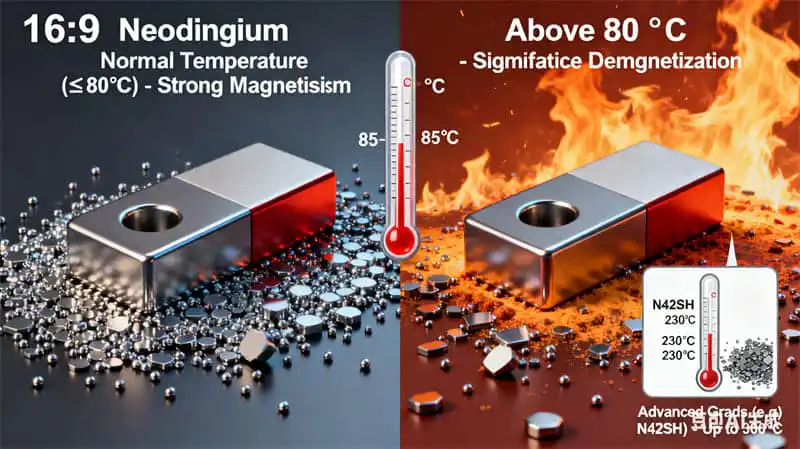
The strongest permanent magnets on the market are neodymium magnets (NDFEB). So we are also sensitive to temperature. Standard grades such as N35 or N52 typically begin to lose their magnetism at 80°C (176°F).
When the temperature exceeds the limit, the efficiency of the magnet deteriorates rapidly and may not recover completely when it cools down.
A magnet undergoes a constant change when it reaches its Curie temperature. This is the point at which it loses all magnetic properties, depending on the material composition. This point usually falls between 310°C and 400°C (590°F and 752°F) for neodymium magnets.
Max operating temperature depends on shape (permeance coefficient).
The shape and design of a magnet affect how much heat it can withstand. The term “permeance coefficient” (Pc) refers to this component.
Its magnetic field is more stable, hence a magnet with a higher permanence coefficient. For example, a thicker cylinder can retain its magnetism better when heated.
On the other hand, at higher temperatures, thinner or smaller magnets with lower PCO values are more likely to demagnetize.
High-temperature Grades (e.g., N42SH, N35AH)
Special high-temperature neodymium magnet grades have been developed to solve heat sensitivity problems.
Even under harsh conditions these grades can maintain their strong magnetic properties due to the employment of modified alloys and mortars:
- The operating temperature of the N42SH is 150°C (902°F).
- Temperatures up to 200°C (392°F) can be handled by the N35EH.
- 230°C can withstand temperatures up to 35AH (446°F).
Although these high-temperature grades may not be as magnetically strong as regular grades, they are ideal for demanding applications such as electric motors and automotive sensors because they can retain their magnetism when heated.
It is possible to restore the magnetism to its original strength, but it is not economical. An irreversible loss happens only once.
Conclusion
Magnets are greatly affected by temperature; above the Curie point, permanent magnets such as iron or neodymium lose all their magnetic force. Their field strength increases with lower temperature.
Due to their reduced electrical strength, electromagnets eventually lose their strength as they overheat. Superconducting electromagnets are therefore enhanced by cooling to very high
fields.
Temperature must be carefully managed. Magnetism is maintained by keeping the permanent magnet away from extreme heat. Strong magnetic fields are made possible by cooling electromagnets.
New magnetic applications in science, engineering, and medicine can be opened up by using heat and boundaries.
Najczęściej zadawane pytania
Jak temperatura wpływa na magnesy samarowo-kobaltowe?
Magnesy samarowo-kobaltowe (SmCo) mogą skutecznie pracować w temperaturze do 300 °C (572 °F) dzięki wyjątkowej odporności na wysoką temperaturę. Wysoka temperatura Curie pozwala im zachować właściwości magnetyczne nawet w trudnych warunkach.
Jednak w przypadku przegrzania mogą trwale utracić właściwości magnetyczne. Dzięki stabilności w skrajnie niskich temperaturach magnesy SmCo idealnie nadają się do zastosowań wysokotemperaturowych oraz w przemyśle lotniczym i kosmicznym.
Jak temperatura wpływa na magnesy samarowo-kobaltowe?
Po podgrzaniu magnesów neodymowych powyżej 80 °C (176 °F) ich siła magnetyczna gwałtownie maleje. Rozszerzanie się w podwyższonej temperaturze może prowadzić do nieodwracalnego rozmagnesowania.
Jednak w niskich temperaturach ich domeny magnetyczne ulegają silniejszemu uporządkowaniu, dzięki czemu siła magnetyczna wzrasta.
Czy wysoka temperatura powoduje rozmagnesowanie magnesu?
Rzeczywiście, magnes całkowicie traci właściwości magnetyczne, gdy jego temperatura wzrośnie powyżej punktu Curie, ponieważ domeny magnetyczne tracą uporządkowanie.
Jak ciepłe jądro Ziemi może być namagnesowane?
Źródłem pola magnetycznego Ziemi nie jest magnes trwały. Pole to powstaje wskutek działania geodynama w stopionym żelazie i niklu tworzących jądro zewnętrzne.
Chociaż temperatura jądra jest zbyt wysoka, aby mogło ono zachować samoistne namagnesowanie, ruch tych materiałów przewodzących wytwarza prąd elektryczny, który z kolei generuje silne pole magnetyczne.