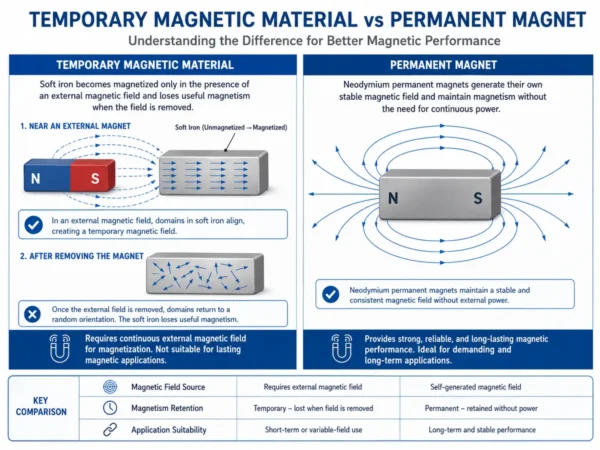







자석 내부 자구의 정렬이 변하면 온도에 따라 자력이 영향을 받습니다. 저온에서는 자력이 증가하고 고온에서는 감소합니다. 가열되면 자석을 구성하는 원자의 움직임이 커지면서 자구의 정렬이 흐트러지고, 그 결과 자기장이 약해집니다.
그러나 자구의 정렬을 안정화하면 자석을 냉각할 때 자력이 증가할 수 있습니다. 온도가 자석에 미치는 영향에 관한 절에서는 퀴리 온도의 정의, 열이 자력에 변화를 일으키는 방식, 최저 온도에서 발생하는 현상을 모두 설명합니다.
퀴리 온도란 무엇인가요?
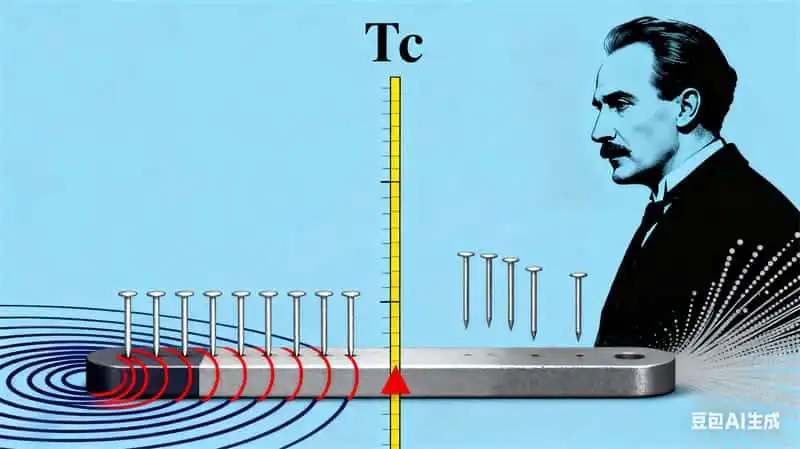
퀴리 온도(Tc)는 자성 물질이 자기적 특성을 모두 잃는 온도입니다.
자기 모멘트의 정렬이 흐트러질 수 있는 최고 온도를 나타내는 퀴리 온도는 자성과 온도의 관계를 보여주는 지표입니다. 물리학자인 피에르 퀴리가 이 온도의 명명자로 알려져 있습니다.
예를 들면,
- 네오디뮴 자석은 약 310 °C입니다.
- 프라이드 자석은 약 450 °C입니다.
- 사마륨 코발트 자석은 약 750 °C입니다.
- 알니코 자석은 약 880 °C입니다.
자석은 퀴리점에 도달하면 고유한 특성을 잃으며, 냉각해도 다시 강해지지 않습니다.
저온은 자석에 어떤 영향을 미치나요?
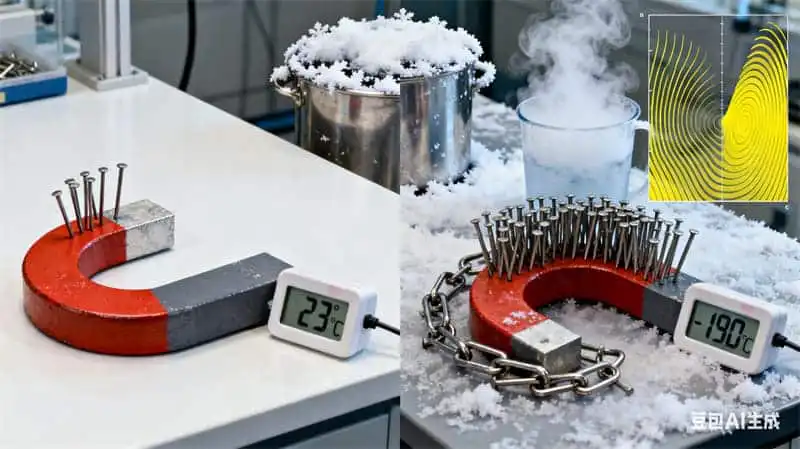
일반적으로 저온에서는 원자의 움직임이 느려져 정렬이 회복되는 데 도움이 되므로 자력이 증가합니다. 그러나 극저온에서는 자석이 취성화될 수 있으며, 일반적으로 네오디뮴과 같은 재료로 제작된 경우 이러한 현상이 나타납니다.
초전도 자석은 실험실에서 극저온으로 유지되는 경우가 많습니다. 실제로 대부분의 자석은 저온에서 자력이 약간 더 강하고 안정적이지만, 온도가 125 °C 이하로 내려가면 자기력은 점차 감소합니다.
온도가 196 °C로 내려가면 자력은 85~90%로 증가합니다.
열은 자석에 어떤 영향을 미칠까요?
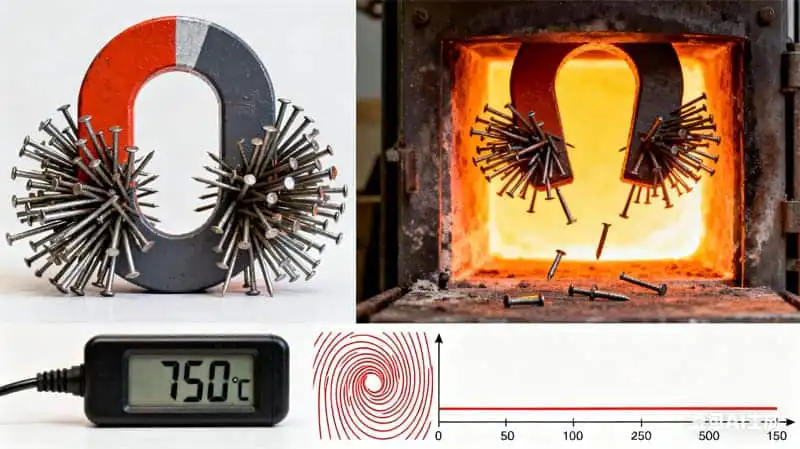
결합된 원자의 작은 영역인 자구는 열에너지로 인해 온도가 상승하면 정렬이 어긋납니다. 그 결과 자력이 점차 감소합니다. 온도가 지나치게 상승해도 자석은 자기 특성을 거의 잃지 않습니다.
이 과정은 열로 얼음이 녹는 현상과 약간 비슷합니다. 일정 지점에 도달하면 이러한 변화를 되돌리기 어렵습니다. 열은 왁스 분자를 더 빠르게 움직이고 더 큰 운동 에너지를 갖게 하며, 그 결과 분자 배열이 더욱 규칙적으로 변합니다.
온도가 계속 상승하면 이러한 분자들의 정렬이 어긋나기 시작하고, 마침내 양 끝이 서로 반대 전하를 띠며 격자 형태의 배열에서 더 이상 서로 마주 보지 않게 됩니다. 자석에 가해진 열이 최대 작동 온도 이하로 유지되었다면, 냉각 후 원래 기능을 회복할 수 있습니다.
자석 재료에 따라 온도에 다르게 반응합니다
자석은 종류에 따라 온도와 압력 변화에 다르게 반응합니다. 물질의 내부 결정 구조와 조성이 이러한 반응을 결정합니다. 여기에서는 가장 일반적으로 사용되는 자성 재료가 온도 변화에 어떻게 반응하는지 살펴봅니다.
Alnico
많은 소비재 및 산업 장비가 Alnico 영구자석에 의존합니다. Alnico 자석은 소 자석, 진행파관, 전기 모터, 일렉트릭 기타 픽업, 마이크, 센서 및 스피커를 비롯한 다양한 장치에 사용됩니다.
그러나 현재는 희토류 자석이 높은 BHmax와 강한 자기장(Br)을 생성할 수 있어 제품 소형화가 가능하므로 다양한 제품에 사용되고 있습니다.
SmCo
사마륨 코발트 자석의 잘 알려진 특징은 탁월한 열 안정성입니다. 최대 350 °C의 온도에서도 자력이 크게 약해지지 않습니다.
NdFeB
시판되는 영구자석 중 가장 강한 자석은 네오디뮴 자석입니다. 그러나 온도에는 가장 민감합니다. 고급 등급(예: N42SH 또는 N52VH) 은 최대 230 °C까지 작동할 수 있지만, 등급에 따라 80 °C를 초과하면 자력이 저하됩니다.
한계를 초과하면 비가역적 탈자가 발생하므로 극도로 높은 온도 조건에는 적합하지 않습니다.
페라이트
Ferrite magnets are inexpensive and commonly used. They consist of iron oxide and barium or strontium. Their magnetism is slightly reduced below freezing temperatures.
Still, they work well up to 250°C. Nevertheless, because they offer a compromise between cost and reliability, they are preferred for applications such as loudspeakers and refrigerator magnets.
~0.11% Loss per °C (Reversible Below Max Operating Temp)
When the operating temperature is below maximum, magnets typically lose about 0.11% of their strength for every degree Celsius. Thankfully, this damage is reversible, so the magnet returns to its original strength as it cools.
However, part of the damage is irreversible if the temperature exceeds the rated range. Choosing the proper magnet grade for your application is critical to prevent irreversible demagnetization.
Temperature Rating by Grade (e.g., VH/AH up to ~230°C)
Each magnet has a specific temperature rating, depending on its grade and material composition. Neodymium magnets (NdFeB), for example, are graded into N95, N42, N35, and similar grades.
Each grade has a maximum operating temperature range. Generally ranges from 80°C to 230°C for special high-temperature types such as VH (Very High) and AH (Additionally High). If these limits are exceeded, the magnetism can be irreversibly lost.
What happens to magnets at high temperatures?

When magnets are exposed to high temperatures, there are two possible effects.
Reversible loss:
When the heating process remains below its maximum operating temperature, the magnetization reverses. This shows that the material is still less magnetic when heated. The domains lose some of their alignment as a result of thermal agitation caused by increasing temperature.
A magnet can regain its strength after cooling. If the sheet temperature remains below a certain threshold, also known as the Curie temperature or Curie point.
The magnet may weaken momentarily when exposed to moderate heat. We call this phenomenon reversible damage.
Irreversible loss (and permanent loss)
When a magnet is exposed to temperatures above its maximum operating temperature and below its Curie temperature, irreversible loss of magnetism occurs.
This means that:
● It will perform worse when cold.
How hot is too hot for neodymium magnets?
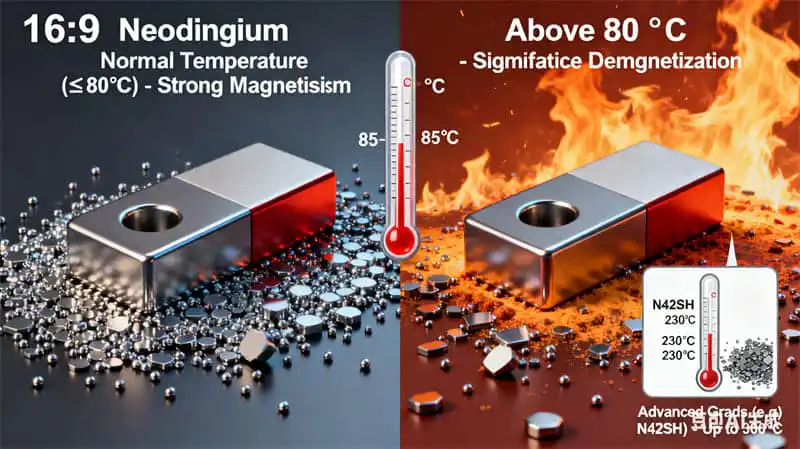
The strongest permanent magnets on the market are neodymium magnets (NDFEB). So we are also sensitive to temperature. Standard grades such as N35 or N52 typically begin to lose their magnetism at 80°C (176°F).
When the temperature exceeds the limit, the efficiency of the magnet deteriorates rapidly and may not recover completely when it cools down.
A magnet undergoes a constant change when it reaches its Curie temperature. This is the point at which it loses all magnetic properties, depending on the material composition. This point usually falls between 310°C and 400°C (590°F and 752°F) for neodymium magnets.
Max operating temperature depends on shape (permeance coefficient).
The shape and design of a magnet affect how much heat it can withstand. The term “permeance coefficient” (Pc) refers to this component.
Its magnetic field is more stable, hence a magnet with a higher permanence coefficient. For example, a thicker cylinder can retain its magnetism better when heated.
On the other hand, at higher temperatures, thinner or smaller magnets with lower PCO values are more likely to demagnetize.
High-temperature Grades (e.g., N42SH, N35AH)
Special high-temperature neodymium magnet grades have been developed to solve heat sensitivity problems.
Even under harsh conditions these grades can maintain their strong magnetic properties due to the employment of modified alloys and mortars:
- The operating temperature of the N42SH is 150°C (902°F).
- Temperatures up to 200°C (392°F) can be handled by the N35EH.
- 230°C can withstand temperatures up to 35AH (446°F).
Although these high-temperature grades may not be as magnetically strong as regular grades, they are ideal for demanding applications such as electric motors and automotive sensors because they can retain their magnetism when heated.
It is possible to restore the magnetism to its original strength, but it is not economical. An irreversible loss happens only once.
결론
Magnets are greatly affected by temperature; above the Curie point, permanent magnets such as iron or neodymium lose all their magnetic force. Their field strength increases with lower temperature.
Due to their reduced electrical strength, electromagnets eventually lose their strength as they overheat. Superconducting electromagnets are therefore enhanced by cooling to very high
fields.
Temperature must be carefully managed. Magnetism is maintained by keeping the permanent magnet away from extreme heat. Strong magnetic fields are made possible by cooling electromagnets.
New magnetic applications in science, engineering, and medicine can be opened up by using heat and boundaries.
자주 묻는 질문
온도는 사마륨 코발트 자석에 어떤 영향을 미칩니까?
사마륨 코발트(SmCo) 자석은 뛰어난 내열성으로 최대 300 °C(572 °F)의 온도에서도 효과적으로 작동합니다. 퀴리 온도가 높아 가혹한 조건에서도 자력을 유지할 수 있습니다.
그러나 과열되면 자성을 영구적으로 잃을 수 있습니다. SmCo 자석은 극저온에서도 안정적이므로 고온 및 항공우주 분야에 적합합니다.
온도는 사마륨 코발트 자석에 어떤 영향을 미칩니까?
네오디뮴 자석은 80 °C(176 °F) 이상으로 가열되면 자력이 급격히 감소합니다. 고온에서 팽창하면 비가역적 감자가 발생할 수 있습니다.
반면 저온에서는 자구가 더 강하게 정렬되므로 자력이 증가합니다.
열에 의해 자석이 감자된다는 것이 사실인가요?
자석의 온도가 퀴리점 이상으로 올라가면 자구의 정렬이 흐트러지므로 자성을 완전히 잃습니다.
지구의 뜨거운 핵은 어떻게 자화될 수 있습니까?
지구 자기장은 영구자석에서 비롯되는 것이 아닙니다. 오히려 외핵의 용융 철과 니켈에서 일어나는 지오다이너모 효과로 생성됩니다.
핵은 자체적으로 자화를 유지하기에는 온도가 너무 높지만, 이러한 전도성 물질의 운동이 전류를 발생시키고, 이 전류가 다시 강한 자기장을 형성합니다.