







OSENC manufactures custom triangular neodymium magnets to your drawing, including standard triangles, countersunk designs and drawing-defined irregular geometries. Our published size envelope covers 1–200 mm length, 0.5–100 mm width and 0.3–120 mm thickness, with N35–N55 plus M, H, SH, EH and AH grade families and nickel, zinc or epoxy coating options.
OSENC will confirm geometry, grade, magnetization, coating, critical tolerances and the quotation basis from your drawing.
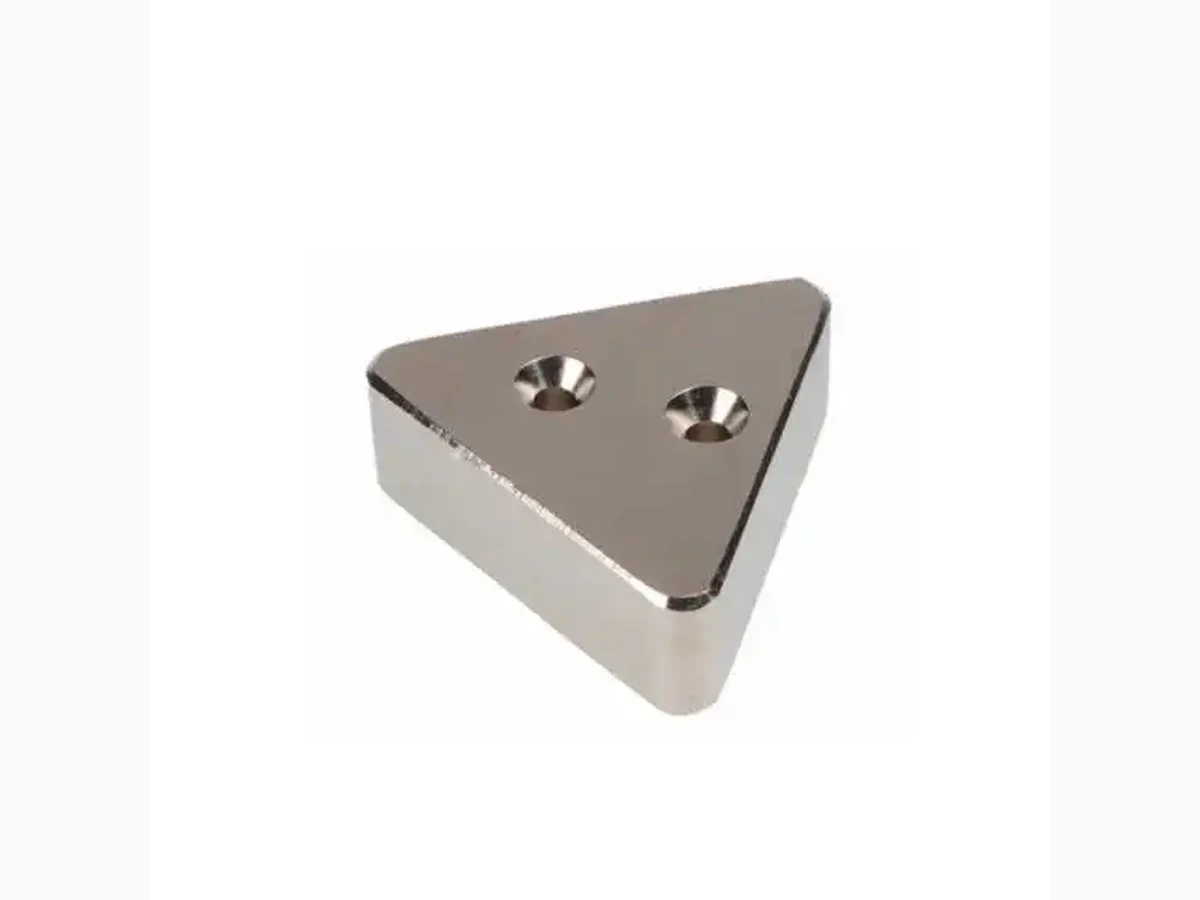
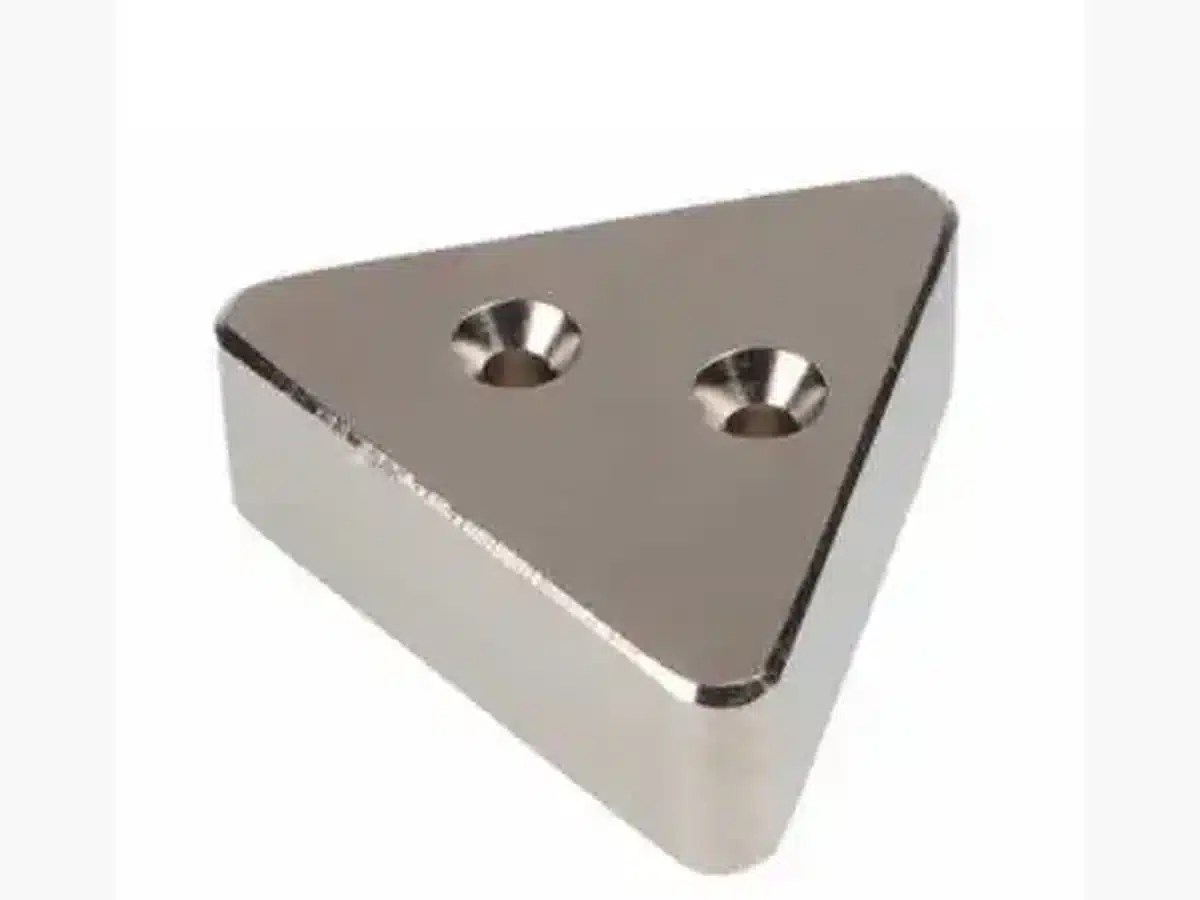
OSENC quotes triangular magnets from a drawing-defined geometry rather than a generic L × W × H description. For quotation and production definition, specify side lengths A, B and C or the controlling angles, plus thickness T.
Add corner radii or chamfers, hole geometry, countersink details, coating, tolerance and magnetization direction. For curved or segment-derived triangular parts, include the controlling radius, centerline and included angle.
| Parameter | OSENC Published Range | What We Need on the Drawing |
|---|---|---|
| Length envelope | 1–200 mm | Identify the controlling side or overall projected length. |
| Width envelope | 0.5–100 mm | Identify the corresponding side or projected width. |
| Height / thickness | 0.3–120 mm | Show whether thickness is also the intended pole-to-pole direction. |
| Smallest listed simplified triangle | 1 × 1 × 0.3 mm | Send the exact side lengths, angles and thickness for production confirmation. |
For acute corners, thin sections or dimensions near the envelope limits, OSENC confirms the complete geometry instead of reducing the decision to one dimension.
| Your Design | OSENC Engineering Response |
|---|---|
| Standard triangle with simple thickness | Quote from drawing |
| Triangle with countersunk holes | Supported from the approved drawing; define hole and countersink geometry. |
| Acute corners | Geometry confirmation required; corner angle, local thickness and edge condition are controlled together. |
| Thin section close to a hole | Manufacturability confirmation required; define hole position, remaining wall and thickness. |
| Curved triangular boundary | Send radius + centerline + included angle. |
| Special pole orientation | Mark the required N/S pole faces on the drawing. |
| Tight dimensional tolerance | Specify the tolerance; OSENC confirms the achievable production target against the part geometry. |
| Gauss, flux or pull-force target | Provide the measurement conditions so the target can be defined against the real magnetic circuit. |
Send the geometry, tolerance, coating and pole orientation. OSENC will confirm manufacturability and build the quotation from the approved geometry.
Check Your Triangle GeometryOSENC turns a drawing-defined triangle into a controlled production specification. The objective is not simply to machine three sides; it is to make geometry, magnetization, coating and inspection work together in the finished OEM assembly.
Side lengths, angles, thickness, holes, countersinks, chamfers and curved features are locked from the approved drawing before production.
The required N/S pole faces and material orientation are defined against the real triangle geometry before magnetization.
Fit-critical dimensions are controlled against the finished coated part when coating build affects the customer assembly.
Acute corners, countersinks, thin walls and hole-to-edge relationships are addressed before the sample specification is released.

| Feature | OSENC Production Control |
|---|---|
| Triangle geometry | Side lengths, internal angles and thickness |
| Sharp corners | Corner geometry, local section thickness and chipping risk |
| Through holes | Diameter, position and distance from edges |
| Countersinks | Hole geometry, screw interface and remaining wall thickness |
| Chamfers / radii | Drawing-defined edge treatment |
| Curved boundaries | Radius, centerline and included angle |
| Magnetization | Required N/S pole faces and material orientation |
| Coating | Environment, coating route and fit-sensitive dimensions |
OSENC controls dimensional tolerances against triangle size, thickness, corner geometry and secondary features. Specify the required tolerance on your drawing, and we confirm the achievable production target for that part before the specification is released.
When angle tolerance, flatness, parallelism or hole position affects assembly fit, place the requirement directly on the drawing so it becomes part of the controlled project specification.
OSENC supplies triangular neodymium magnets in N35–N55 grade ranges, together with M, H, SH, EH and AH grade families for projects with higher coercivity or temperature-related requirements.
We select the starting grade against the required magnetic output, available magnet volume, working gap and surrounding magnetic circuit.
M, H, SH, EH and AH grade families provide higher-coercivity options, but finished-part temperature performance still depends on geometry and the magnetic circuit.
Project Br, Hcb, Hcj and (BH)max values should be controlled by the approved material specification or certificate used for the order.
OSENC defines triangular magnetization by pole orientation, not by forcing disc-magnet terminology onto an irregular shape. Practical project directions include through-thickness magnetization, in-plane magnetization along a specified orientation and other drawing-defined custom orientations.
Sintered NdFeB is anisotropic, so the required field direction must be compatible with the material orientation and final geometry. Complex multipole patterns require dedicated magnetic design and magnetizing fixtures and are defined project by project.
If your project has a field, flux or holding-force target, include the measurement location, air gap, steel counterpart and test direction. That turns the target into an engineering requirement instead of an isolated number.

Send your working temperature, assembly space, air gap and target magnetic result. OSENC will use them to define the starting grade, magnetization direction and magnetic configuration.
Send Your Magnetic RequirementsOSENC offers nickel, zinc and epoxy coating routes for triangular neodymium magnets. We match the coating discussion to corrosion exposure, handling, surface requirements and dimensional sensitivity.
| Coating | Best Used When | What to Include in the RFQ |
|---|---|---|
| Nickel / Ni-Cu-Ni | General indoor assemblies and standard handling environments | Tell us if coating build affects assembly fit or a finished dimension. |
| Zinc | Projects requiring a zinc finish | Define environmental exposure and any appearance requirement. |
| Epoxy | Projects requiring an epoxy-coated surface or additional corrosion protection | Specify environment, color if required and dimensional sensitivity. |
OSENC uses triangular geometry when the magnet must fit an angular cavity, follow a non-rectangular mounting interface, place magnetic material close to an angled boundary or integrate mounting features into a triangular footprint.
Use a triangular magnet when a block or disc wastes space or interferes with surrounding components.
Useful when pole position and the mechanical envelope must be controlled together inside a compact layout.
Suitable for screw-mounted designs that require a triangular footprint and defined hole geometry.
For drawing-defined assemblies where geometry, pole orientation and neighboring steel must be engineered together.
Provide geometry, dimensions, tolerance, grade or application target, coating, magnetization and quantity.
OSENC confirms edge geometry, holes, countersinks, coating requirements, pole orientation and operating conditions before the sample specification is released.
The quotation and sample plan are built around the approved specification instead of a generic triangle description.
Dimensions, coating, magnetization direction and project-specific magnetic requirements are checked before volume production.
Production follows the approved drawing and the project inspection requirements.
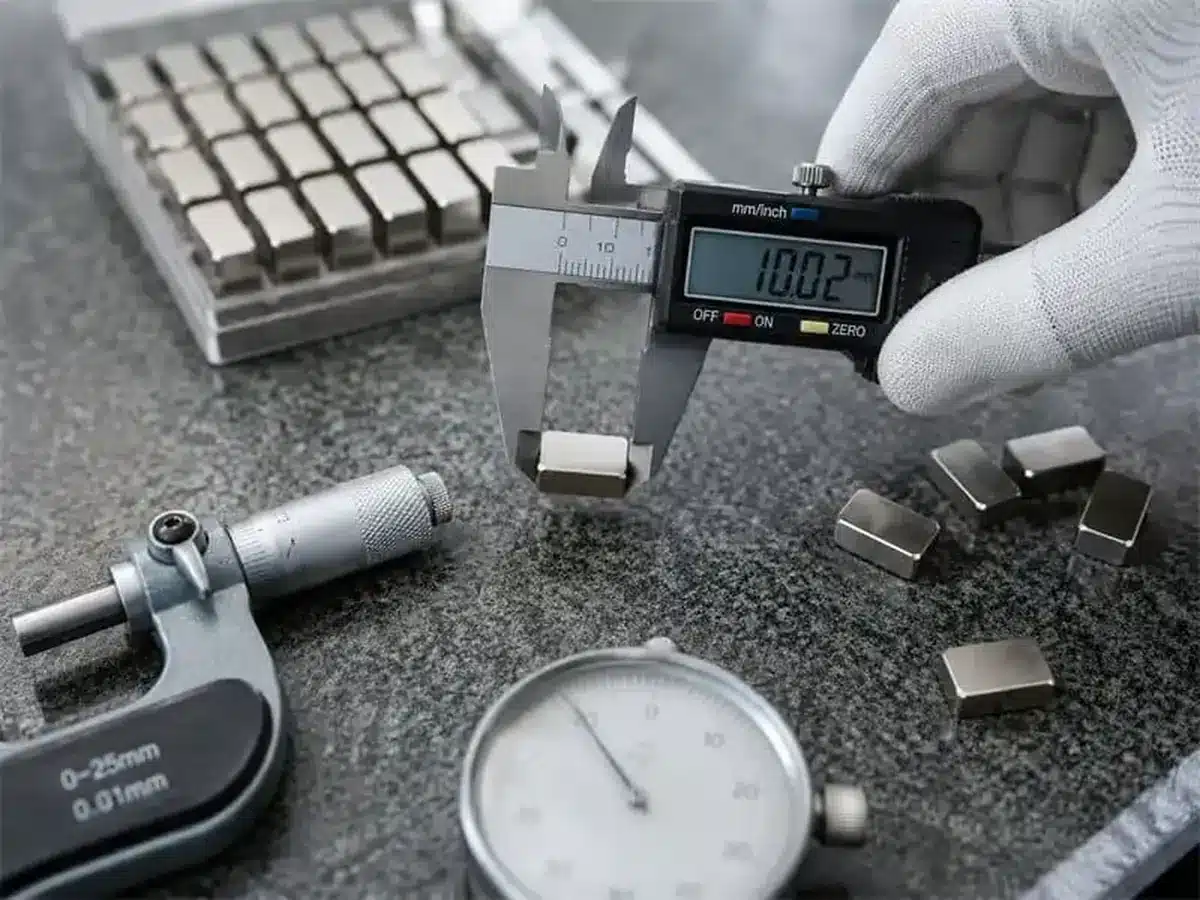
OSENC controls custom triangular magnets against the approved drawing and project requirements. The inspection focus follows the characteristics that affect fit, function and magnetic orientation.
Critical dimensions and project tolerances are checked against the approved drawing.
Coating appearance and project-defined coating requirements are inspected as part of the approved specification.
Pole orientation is checked against the approved magnetic direction before packing.
When the specification includes project-specific magnetic performance requirements, the acceptance method and test conditions should be defined with the order.
Sintered neodymium magnets are hard and brittle. Triangular corners, thin sections and countersunk areas can be more vulnerable to chipping if magnetized parts snap together.
OSENC selects packaging according to magnet size, magnetic strength, quantity and shipping method. Separation and protective packing help reduce uncontrolled attraction, corner impact, chipping and magnetic interference during transport.

A/B/C side lengths or controlling angles, thickness T, corner radius or chamfer, hole diameter, countersink, slots, grooves, curved features and drawing revision.
Grade if known, coating, required pole faces or magnetization direction, dimensional tolerance and any critical finished-size requirement.
Quantity, operating temperature, corrosion exposure, assembly material, air gap and any field, flux or holding-force target with its test conditions.
The current published envelope is 1–200 mm in length, 0.5–100 mm in width and 0.3–120 mm in height or thickness. The smallest listed simplified triangle is 1 × 1 × 0.3 mm. OSENC confirms the exact geometry against the drawing.
Yes. OSENC manufactures countersunk triangular designs from the approved drawing. Define hole diameter, countersink geometry, position, edge relationship and thickness so manufacturability can be confirmed before quotation.
Include side lengths A/B/C or the controlling angles, thickness T, holes or countersinks, chamfers or radii, tolerances, coating, required pole faces and any critical assembly dimensions.
Specify the tolerance your assembly actually needs. Published NdFeB machining references commonly cite about ±0.10 mm for general machining and around ±0.05 mm for selected tighter geometries, but OSENC confirms the achievable production target against your drawing.
Through-thickness, specified in-plane and drawing-defined custom orientations can be manufactured when they are compatible with the material orientation and geometry. Mark the required north and south pole faces on the drawing. Complex multipole designs require project-specific magnetic design and fixture confirmation.
OSENC offers nickel, zinc and epoxy coating routes for triangular neodymium magnets. If coating thickness or coating stack affects fit or corrosion performance, include that requirement in the RFQ.
Yes. Send the application, operating temperature, available space, air gap, surrounding steel and target magnetic result. OSENC uses those inputs to define the starting grade and magnetic configuration.
Include side lengths or angles, thickness, holes or countersinks, grade if known, coating, pole orientation, tolerance, quantity and operating conditions. OSENC will confirm the real geometry and build the quotation around the approved specification.