






Rozmagnesowanie to proces zmniejszania lub usuwania niepożądanego magnetyzmu szczątkowego z materiału, przedmiotu obrabianego, narzędzia lub komponentu.
W produkcji proces odmagnesowania jest istotny, ponieważ magnetyzm szczątkowy może przyciągać wióry metalowe, pogarszać jakość obróbki, zakłócać spawanie, utrudniać nakładanie powłok lub galwanizację, powodować problemy z czyszczeniem i obniżać dokładność pomiarów.
Nie zawsze jest konieczne całkowite odmagnesowanie przedmiotu obrabianego. W większości zastosowań przemysłowych celem jest ograniczenie magnetyzmu szczątkowego do poziomu dopuszczalnego dla kolejnego procesu, etapu kontroli lub zastosowania końcowego.
Krótka odpowiedź: czym jest odmagnesowanie?
Rozmagnesowanie to proces zmniejszania lub usuwania niepożądanego magnetyzmu szczątkowego z materiału, przedmiotu obrabianego, narzędzia lub komponentu.
W produkcji proces odmagnesowania jest istotny, ponieważ magnetyzm szczątkowy może powodować praktyczne problemy produkcyjne. Może przyciągać wióry metalowe, zakłócać spawanie, utrudniać nakładanie powłok lub galwanizację, powodować problemy z czyszczeniem, zakłócać pomiary lub prowadzić do zanieczyszczenia montowanych elementów.
Znaczenie procesu odmagnesowania
Proces odmagnesowania jest istotny, ponieważ magnetyzm szczątkowy może powodować praktyczne problemy w produkcji.
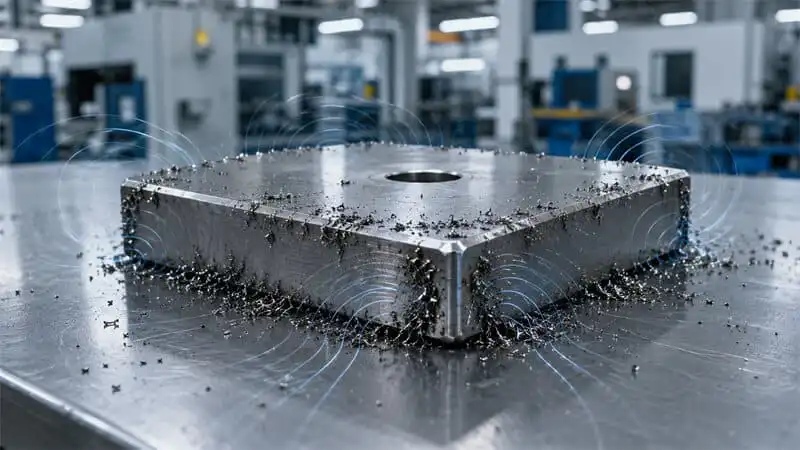
Namagnesowany przedmiot obrabiany może przyciągać wióry metalowe, pył szlifierski, małe śruby, cząstki powstające podczas skrawania lub inne zanieczyszczenia ferromagnetyczne. Cząstki te mogą pozostawać na powierzchni i utrudniać czyszczenie, obróbkę, pomiary, nakładanie powłok lub montaż.
W produkcji precyzyjnej nawet niewielki niepożądany magnetyzm może powodować problemy z jakością. Może pogarszać jakość wykończenia powierzchni, zwiększać zużycie narzędzi, zakłócać spawanie, powodować wady powłok lub zakłócać działanie urządzeń testowych.
Odmagnesowanie często wykonuje się przed następującymi procesami lub po nich:
- Obróbka mechaniczna
- Szlifowanie
- Wiercenie
- Spawanie
- Galwanizacja
- Powłoka
- Czyszczenie
- Montaż
- Badania magnetyczno-proszkowe
- Badania prądami wirowymi
- Końcowa kontrola jakości
Z tego względu rozmagnesowanie należy traktować jako proces kontroli jakości, a nie tylko jako etap wykończeniowy.
Co powoduje magnetyzm szczątkowy?
Magnetyzm szczątkowy to pole magnetyczne, które pozostaje w materiale po oddziaływaniu pola magnetycznego, prądu elektrycznego, uchwytu magnetycznego lub innego czynnika magnesującego.
Do częstych przyczyn magnetyzmu szczątkowego należą:
- Mocowanie magnetyczne podczas obróbki
- Podnoszenie i przemieszczanie za pomocą urządzeń magnetycznych
- Kontakt z magnesami trwałymi
- Wiercenie, frezowanie, toczenie, szlifowanie lub piłowanie
- Spawanie lub przepływ prądu przez część
- Hartowanie indukcyjne
- Gięcie, kształtowanie lub prasowanie
- Znakowanie laserowe
- Badania magnetyczno-proszkowe
- Przechowywanie w pobliżu silnych pól magnetycznych
- Kontakt z namagnesowanymi narzędziami lub oprzyrządowaniem
Materiały ferromagnetyczne są bardziej podatne na zachowywanie magnetyzmu szczątkowego. Należą do nich liczne stale, żeliwo, nikiel, kobalt i niektóre stopy. Niektóre stale nierdzewne wykazują znacznie słabsze właściwości magnetyczne, jednak wykonane z nich części mogą ulec namagnesowaniu w wyniku kształtowania, obróbki skrawaniem lub obróbki plastycznej na zimno.
Jakie problemy może powodować magnetyzm szczątkowy?
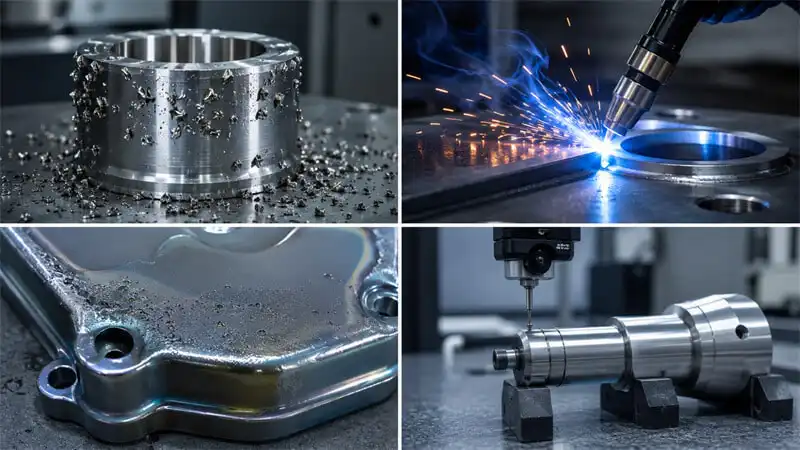
Magnetyzm szczątkowy może wpływać na więcej niż jeden etap produkcji. Detal może wyglądać prawidłowo, ale niepożądany magnetyzm nadal może powodować problemy podczas czyszczenia, spawania, pomiarów, obróbki powierzchniowej lub montażu.
| Problem | Dlaczego ma to znaczenie |
| Wióry metalowe przywierają do obrabianego przedmiotu | Wióry mogą utrudniać czyszczenie i obróbkę oraz wpływać na jakość powierzchni i montaż końcowy. |
| Pył szlifierski pozostaje na powierzchni | Drobne cząstki mogą obniżać jakość powierzchni i zwiększać nakład pracy związany z czyszczeniem. |
| Welding arc deflection | Residual magnetism can disturb the welding arc and cause unstable welds. |
| Coating or electroplating defects | Metallic particles may create contamination, uneven coating, or poor surface results. |
| Cleaning problems | Magnetic particles may remain attached after normal washing or air blowing. |
| Measurement errors | Residual fields may affect measuring devices or inspection accuracy. |
| Eddy current testing errors | Unwanted magnetic fields can interfere with non-destructive testing and create false rejection. |
| Assembly contamination | Small metal particles may remain on precision parts and affect final performance. |
| Increased tool wear | Sticking chips and particles can damage tools, surfaces, and fixtures. |
The most important point is simple: residual magnetism can create hidden quality risks. Demagnetization helps reduce those risks before they become production defects, rework, or customer complaints.
How Does the Demagnetization Process Work?
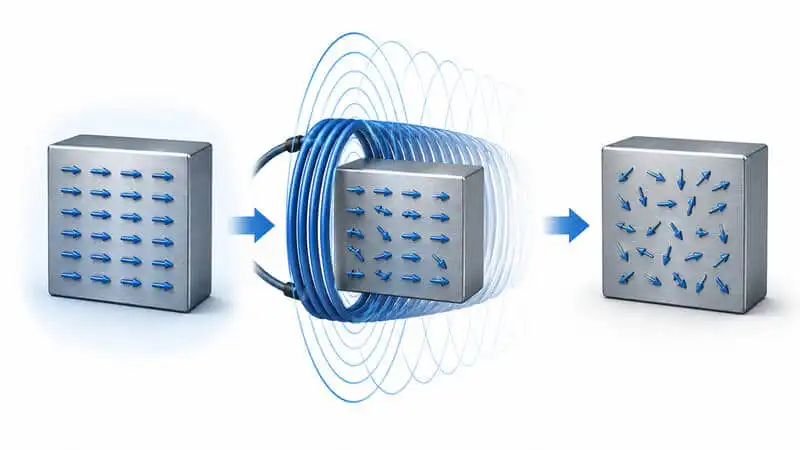
The demagnetization process usually works by exposing the part to an alternating magnetic field that gradually decreases in strength.
This alternating field changes the magnetic direction inside the material again and again. As the field becomes weaker, the magnetic domains become less aligned. The remaining magnetic field is then reduced.
A simple process looks like this:
- The workpiece contains unwanted residual magnetism.
- A demagnetizer applies an alternating magnetic field.
- The field strength gradually decreases.
- The magnetic domains become less aligned.
- The residual magnetic field becomes weaker.
- The result is checked with a magnetic field measuring device.
The final result depends on the workpiece material, size, shape, wall thickness, initial magnetization level, demagnetizer type, field strength, frequency, and process speed.
Common Demagnetization Methods
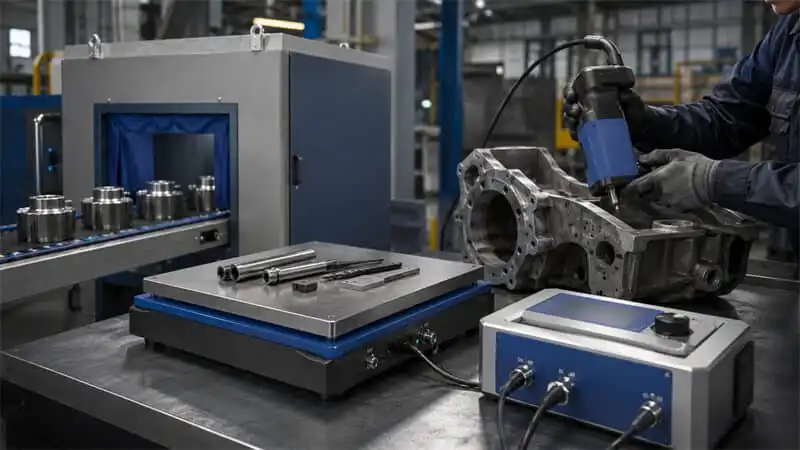
There is no single demagnetization method that fits every part. The right method depends on workpiece size, geometry, material, production volume, and the required residual magnetism limit.
Alternating Field Demagnetization
Alternating field demagnetization is one of the most common industrial methods.
The workpiece is exposed to an alternating magnetic field, and the field strength is gradually reduced. This method is widely used because it is practical for many steel workpieces, tools, machined parts, and components.
Tunnel Demagnetizers
Tunnel demagnetizers are often used in production lines.
Parts pass through a demagnetizing tunnel, usually by hand, conveyor, or roller system. This method is suitable for repeated production parts, batch processing, and workpieces with regular shapes.
Table or Plate Demagnetizers
Table demagnetizers are often used for flat parts, tools, small workpieces, or workshop applications.
The part is moved across the demagnetizing surface. This method is practical for manual workstations, machining areas, inspection areas, and repair shops.
Handheld Demagnetizers
Handheld demagnetizers are useful for large, irregular, or hard-to-move workpieces.
The operator moves the device across the workpiece surface to reduce residual magnetism. This method is flexible, but the final result depends strongly on operator technique, part geometry, and measurement after demagnetization.
Pulse Demagnetization
Pulse demagnetization uses a controlled magnetic pulse that rises and then decreases in a controlled way.
This method may be used when a more controlled demagnetizing process is needed, especially for parts with specific geometry or residual magnetism requirements.
Where Is Demagnetization Used?
Demagnetization is used in many industrial fields where residual magnetism can affect production quality, cleanliness, inspection, or final performance.
| Obszar zastosowania | Why Demagnetization Matters |
| Obróbka mechaniczna | Helps prevent chips from sticking to workpieces, tools, and fixtures. |
| Grinding and lapping | Helps reduce adhesion of fine metal particles and grinding dust. |
| Spawanie | Helps reduce arc deflection and unstable weld seams. |
| Electroplating and coating | Helps reduce particle contamination and surface defects. |
| Czyszczenie | Makes it easier to remove metallic particles from the part surface. |
| Montaż | Helps prevent small metal particles from staying on precision parts. |
| Badania prądami wirowymi | Helps reduce testing interference and false rejection. |
| Badania magnetyczno-proszkowe | Helps remove residual magnetism after inspection. |
| Precision components | Helps improve cleanliness, measurement reliability, and final quality. |
| Fasteners and screws | Helps reduce residual chips before final cleaning, packing, or assembly. |
| Automotive parts | Helps support cleaner surfaces and more reliable inspection. |
| Mold and tooling parts | Helps prevent chips, dust, and particles from sticking during processing. |
How to Check Whether Demagnetization Is Successful
A demagnetized part should be checked with a gauss meter or magnetic field measuring device. Visual inspection alone is not enough.
The acceptable residual magnetism level depends on the next process, customer specification, industry requirement, or inspection method. Some processes accept a low residual field. Others need stricter limits.
Important checking points include:
- Measure more than one area of the workpiece.
- Check edges, holes, corners, grooves, and long surfaces.
- Check both before and after demagnetization.
- Use the same measuring method for repeated comparison.
- Repeat the demagnetization process if the residual field is still too high.
- Use the customer specification or process requirement as the final standard.
Absolute zero magnetism is usually not realistic or necessary. A practical goal is to reduce residual magnetism below the level that causes production, inspection, or functional problems.
Demagnetization vs Degaussing: Are They the Same?
Demagnetization and degaussing are often used in similar ways, but the meaning depends on the industry.
In manufacturing, demagnetization usually means reducing unwanted residual magnetism in workpieces, tools, parts, or components.
Degaussing is also used to describe the reduction or removal of magnetic fields. It is common in electronics, data storage, ship magnetic signature reduction, and industrial demagnetizing applications.
For many manufacturing users, both terms point to the same practical goal: reducing unwanted magnetism so the part can move safely into the next process.
Does Demagnetization Make Steel Non-Magnetic?
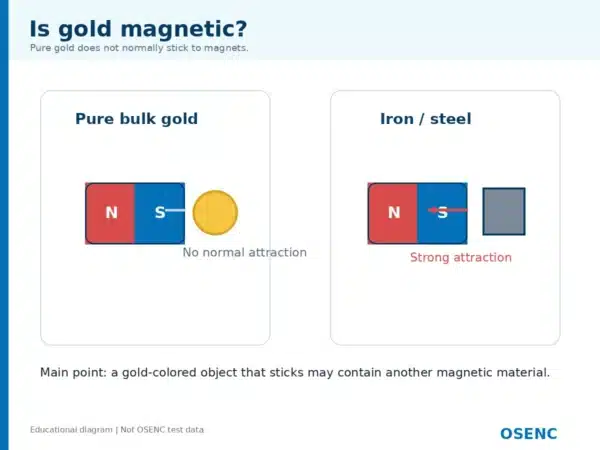
No. Demagnetization does not turn magnetic steel into non-magnetic steel.
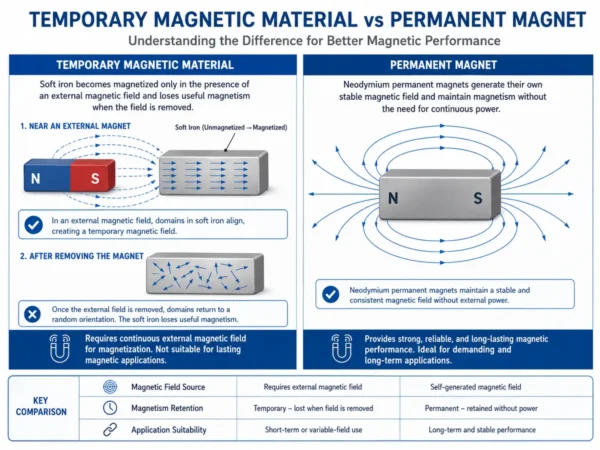
It removes or reduces the current magnetized state of the workpiece. It does not change the basic material structure. Ferritic or martensitic steel can become magnetized again if it is exposed to a magnetic field, magnetic clamping, electric current, or magnetic inspection process.
This is an important distinction. Demagnetization solves unwanted residual magnetism. It does not convert the material into a non-magnetic alloy.
Demagnetization for Workpieces vs Permanent Magnets
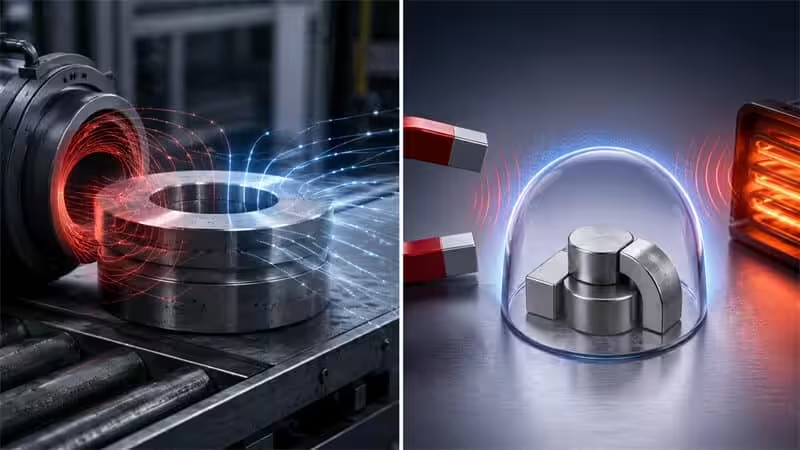
Demagnetizing a workpiece is different from demagnetizing a permanent magnet.
A magnetized steel workpiece may only have unwanted residual magnetism. The goal is usually to reduce that residual field to a safe or acceptable level.
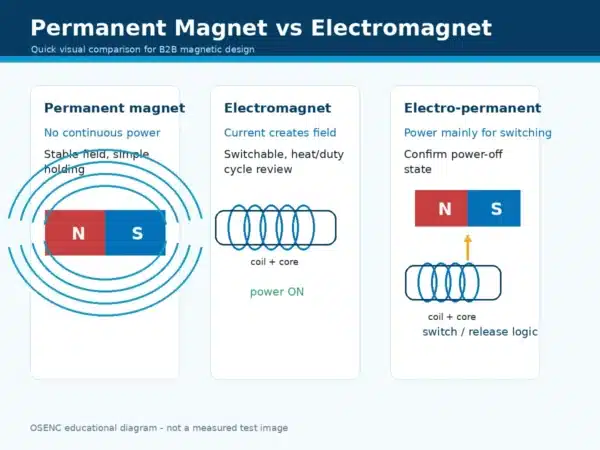
A permanent magnet is designed to keep its magnetism. For example, magnesy neodymowe are made to provide strong and stable magnetic performance. Accidentally demagnetizing a permanent magnet can reduce its holding force, field strength, or final product performance.
This difference matters in manufacturing. Workpieces may need demagnetization before welding, coating, cleaning, or inspection. Permanent magnets usually need protection from demagnetization caused by excessive heat, strong opposing magnetic fields, poor design, or incorrect handling.
W przypadku magnesy neodymowe wykonywane na zamówienie, the magnet grade, operating temperature, coating, magnetization direction, and application environment should be reviewed carefully before production.
Common Mistakes About Demagnetization
Mistake 1: Thinking Demagnetization Always Means Zero Magnetism
In most production cases, zero magnetism is not the real target. The goal is to reduce residual magnetism below the level that affects the next process or final use.
Mistake 2: Checking Only One Point on the Workpiece
Residual magnetism may not be evenly distributed. Edges, holes, corners, grooves, and long surfaces may show different readings. Several points should be checked.
Mistake 3: Using the Wrong Demagnetizer
A handheld demagnetizer may work for some large or irregular parts. A table demagnetizer may be better for flat parts. A tunnel demagnetizer may be better for production-line parts. The wrong equipment may leave residual magnetism in the part.
Mistake 4: Forgetting to Measure After Demagnetization
Demagnetization should be verified. A part may still have residual magnetism even after one pass through a demagnetizer.
Mistake 5: Treating Workpieces and Permanent Magnets the Same Way
A workpiece with residual magnetism and a permanent magnet are not the same. A workpiece may need demagnetization. A permanent magnet usually needs protection from accidental demagnetization.
How Osenc Understands Demagnetization in Magnet Manufacturing
Osenc focuses on permanent magnets, custom NdFeB magnets, and magnetic assemblies. In magnet-related projects, demagnetization must be understood carefully because the goal is not always to remove magnetism.
For steel workpieces, demagnetization is often used to reduce unwanted residual magnetism before machining, coating, cleaning, inspection, or assembly.
For permanent magnets, the focus is usually different. The goal is to maintain stable magnetic performance and avoid unwanted demagnetization caused by heat, opposing magnetic fields, poor material grade selection, or unsuitable application conditions.
Osenc can support customers with magnet material selection, magnet grade review, coating selection, magnetization direction, dimensional requirements, and magnetic assembly design. This helps reduce the risk of choosing a magnet that is strong on paper but unsuitable for the real working environment.
When Should a Workpiece Be Demagnetized?
A workpiece should be considered for demagnetization when residual magnetism may affect the next step of production or inspection.
Demagnetization is especially important before:
- Precision machining
- Final cleaning
- Spawanie
- Surface coating
- Galwanizacja
- Montaż
- Measuring
- Hardness testing
- Badania prądami wirowymi
- Packaging of precision metal parts
- Delivery to customers with residual magnetism requirements
It is also useful after magnetic particle inspection or magnetic clamping, because these processes can leave unwanted magnetism in the part.
What Information Is Needed Before Choosing a Demagnetization Method?
Before choosing a demagnetization method, several details should be reviewed:
- Workpiece material
- Workpiece size
- Wall thickness
- Shape and geometry
- Initial residual magnetism level
- Target residual magnetism limit
- Production volume
- Whether the part is flat, long, round, irregular, or assembled
- Whether the part can pass through a tunnel demagnetizer
- Whether the part must be handled manually
- Whether the next process is machining, welding, coating, cleaning, measuring, or testing
This information helps determine whether a handheld, table, tunnel, or pulse demagnetizing method is more suitable.
Najczęściej zadawane pytania
Czym jest rozmagnesowanie?
Rozmagnesowanie to proces zmniejszania lub usuwania niepożądanego magnetyzmu szczątkowego z materiału, przedmiotu obrabianego, narzędzia lub komponentu.
Dlaczego proces rozmagnesowania jest ważny?
Proces rozmagnesowania jest istotny, ponieważ magnetyzm szczątkowy może przyciągać cząstki metalu, pogarszać jakość obróbki, zakłócać spawanie, powodować wady powłok, zmniejszać skuteczność czyszczenia oraz prowadzić do błędów pomiarowych lub kontrolnych.
Czym jest magnetyzm szczątkowy?
Magnetyzm szczątkowy to pole magnetyczne, które pozostaje w materiale po poddaniu go działaniu pola magnetycznego, prądu elektrycznego, mocowania magnetycznego, obróbki mechanicznej, kontroli magnetycznej lub innego czynnika magnesującego.
Jak działa demagnetyzer?
Urządzenie do rozmagnesowywania zazwyczaj wytwarza przemienne pole magnetyczne o stopniowo malejącym natężeniu. Powoduje to zmniejszenie uporządkowania domen magnetycznych w materiale i osłabienie szczątkowego pola magnetycznego.
Czy rozmagnesowanie jest tym samym co demagnetyzacja?
W wielu zastosowaniach przemysłowych terminy „rozmagnesowanie” i „degaussing” są używane w podobnym znaczeniu. Oba oznaczają zmniejszanie niepożądanego magnetyzmu szczątkowego, choć termin „degaussing” jest również powszechnie stosowany w odniesieniu do elektroniki, nośników danych oraz redukcji sygnatury magnetycznej.
Czy po rozmagnesowaniu stal staje się niemagnetyczna?
Nie. Rozmagnesowanie usuwa lub osłabia istniejące namagnesowanie, ale nie zmienia struktury materiałowej stali. Stal ferromagnetyczna może zostać ponownie namagnesowana.
Kiedy należy rozmagnesować detale?
Elementy obrabiane należy rozmagnesować przed lub po procesach, w których magnetyzm szczątkowy może powodować problemy, takich jak obróbka skrawaniem, spawanie, nakładanie powłok, galwanizacja, czyszczenie, montaż, pomiary lub badania nieniszczące.
Jak mierzy się magnetyzm szczątkowy?
Magnetyzm szczątkowy jest zwykle mierzony miernikiem Gaussa lub urządzeniem do pomiaru pola magnetycznego. Dopuszczalna wartość graniczna zależy od wymagań procesu lub specyfikacji klienta.
Czy magnes trwały może ulec rozmagnesowaniu?
Tak. Magnes trwały może utracić część swoich właściwości magnetycznych w wyniku narażenia na nadmiernie wysoką temperaturę, silne przeciwne pola magnetyczne, uszkodzenia mechaniczne lub nieodpowiednie warunki pracy. Zwykle jest to zjawisko niepożądane, którego należy unikać w zastosowaniach magnesów.
Czy każdy przedmiot obrabiany wymaga rozmagnesowania?
Nie. Rozmagnesowanie jest konieczne, gdy magnetyzm szczątkowy może wpływać na produkcję, czyszczenie, spawanie, nakładanie powłok, pomiary, kontrolę, montaż lub użytkowanie końcowe.
Conclusion
Demagnetization is important because unwanted residual magnetism can create real production problems. It can attract metal chips, affect machining, disturb welding, reduce cleaning quality, cause coating defects, and interfere with measurement or inspection.
The key is not always to reach zero magnetism. The better goal is to reduce residual magnetism to an acceptable level for the next process or final application.
For manufacturing workpieces, demagnetization helps improve process stability and product quality. For permanent magnets, the focus is different: magnet performance should be protected from accidental demagnetization through proper grade selection, temperature review, coating choice, magnetization direction, and application design.
Need help choosing magnets for an application where magnetic performance, residual magnetism, temperature, coating, or magnetization direction matters?
Osenc can support custom neodymium magnets, magnetic assemblies, material selection, magnetization direction review, and application-based magnet design