






Przewodnik po materiałach i inżynierii
Które metale są magnetyczne?
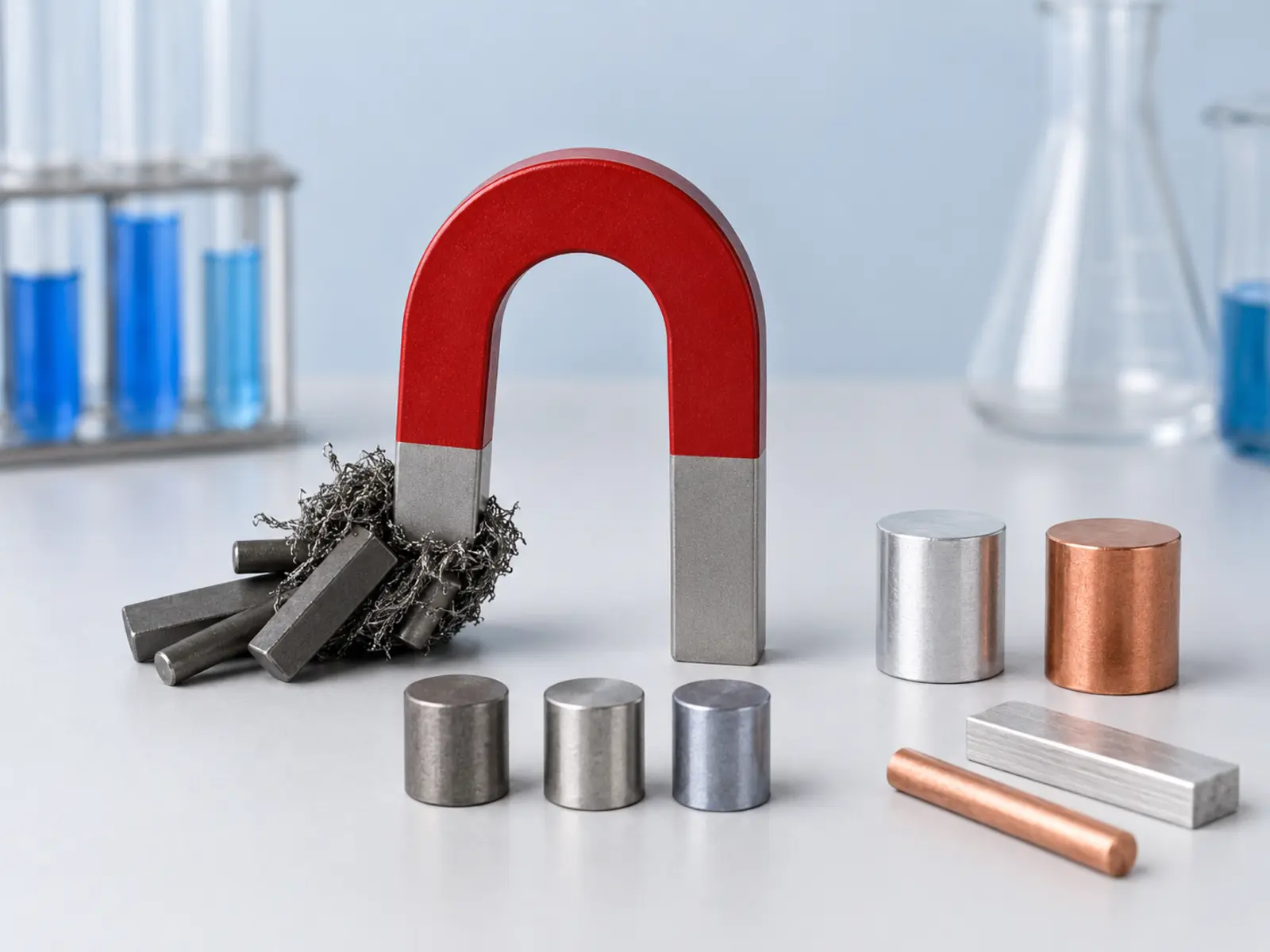
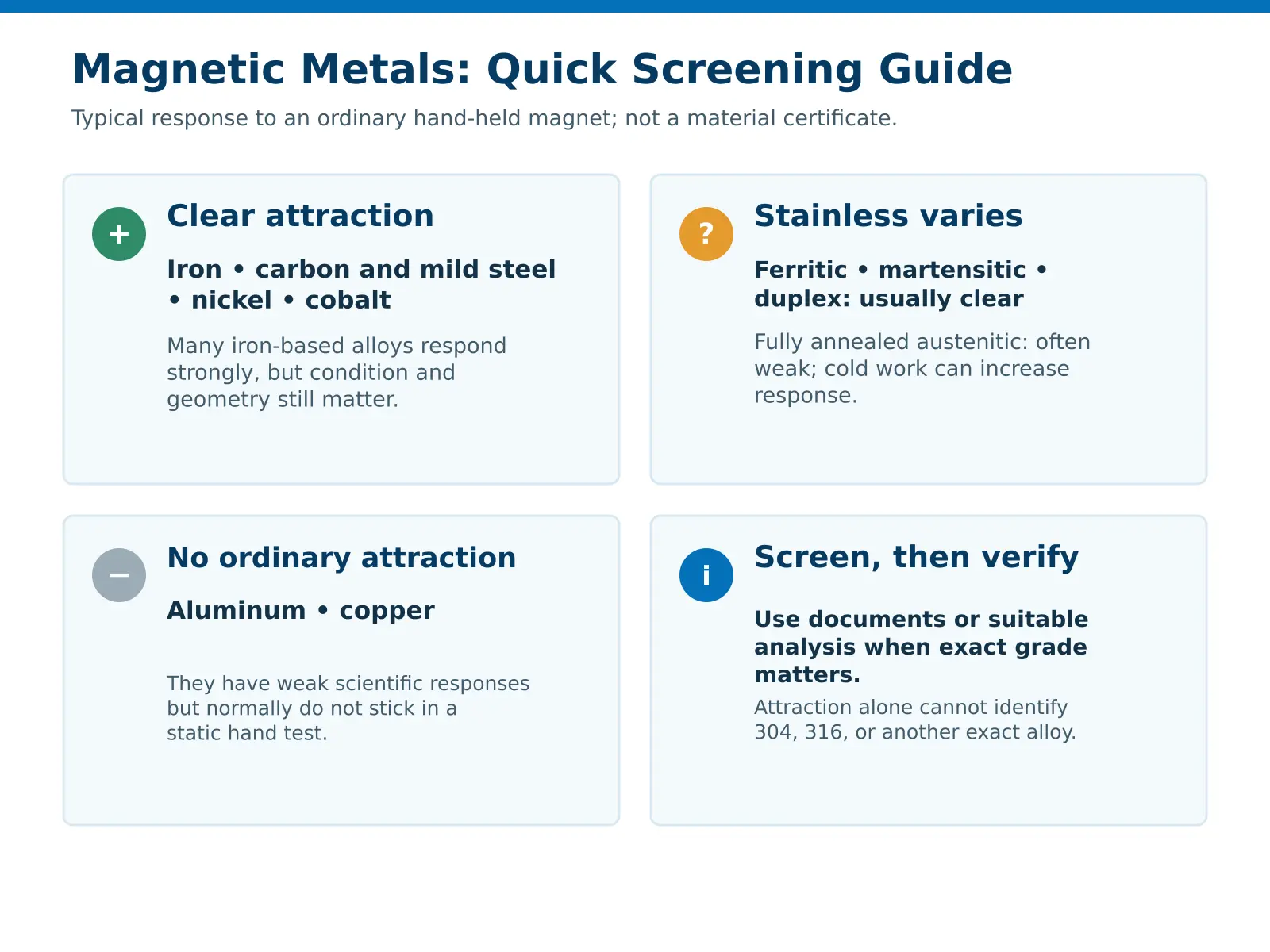
Żelazo, nikiel i kobalt to najbardziej znane metale silnie przyciągane przez magnesy. Wyraźne właściwości magnetyczne wykazuje również wiele stopów na bazie żelaza, w tym stal węglowa oraz kilka grup stali nierdzewnych.
Sama nazwa metalu nie jest jednak wystarczająca. Na wynik obserwacji mogą wpływać struktura stopu, stan po obróbce, grubość elementu, powierzchnia styku oraz sposób przeprowadzenia testu.
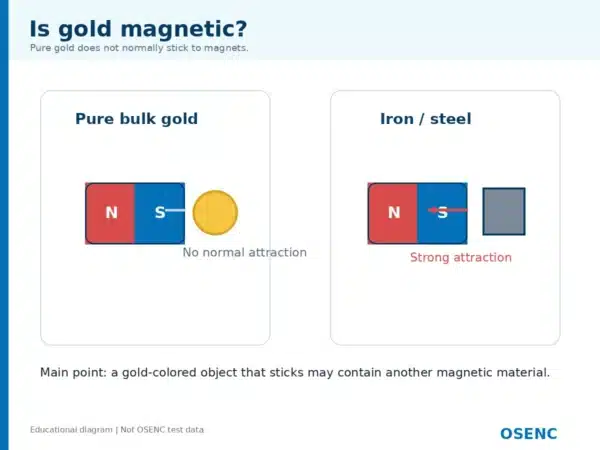
Aluminium i miedź zwykle nie są przyciągane przez zwykły magnes trwały. Z naukowego punktu widzenia reagują jednak na pola magnetyczne, lecz reakcja ta jest zbyt słaba, aby można ją było wyczuć podczas standardowego testu ręcznego.
Jakie metale są magnetyczne? Skrócona tabela porównawcza
Poniższa lista metali magnetycznych opisuje ich typową reakcję na zwykły magnes ręczny. Nadaje się do wstępnej identyfikacji, ale nie do certyfikacji materiału.
| Metal lub grupa materiałów | Czy zwykle jest przyciągany przez zwykły magnes? | Istotne zastrzeżenie |
|---|---|---|
| Żelazo | Tak, silnie | Jeden z głównych pierwiastków ferromagnetycznych |
| Stal węglowa i stal niskowęglowa | Zwykle tak | Reakcja zależy od składu, struktury, grubości i stanu materiału |
| Nikiel | Tak | Czysty nikiel jest ferromagnetyczny w zwykłych temperaturach |
| Kobalt | Tak | Czysty kobalt jest ferromagnetyczny w zwykłych temperaturach |
| Ferrytyczna stal nierdzewna | Zwykle tak | Zwykle wyraźnie reaguje na magnes trzymany w dłoni |
| Martenzytyczna stal nierdzewna | Zwykle tak | Zwykle ferromagnetyczna |
| Stal nierdzewna duplex | Zwykle tak | Zawiera fazę ferrytyczną i austenityczną |
| Austenityczna stal nierdzewna | Często wykazuje słabą lub pomijalną reakcję | Obróbka na zimno i stan materiału mogą zwiększyć jego reakcję magnetyczną |
| Aluminium | Brak zauważalnego przyciągania w zwykłych warunkach | Jest paramagnetyczne, lecz reakcja jest bardzo słaba |
| Miedź | Brak zauważalnego przyciągania w zwykłych warunkach | Jest diamagnetyczna i zwykle nie przywiera do magnesu |
Na mniejszych ekranach przesuń tabelę palcem w poziomie, aby zobaczyć wszystkie kolumny.
Ta tabela nie pozwala określić dokładnych gatunków materiału. Jeśli potwierdzenie gatunku ma znaczenie, nadal wymagana jest dokumentacja dostawcy, świadectwa materiałowe, analiza składu chemicznego lub inna odpowiednia metoda identyfikacji.
Co właściwie oznacza “magnetyczny”?
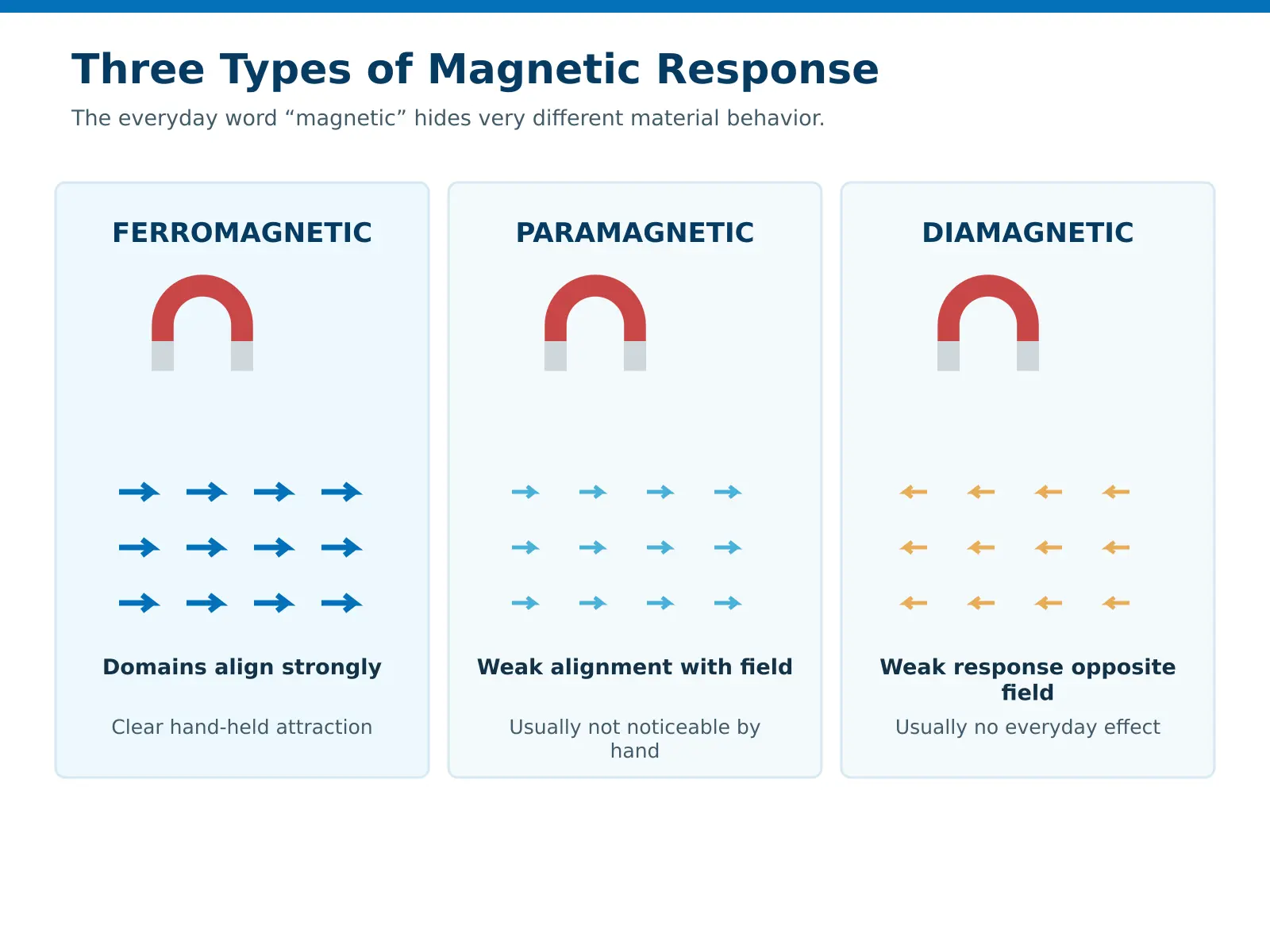
W języku potocznym metal nazywa się magnetycznym, jeśli jest przyciągany przez magnes na lodówkę lub magnes warsztatowy. W fizyce termin ten obejmuje kilka różnych sposobów reagowania materiału na pole magnetyczne.
| Termin | Znaczenie | Co zwykle można zaobserwować |
|---|---|---|
| Ferromagnetyczny | Silnie reaguje na przyłożone pole magnetyczne i zawiera domeny magnetyczne | Wyraźne przyciąganie przez magnes trzymany w dłoni |
| Paramagnetyczny | Słabo reaguje w kierunku przyłożonego pola magnetycznego | Zwykle brak zauważalnego przyciągania przez magnes trzymany w dłoni |
| Diamagnetyczny | Wykazuje bardzo słabą reakcję przeciwną do przyłożonego pola magnetycznego | Zwykle nie wywołuje zauważalnego efektu w codziennych warunkach |
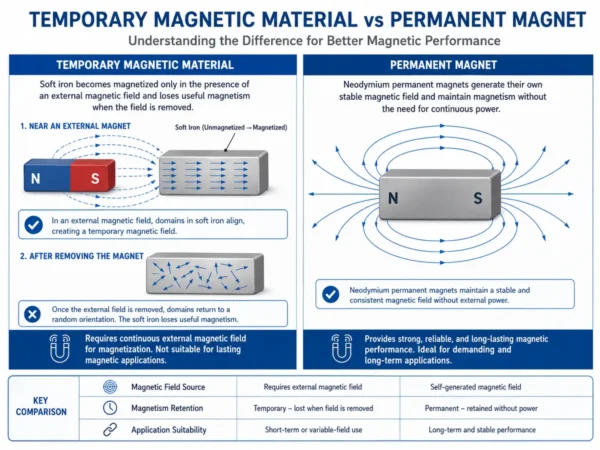
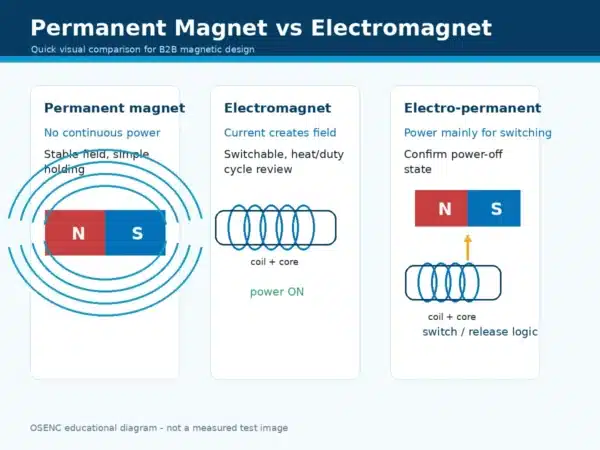
| Magnes trwały | Zachowuje użyteczne namagnesowanie i wytwarza zewnętrzne pole magnetyczne | Może przyciągać odpowiednie materiały ferromagnetyczne |
Na mniejszych ekranach przesuń tabelę palcem w poziomie, aby zobaczyć wszystkie kolumny.
Fizyka uniwersytecka OpenStax klasyfikuje materiały według ich reakcji ferromagnetycznej, paramagnetycznej i diamagnetycznej. Aluminium zalicza do paramagnetyków, a miedź do diamagnetyków, wyjaśniając przy tym, dlaczego te słabe reakcje znacznie różnią się od przyciągania ferromagnetycznego.
W zastosowaniach inżynierskich należy precyzyjnie określić wymaganie. Projekt może wymagać:
- Elementu docelowego, który może być przyciągany przez magnes.
- Materiału, który można namagnesować.
- Magnesu trwałego, który wytwarza użyteczne pole magnetyczne.
- Kompletnego obwodu magnetycznego zapewniającego wymaganą siłę w odległości roboczej.
Wymagania te są ze sobą powiązane, ale nie można ich traktować zamiennie.
Dlaczego żelazo, nikiel, kobalt i wiele gatunków stali jest przyciąganych przez magnesy?
Materiały ferromagnetyczne zawierają domeny magnetyczne, które mogą silnie reagować na zewnętrzne pole magnetyczne. Dlatego nawet nienamagnesowany element stalowy może być przyciągany przez magnes trwały.
Żelazo, nikiel i kobalt to najbardziej znane metale ferromagnetyczne w typowych zagadnieniach inżynierskich. Wiele stopów na bazie żelaza również wykazuje właściwości ferromagnetyczne, jednak istotne pozostają skład chemiczny stopu i mikrostruktura.
It is therefore unsafe to assume that every alloy containing iron, nickel, or cobalt will behave the same way. The finished material condition must be considered.
Are All Steels and Stainless Steels Magnetic?
No. Many steels are attracted to magnets, but not every steel or stainless steel grade produces the same response.
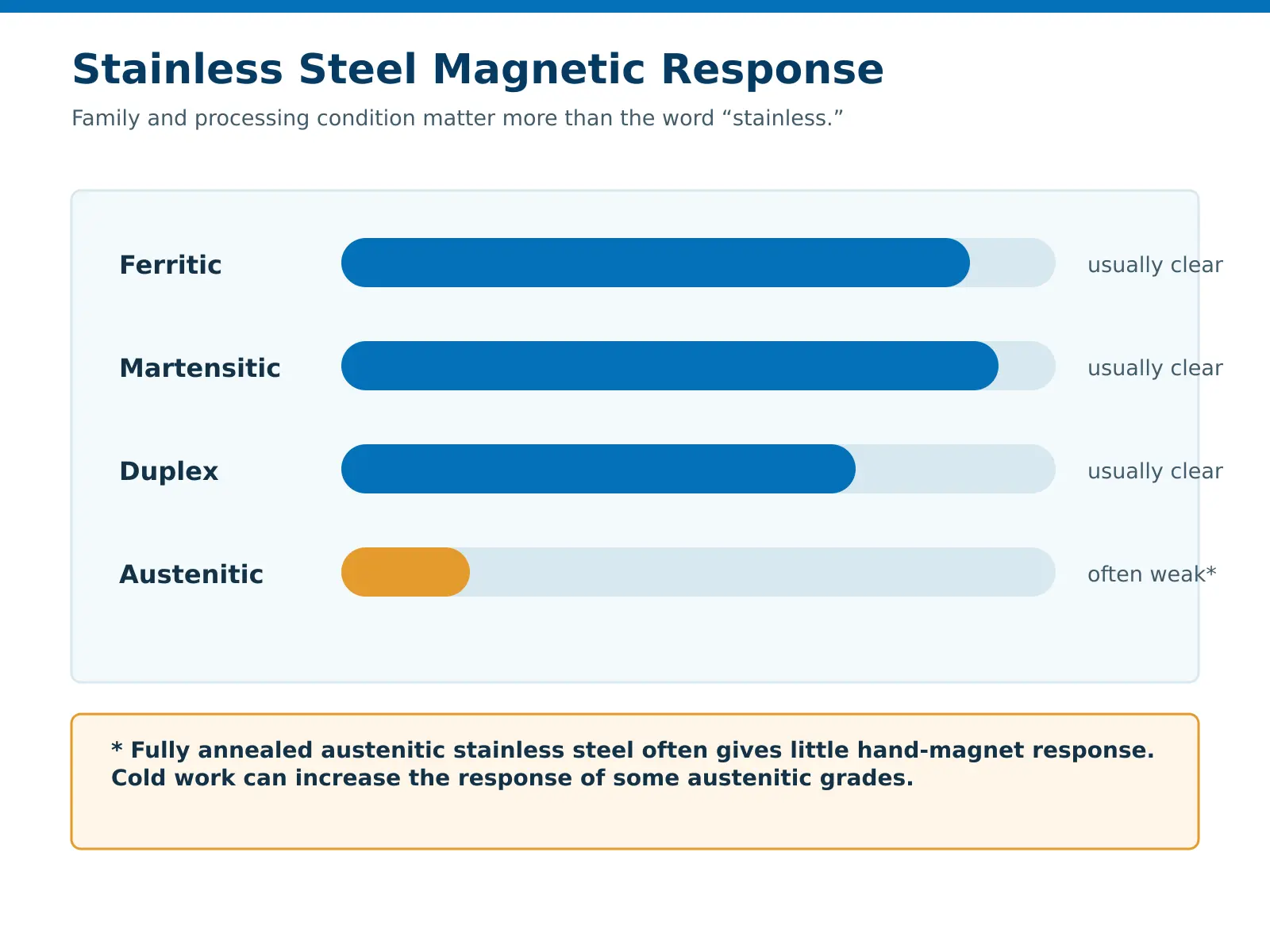
Carbon and mild steels usually respond clearly. Stainless steel is more complicated because its magnetic behavior depends mainly on its metallurgical structure and processing condition.
Dokument Brytyjskie Stowarzyszenie Stali Nierdzewnej explains that ferritic, martensitic, duplex, and most precipitation-hardening stainless steels normally show a strong response to a hand-held magnet. Austenitic stainless steels usually show little response when fully annealed.
Cold work can increase the magnetic response of some austenitic stainless steels. Composition and heat-treatment condition also matter. See the BSSA guidance on the effect of cold work and heat treatment.
This leads to two practical rules:
- A stainless steel part sticking to a magnet does not prove its exact grade.
- A weak response does not automatically prove that the part is 304 or 316 stainless steel.
Welded or heavily machined areas should be evaluated according to their actual composition and processing history rather than a general rule.
Which Metals Do Not Normally Stick to a Magnet?
Aluminum and copper do not normally show noticeable attraction in a static hand-held magnet test.
Aluminum is paramagnetic, which means it responds weakly in the direction of an applied field. Copper is diamagnetic, which means its weak induced response opposes the applied field. Neither effect normally produces useful holding force with an ordinary permanent magnet.
Aluminum can interact with changing magnetic fields through other physical effects. That is different from ordinary static attraction and belongs in a dedicated discussion of aluminum and magnets.
A plated or painted part may also give a misleading result. A thin outer layer may hide steel, a steel insert, or another ferromagnetic component underneath.
Can You Identify a Metal with a Magnet Test?
A magnet test is useful for quick screening, but it cannot identify an exact alloy.
Use the same small test magnet, similar contact conditions, and known reference samples when comparing parts. Dirt, coatings, curvature, thickness, and hidden inserts can change the result.
| Test result | What it may indicate | What it does not prove |
|---|---|---|
| Silne przyciąganie | A ferromagnetic material or hidden ferromagnetic component may be present | Exact alloy or grade |
| Weak attraction | Austenitic stainless steel affected by processing, a thin ferromagnetic section, or another mixed structure | A specific stainless grade |
| No noticeable attraction | The part may be aluminum, copper, annealed austenitic stainless steel, or another weak-response material | Exact composition |
| Different responses across one part | Mixed materials, inserts, weld areas, coatings, or different processing conditions may be present | The cause without further inspection |
Na mniejszych ekranach przesuń tabelę palcem w poziomie, aby zobaczyć wszystkie kolumny.
What Should a Magnet Test Be Used For?
| Use a magnet test for | Do not use it for |
|---|---|
| Preliminary material screening | Exact alloy certification |
| Finding obvious ferromagnetic parts | Confirming 304 versus 316 |
| Detecting a possible hidden steel insert | Approving safety-critical material |
| Comparing samples under consistent conditions | Predicting final assembly holding force |
Use the test as a screening step, not as acceptance evidence for a production specification.

Why Can Magnetic Attraction Change in a Real Assembly?
Knowing that a target metal is ferromagnetic does not tell you how much force a finished assembly will provide.
For buyers, the practical question is:
Can this target material, at its actual thickness and working gap, provide enough usable force in the final assembly?
| Assembly factor | Dlaczego jest to istotne | Information to provide |
|---|---|---|
| Target material and condition | Different steels and structures respond differently | Grade, family, certificate, or sample |
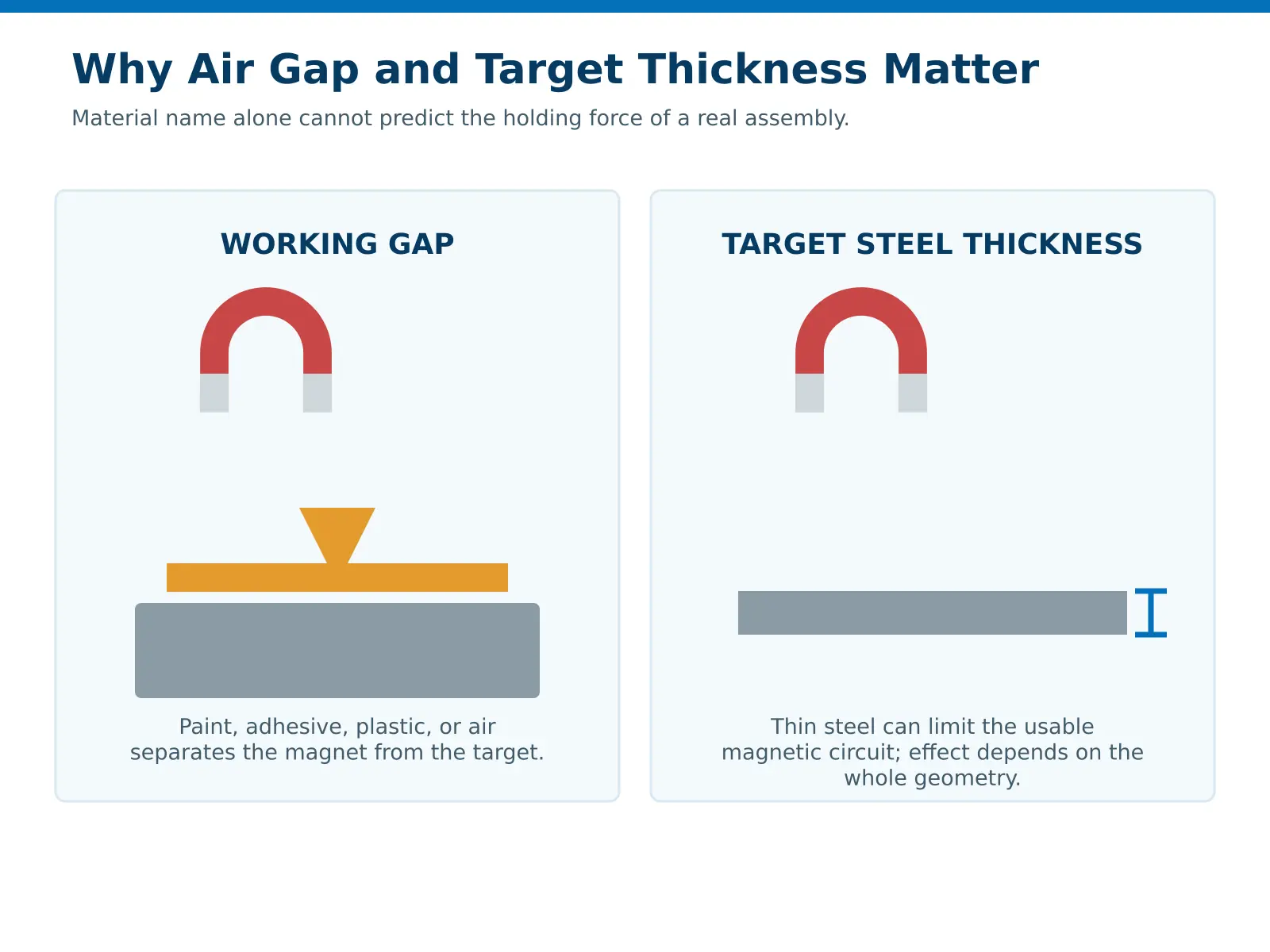
| Target thickness | Thin steel may limit the usable magnetic circuit | Actual thickness and available target area |
| Working gap | Air, paint, adhesive, plastic, and coatings separate the magnet from the target | Total nonmagnetic gap |
| Surface flatness | Curved, rough, rusty, or uneven surfaces reduce effective contact | Surface drawing or sample |
| Magnet geometry | Diameter, length, thickness, and pole area affect field distribution | Available installation space |
| Kierunek magnesowania | The pole orientation must match the working face | Required working face and assembly orientation |
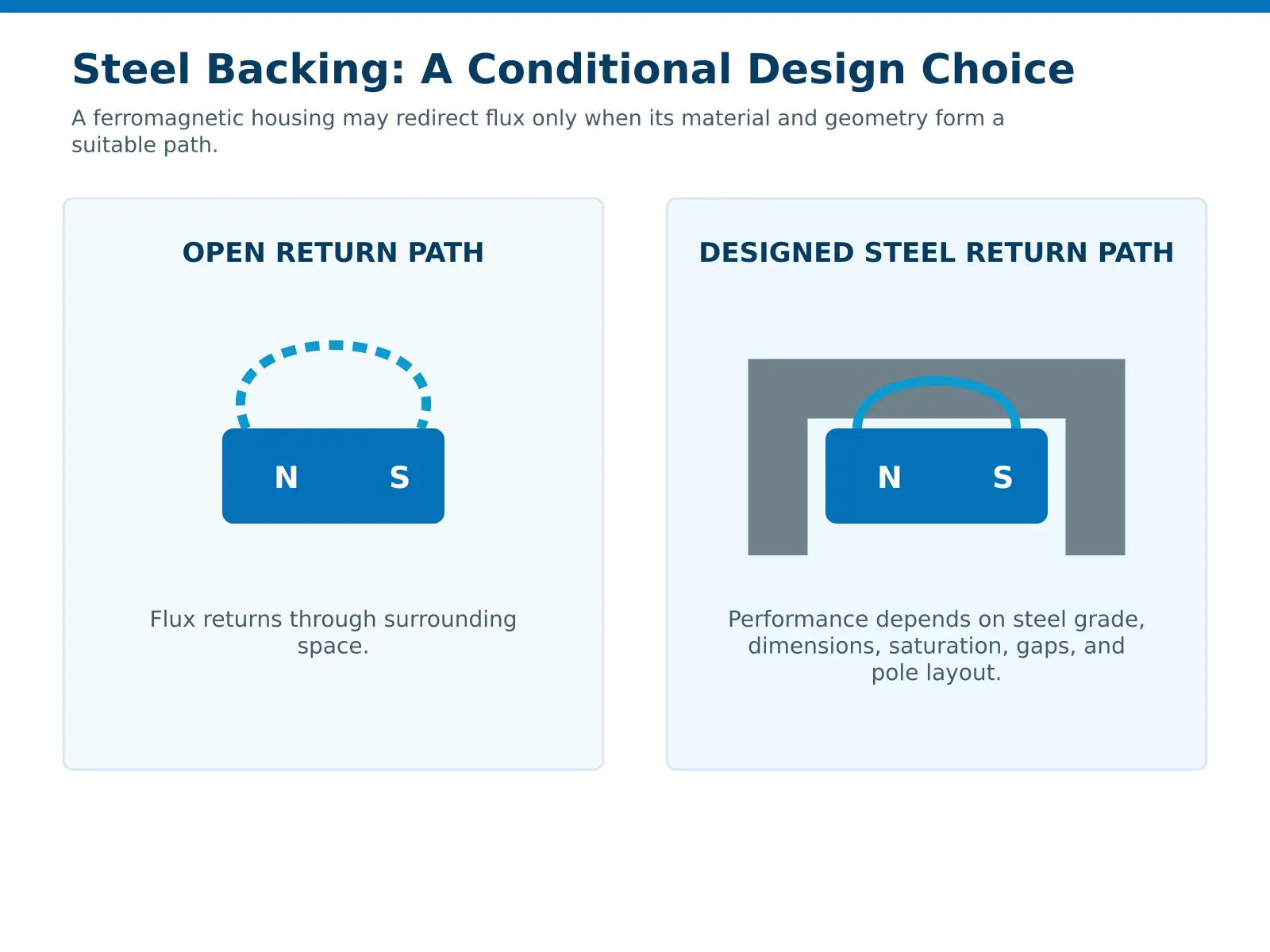
| Steel backing or housing | A properly designed ferromagnetic structure may redirect flux | Housing material, dimensions, and layout |
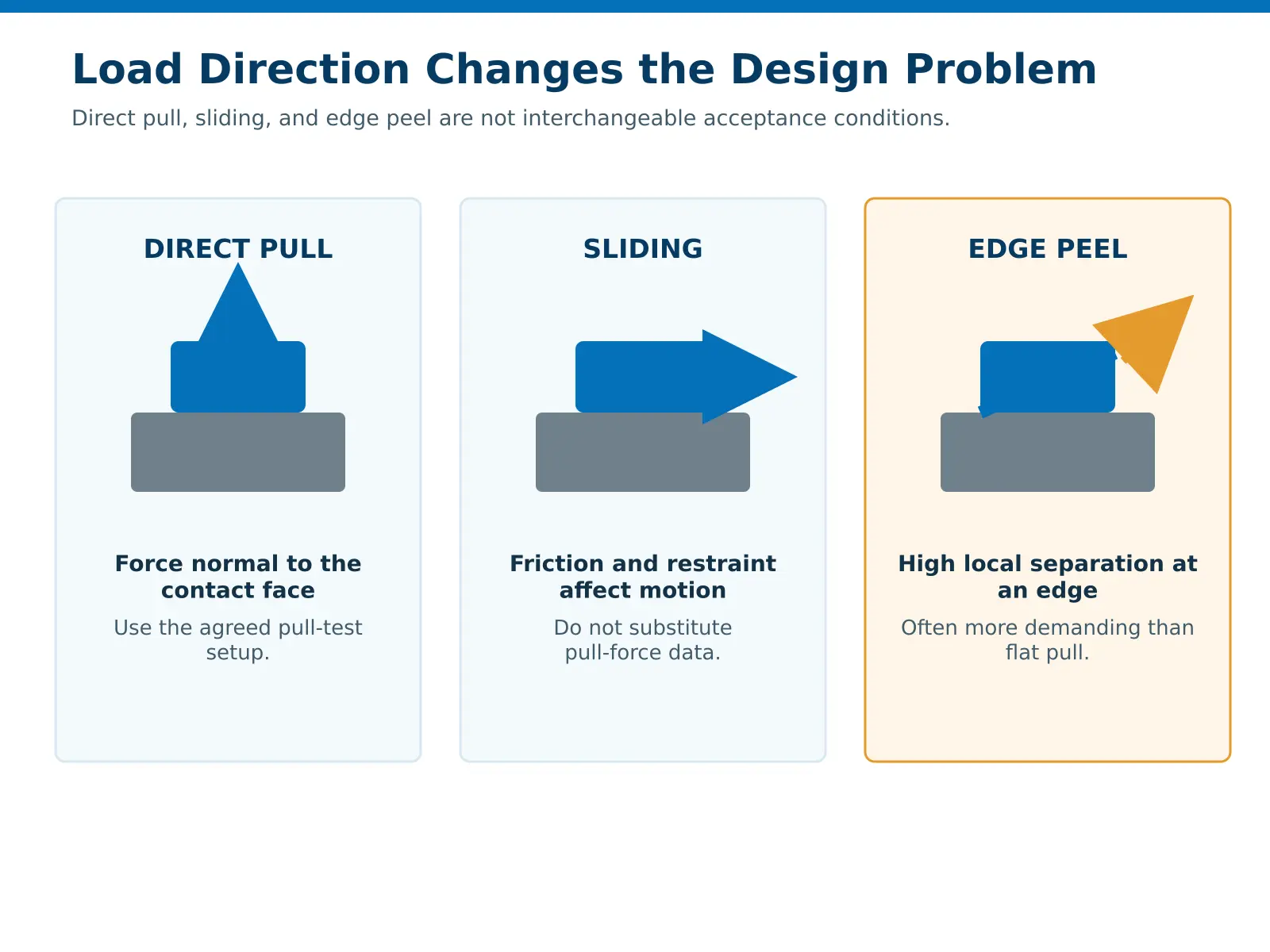
| Kierunek obciążenia | Direct pull, sliding, and edge peel create different demands | Load direction and mounting position |
| Operating conditions | Temperature, vibration, impact, and corrosion can affect suitability | Actual service environment |
| Acceptance method | Supplier pull-force values may use different test conditions | Required test setup and pass criteria |
Na mniejszych ekranach przesuń tabelę palcem w poziomie, aby zobaczyć wszystkie kolumny.
A coating, air gap, or uneven surface can reduce usable pull force. Thin target steel may also limit performance, but the effect depends on magnet geometry, target material, and the complete magnetic circuit.
Specialist test guidance shows that steel thickness and contact conditions can materially change pull force. It also warns that calculated or catalog values should not replace application testing. See the K&J Magnetics steel-thickness guidance.
A properly designed ferromagnetic backing or housing can direct more magnetic flux toward a working face. This is not automatic; the geometry and material must form a suitable magnetic circuit.
A magnet that performs well in direct pull may behave differently under sliding or edge-peel loading. Sliding resistance also depends on friction, surface condition, and mechanical restraint.
What Should You Provide for a Magnetic Holding or Separation Project?
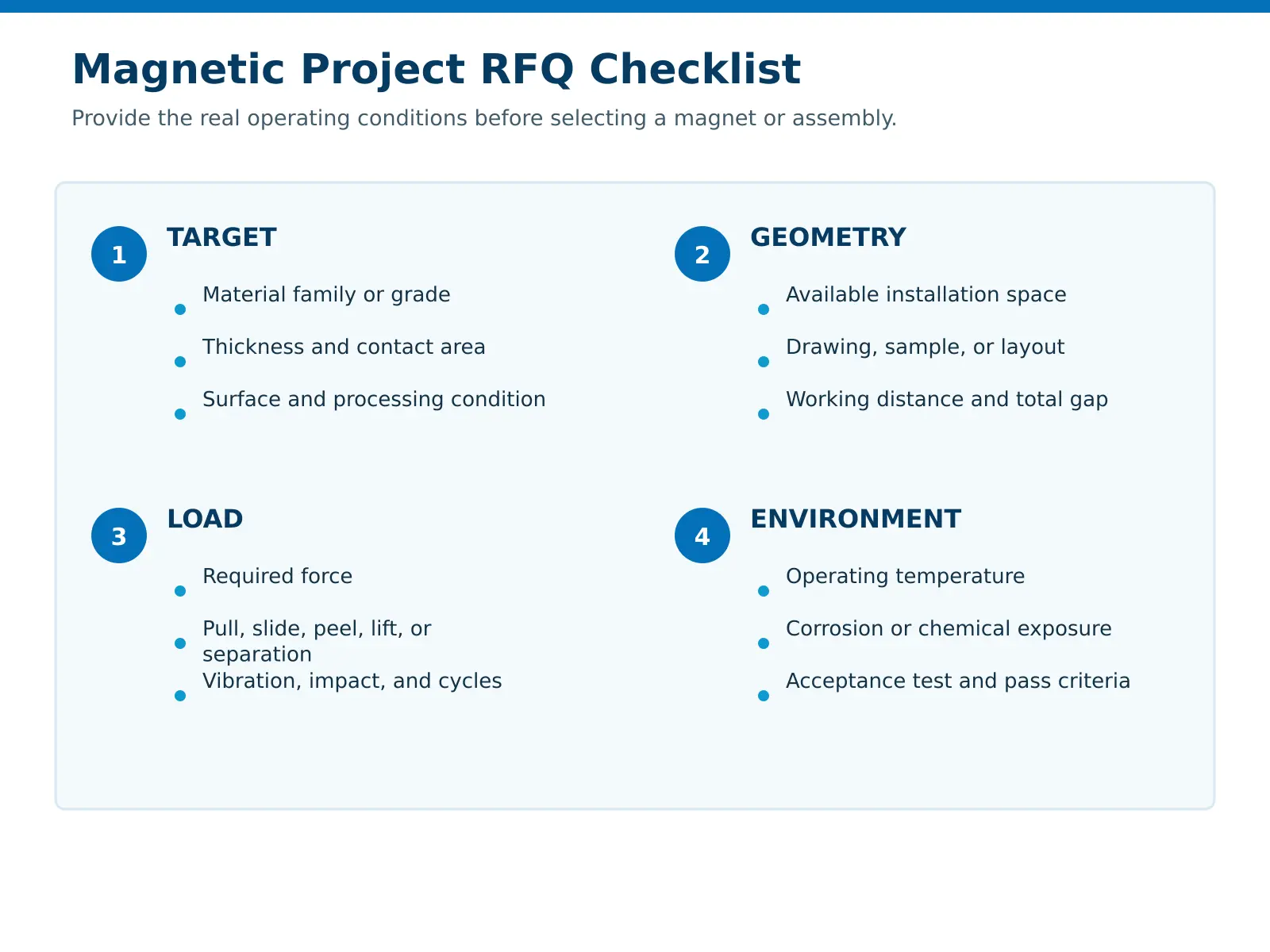
Provide the following information before selecting a magnet or magnetic assembly:
- Target material family and grade, if known.
- Material condition or processing history.
- Target thickness and available contact area.
- Coatings, paint, adhesive, plastic, or other working gaps.
- Surface shape, flatness, roughness, and corrosion condition.
- Available space for the magnet and housing.
- Required working distance.
- Required force and load direction.
- Whether the load is direct pull, sliding, peel, lifting, or separation.
- Operating temperature and environmental exposure.
- Vibration, impact, movement, or repeated-cycle requirements.
- Drawing, sample, sketch, or assembly layout.
- Required validation method and acceptance conditions.
For magnetic separation, also provide the material flow, contamination type, expected particle size, working distance, and cleaning method. A magnetic drum separator or another magnetic structure must be evaluated against the real process rather than selected only by magnet grade.
When Is a Custom Magnet or Magnetic Assembly Review Needed?
A simple hand-held test may be enough for basic material screening. It is not enough when the project has a defined holding force, limited space, a working gap, thin target steel, unusual load direction, or a complex steel housing.
Osenc can review drawings, samples, sketches, and application requirements for magnesy neodymowe wykonywane na zamówienie and magnetic assemblies. The review may consider magnet geometry, grade, magnetization direction, coating, target material, working gap, and magnetic-circuit structure.
A higher magnet grade is not automatically the correct solution. Geometry, target material, available pole area, temperature, assembly design, cost, and validation requirements must be considered together.
Projects can also begin with suitable neodymium magnet samples or prototypes before moving to batch production. Actual force must be validated under agreed test conditions.
Najczęściej zadawane pytania
Jakie są trzy najczęściej spotykane metale magnetyczne?
Żelazo, nikiel i kobalt to trzy najbardziej znane metale ferromagnetyczne powszechnie stosowane w technice. Wiele stopów opartych na tych pierwiastkach również może wykazywać właściwości magnetyczne, jednak ich zachowanie zależy od składu i struktury.
Czy stal jest magnetyczna?
Większość stali węglowych i niskowęglowych jest wyraźnie przyciągana przez magnesy. Natomiast właściwości magnetyczne stali nierdzewnej zależą od jej grupy oraz stanu po obróbce.
Czy stal nierdzewna jest magnetyczna?
Niektóre stale nierdzewne są magnetyczne, natomiast inne wykazują niewielkie przyciąganie magnetyczne. Stale nierdzewne ferrytyczne, martenzytyczne i duplex są zwykle magnetyczne, podczas gdy całkowicie wyżarzone stale nierdzewne austenityczne często reagują słabo.
Czy aluminium jest magnetyczne?
Aluminium jest paramagnetykiem, ale zwykle nie przywiera do typowego magnesu trwałego. Jego reakcja magnetyczna jest zbyt słaba, aby można ją było wyczuć w standardowej próbie statycznej.
Czy miedź jest magnetyczna?
Miedź jest diamagnetykiem i w normalnych warunkach nie jest przyciągana przez magnes. Wyraźne przyciąganie może wskazywać na obecność stalowej wkładki, zanieczyszczenia, powłoki galwanicznej lub innego materiału w danym elemencie.
Czy test magnetyczny pozwala zidentyfikować gatunek metalu?
Nie. Może rozdzielać materiały na podstawie ich ogólnej reakcji magnetycznej, ale nie pozwala wiarygodnie potwierdzić konkretnego stopu ani gatunku stali nierdzewnej.
Czy silniejsze przyciąganie oznacza, że metal zawiera więcej żelaza?
Niekoniecznie. Przyciąganie zależy od mikrostruktury, składu, docelowej grubości, warunków procesu, geometrii magnesu i konfiguracji stanowiska testowego.
Czy metal magnetyczny może zagwarantować dużą siłę trzymania?
Nie. Materiał przyciągany przez magnes stanowi tylko jeden z elementów obwodu magnetycznego. Na użyteczną siłę wpływają również szczelina robocza, grubość przyciąganego elementu, stan powierzchni, geometria magnesu, obudowa i kierunek obciążenia.
Discuss Your Magnetic Application with Osenc
Selecting a magnetic target material is only the first step. The final design must work with the actual target thickness, gap, surface, load direction, available space, and operating conditions.
Osenc can review your drawing, sample, or application requirements before sample validation. The goal is to match the magnet and magnetic circuit to the real application rather than selecting a magnet only by grade.
Contact Osenc with the target material, drawing, working distance, required force, load direction, and operating environment.
Request an Engineering Review