






A ring magnet (you’ll also hear “donut magnet,” “annular magnet,” or “magnetic ring”) is basically a washer-shaped permanent magnet—round on the outside with a hole through the center. That hole is what makes it so useful: you can slip it onto a shaft, rod, or screw and keep everything centered, which is exactly why ring magnets show up so often in motors, encoders, and magnetic couplings.
One quick note from production work: people often assume a “stronger grade” automatically means a stronger hold. In real builds, grade is a filter—not the finish line. Geometry, air gap, coating thickness, and the steel surface condition often decide the final result. I start with grade, then validate holding force using the same steel, spacing, and mounting condition the product will actually see.
Quick Answer — How to Spec a Ring Magnet (Grade, Heat, and Real Holding Force)
For neodymium ring magnets (NdFeB), grade (N35/N42/N52) is mainly a material-strength label ((BH)max, MGOe)—useful, but not the final word on real holding force. But real pull force is usually controlled by air gap, contact area, and the steel target—more than by one grade step.
If heat is involved, suffix grades like H/SH/UH/EH/AH matter because they reduce irreversible demagnetization. In my experience, temperature is the #1 reason “good bench results” fail after installation (motors, enclosed housings, heat-soak).
Czym różni się magnes pierścieniowy i kiedy jest lepszy od magnesu krążkowego
Najprościej wyobrazić sobie magnes pierścieniowy jako magnes krążkowy z centralnym otworem, umożliwiającym dokładniejszy montaż i powtarzalne ustawienie. Innymi słowy jest to okrągły magnes o określonej średnicy wewnętrznej (ID), przeznaczony do montażu i pozycjonowania — dlatego nazywa się go również pierścieniem magnetycznym lub magnesem obrączkowym.
Otwór ten zmienia sposób montażu, ustawiania i stabilizacji magnesu w zespołach obrotowych. W porównaniu z pełnym magnesem krążkowym kształt pierścieniowy zwykle zapewnia:
- Praktyczne możliwości montażu bez konstrukcji wymagających dużej ilości kleju
- Łatwiejszy montaż (na wałach, prętach i śrubach)
- Dokładniejsze ustawienie części obrotowych (silników, enkoderów i sprzęgieł)
Magnesy pierścieniowe wykonuje się z następujących materiałów:
- NdFeB (neodym) dla uzyskania najwyższego stosunku właściwości magnetycznych do wymiarów
- Ferryt (materiał ceramiczny) ze względu na niższy koszt i większą odporność na korozję
- SmCo (samar-kobalt) w celu zapewnienia większej stabilności w podwyższonej temperaturze w wymagających warunkach
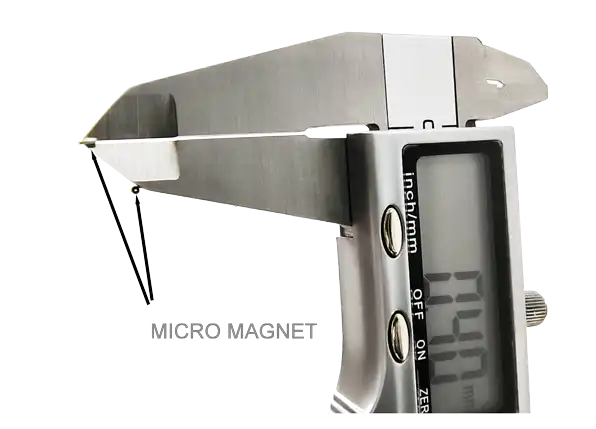
Mikropierścieniowy magnes (małe magnesy pierścieniowe)
Mikropierścieniowe magnesy to po prostu niewielkie magnesy w kształcie pierścienia — ich średnica zewnętrzna często wynosi od zaledwie kilku milimetrów do kilku centymetrów. Są powszechnie stosowane w kompaktowych zespołach, w których istotne jest precyzyjne ustawienie (małe silniki, czujniki, słuchawki douszne, precyzyjne przyrządy montażowe). Przy mikrowymiarach tolerancja i grubość powłoki stają się “rzeczywistą szczeliną powietrzną”,” dlatego zawsze należy potwierdzić średnicę zewnętrzną i wewnętrzną, rodzaj powłoki oraz rzeczywisty odstęp w zmontowanym układzie.
Najważniejsze parametry magnesów pierścieniowych (materiał, wymiary, klasa i powłoka)
W ten sposób wyjaśniam nabywcom dobór magnesów pierścieniowych — i tak w praktyce ustalam ostateczną specyfikację w rzeczywistych projektach. Zachowanie tej kolejności pozwala uniknąć najczęstszego problemu: “na stanowisku testowym działało, ale po zamontowaniu przestało”.
1) Zacznij od warunków pracy (pozwoli to szybko określić materiał i klasę temperaturową)
Zanim rozważysz wybór między N42 a N52, odpowiedz na dwa pytania: Czy magnes będzie narażony na działanie wysokiej temperatury? oraz Czy magnes będzie narażony na wilgoć lub korozję?
- Narażenie na wysoką temperaturę: Jeśli magnes znajduje się w pobliżu silnika, wewnątrz zamkniętej obudowy lub w innym miejscu, w którym z czasem kumuluje się ciepło, główną przyczyną awarii jest zwykle temperatura. Standardowy NdFeB zazwyczaj sprawdza się do około 80 °C, ale rzeczywiste zespoły mogą nagrzewać się bardziej, niż można oczekiwać. W razie wątpliwości wybierz temperature grade (H/SH/UH…) and validate with a sample.
- Corrosion exposure: NdFeB is strong but more corrosion-sensitive. If you have humidity, salt air, water splash, or chemicals, coating and sealing matter more than chasing the highest grade.
2) Lock the geometry (OD × ID × thickness) before you talk about “strength”
Ring magnets are all about fit and field reach. I always confirm three dimensions early:
- OD (outer diameter): sets contact area and how much steel you can “grab.”
- ID (inner diameter): must match the shaft/fastener clearance and tolerance.
- Thickness: strongly affects field reach. If you need more pull at a distance, thickness often helps more than a small grade upgrade.
Real-world reminder: If your design includes paint, tape, epoxy, rubber, or a plastic cover, you already have an air gap. Even 0.2–1.0 mm can erase the advantage of upgrading grade.
3) Choose magnetization direction (axial vs diametric)
This is one of the most common “it feels weak” root causes. Pick axial if your steel target/sensor approaches the face; consider diametric if it reads from the side. (I explain the field direction and what it looks like in the “Magnetic Field” section below.)
- Axial magnetization (most common): poles on the flat faces. Best when your steel target or working surface is facing the magnet. Typical for motors, speakers, and many holding setups.
- Magnesowanie średnicowe: poles on opposite curved sides. Best for side-reading sensors, many encoders, and certain coupling designs.
Quick rule I use: if your sensor or target approaches the face, start axial; if it approaches the side, consider diametric.
4) Pick the grade (and temperature grade) using a practical “cost vs benefit” rule
Now you’re ready for grade—because you already know the fit, the air gap, and the direction.
- N42 is usually the best all-around choice for many ring magnet designs (good strength, reasonable cost, stable supply).
- N52 is best when space is truly tight and you can’t increase volume.
- If heat is involved, don’t “upgrade to N52” first—upgrade the temperature grade:
- H / SH / UH / EH / AH are used to reduce irreversible demagnetization at higher temperatures.
Practical decision tip: If you can increase OD/thickness a little, a slightly larger N42 often beats a tiny N52 in real builds (especially when there’s an air gap).
- H / SH / UH / EH / AH are used to reduce irreversible demagnetization at higher temperatures.
5) Choose the coating (for NdFeB, coating is part of performance—not just appearance)
For neodymium ring magnets, coating isn’t optional in many environments. It affects corrosion resistance and adds a small but real spacing layer. Common options:
- NiCuNi (nickel): common, good general protection for indoor/dry use.
- Epoxy: better for moisture exposure, but can chip if abused; thickness can add to air gap.
- Zn / phosphate / others: used for specific cost or environment needs.
If the magnet will see water, salt air, or chemicals, ask about sealing and handling—not just the coating name.
6) Confirm the test conditions (this is how you avoid surprises after installation)
Before you approve a spec, confirm how “pull force” or “holding force” was measured. I always ask for:
- Steel plate thickness oraz material
- Surface condition (clean vs painted/rough)
- Air gap used in testing (0 mm vs 0.2 / 0.5 / 1.0 mm changes everything)
- Pull direction (vertical pull vs shear/slide)
If a supplier can’t tell you the test setup, the number is hard to trust. The same ring magnet can look “strong” or “weak” depending on how it’s tested.
My 30-Second Ring Magnet Spec Checklist (What I confirm before placing an order)
- OD × ID × thickness: Will it physically fit, and is thickness enough for your working distance?
- Material: NdFeB (compact strength) vs ferrite (cost/corrosion) vs SmCo (high heat stability).
- Grade + temp suffix: N42/N52 for strength, H/SH/UH/EH/AH if heat is involved.
- Magnetization: Axial (face-reading) vs diametric (side-reading) based on your sensor/steel position.
- Coating/sealing: Nickel for dry indoor use; epoxy or better sealing if moisture/salt is present.
- Pull-force test setup: Steel thickness + surface finish + air gap + pull direction (pull vs shear).
Ring Magnet Uses (Real-World Examples + Why the Ring Shape Helps)
Ring magnet uses are pretty practical: the shape makes mounting and alignment easy, especially when something needs to rotate or stay centered. That’s why you’ll see the same ring-shaped magnet show up across motors, sensors, speakers, and couplings.
Here are the most common applications I see in real projects:
- Motors and generators (stable rotation and compact rotor designs)
- Sensors and encoders (easy shaft mounting + consistent alignment)
- Speakers and audio drivers (works with a voice coil to create sound)
- Sprzęgła magnetyczne (contactless torque transfer in pumps and mixers)
- Lab equipment (magnetic stirring and positioning setups)
- Industrial separation (when ring geometry fits the mechanical layout better than blocks/discs)
If you’re choosing between a ring magnet and a disc magnet, the better question isn’t “which is stronger?” It’s “which shape mounts cleanly and stays aligned under real use?”
Magnetic Field of a Ring Magnet (Axial vs Diametric)
When you’re looking at the magnetic field of a ring magnet, the real question is: where are the poles, and where is your sensor or steel target sitting? Once you know whether the field needs to be “face-on” or “side-on,” the magnetization choice becomes straightforward.
Axial Magnetization (Most Common)
With axial magnetization, the north and south poles are on the two flat faces. The field concentrates along the center axis, which is why axially magnetized ring magnets are common in motors, sensors, and speakers.
Diametric Magnetization (Side-to-Side Field)
With diametric magnetization, the poles sit on opposite curved sides of the ring. The field runs across the diameter, creating a “sideways” effect useful for rotary encoders and some coupling designs.
Field Strength Distribution (Where It’s Strongest)
A ring magnet’s field is usually strongest around the rims—both the inner edge of the hole and the outer edge—because that’s where the flux tends to crowd. If you’re trying to visualize the field lines, it helps to think “edge-heavy,” not perfectly uniform. This is also why tiny gaps (paint, tape, rubber pads) can change real performance more than you’d expect.
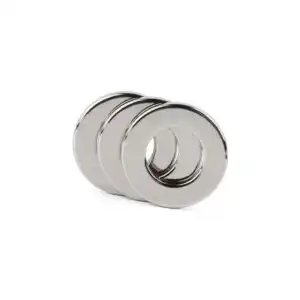
Ring Magnets With a Hole (Normal Hole vs. Countersunk)
A ring magnet is defined by its center hole—but in the market you’ll usually see two “hole styles”: a normal straight hole oraz a countersunk hole (for screws).
Normal Hole Ring Magnet (Straight Bore)
A normal-hole ring magnet is basically a disc magnet with a clean concentric hole. This style is popular because it’s simple, cost-effective, and easy to mount on shafts, rods, or fixtures.
From what I see in real orders:
- Small normal-hole ring magnets are common in compact products like audio components (for example, headphones and small speakers).
- Large ring magnets can be made in much bigger sizes (large OD and ID) for industrial builds, including larger speakers and specialty robotic applications where mounting and alignment matter.
Uwaga praktyczna: when rings get large, performance depends heavily on the steel target and the air gap—not just material grade. That’s why we usually confirm the real installation condition before finalizing the magnet spec.
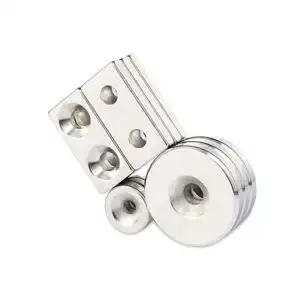
Countersunk Ring Magnets (Screw-Mount Options)
A countersunk ring magnet (often sold as magnesy neodymowe z otworem stożkowym when made from NdFeB) has a tapered recess on one face so a flat-head screw sits flush (often 90°, depending on the hardware standard).
Why engineers and buyers choose countersunk magnets:
- Cleaner assembly (no glue, no brackets, fewer moving parts)
- More consistent positioning (the screw controls alignment)
- Safer handling in production (less chance of magnets shifting during installation)
Real-world tip from manufacturing: countersunk magnets are more sensitive to cracking if the screw is overtightened. If your assembly is high-vibration, I usually recommend confirming screw torque, using the right washer, and verifying the magnet’s seating surface is flat.
How to Make a Ring Magnet Stronger (Without Wasting Money on Grade)
If you’re trying to get a more powerful ring magnet, there are three practical levers—and in many real builds, only one of them is “grade.”
1) Increase magnet volume (OD/ID/thickness)
More volume usually increases available flux. This is often the most cost-effective way to get more performance—if you have space.
2) Upgrade the material (NdFeB or SmCo)
- NdFeB (neodym) is the best strength-to-size choice for most applications.
- SmCo is a strong option when heat stability is critical (it typically handles higher operating temperatures better than NdFeB).
Practical note: NdFeB needs proper corrosion protection in many environments, so coating and sealing matter.
3) Improve the magnetic circuit (reduce air gap, use steel flux return, or use an assembly)
If your design has paint, adhesive, rubber, or any stand-off, reducing the air gap often produces a bigger gain than jumping from N42 to N52.
And if you’re aiming for extremely high flux density, you usually move beyond a single magnet and into a magnet assembly.
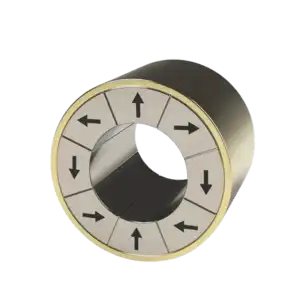
Halbach Array Ring (When You Need Flux Concentration)
A Halbach array ring isn’t a single ring magnet—it’s a carefully arranged magnet assembly designed to concentrate the magnetic field on one side (often inside the ring) while reducing it on the other side.
Where Halbach rings make sense:
- High-efficiency motors and generators
- Łożyska magnetyczne
- Advanced sensing or research equipment
- Designs that need strong flux where space is limited
From project experience: Halbach assemblies can deliver impressive field concentration, but they also require tighter tolerances, careful magnetization control, and solid mechanical retention. In other words, they’re powerful—but they’re not a drop-in replacement for a standard ring magnet.
Advantages of Ring Magnets (Why Engineers Like the Shape)
Ring magnets are popular for one main reason: the geometry makes assembly easier without sacrificing performance.
Here are the advantages that matter most in real applications:
- Easy mounting and alignment (the center hole is perfect for shafts, rods, and screw-mounted designs)
- Great for rotating systems (balanced shape helps with stable rotation in motors and couplings)
- Flexible magnetization options (axial, diametric, and in some cases multi-pole magnetization patterns)
- Wide material choices (NdFeB for compact strength, ferrite for cost and corrosion tolerance, SmCo for heat stability)
Important note: “stronger” depends on the test setup. A ring magnet isn’t automatically stronger than a disc of the same OD—what usually wins is fit, alignment, and the magnetic circuit you build around it.
Where to Buy Ring Magnets (And How to Avoid Spec Mismatches)
You can buy ring magnets from local stores, online retailers, or directly from a manufacturer. The best option depends on how strict your specs are.
1) Local store (fastest for basic needs)
Good for quick testing and simple applications. The downside is limited options for grade, coating, and magnetization direction.
2) Large online marketplaces (convenient, but specs can be inconsistent)
Great customer service and fast shipping—but for technical projects, listings don’t always clearly state grade, magnetization direction, and test conditions.
3) Specialized magnet suppliers (better specs, better consistency)
These suppliers usually provide more detail on material, coating, and tolerances.
4) Manufacturer (best for custom or high-spec projects)
If you need a specific combination—size tolerance, coating, NdFeB grade, klasy temperaturowe magnesów, or a non-standard magnetization pattern—ordering from a manufacturer is usually the safest route.
Practical checklist I use before I approve a ring magnet spec:
- Dimensions (OD × ID × thickness)
- Material (NdFeB / ferrite / SmCo)
- Grade + temperature suffix (if heat is involved)
- Magnetization direction (axial vs diametric)
- Coating and corrosion protection
- Pull-force test condition (steel thickness, air gap, pull direction)
Added case from real use: In one project, a customer upgraded from an N42 ring magnet to N52 because the assembly felt “too weak” during installation. On paper, that sounded reasonable—but the real issue was a thin rubber pad and paint on the steel target, creating a small air gap. Once we removed the pad and switched to a cleaner, flatter steel contact area, the original N42 design performed better than the N52 version in the real build. That experience is why I usually troubleshoot air gap and contact conditions first before paying for a higher grade.
Conclusion
A ring magnet is simple in shape but surprisingly easy to get wrong in real applications if you focus on grade alone. The best approach is to lock down the fundamentals first—geometry, magnetization direction, air gap, steel target condition, and temperature—then select the right material and grade to match.
For NdFeB ring magnets, grade (BHmax) helps you compare strength bands, but temperature suffix grades (H/SH/UH…) often decide whether the magnet keeps its performance after installation. If your application has unknown heat or non-ideal contact conditions, validating with a quick sample test under real assembly conditions is usually the smartest move.
Powiązane:
Najczęściej zadawane pytania
Czym jest pierścień z układem Halbacha?
Pierścieniowy układ Halbacha to zespół magnetyczny, który koncentruje pole po jednej stronie, a po drugiej je wygasza. Wiele magnesów rozmieszcza się tak, aby ich kierunki magnesowania były względem siebie obrócone. Pozwala to uzyskać znacznie silniejsze, skoncentrowane pole — często wewnątrz pierścienia — przy jednoczesnym ograniczeniu pola rozproszonego na zewnątrz. Układ ten stosuje się w silnikach i generatorach o wysokiej sprawności, łożyskach magnetycznych oraz aparaturze badawczej.
Czy można wywiercić otwór w magnesie?
Zwykle nie — zwłaszcza w przypadku magnesów neodymowych. Są twarde, ale kruche, dlatego podczas wiercenia często ulegają wyszczerbieniu lub pękają, a powstające ciepło może trwale osłabić ich właściwości magnetyczne. Pył również może być niebezpieczny. Jeśli potrzebny jest otwór, należy kupić magnes pierścieniowy o odpowiedniej średnicy wewnętrznej lub poddać element obróbce przed namagnesowaniem.
Ile biegunów może mieć magnes pierścieniowy?
Większość magnesów pierścieniowych ma dwa bieguny: północny i południowy. Różnica polega na ich rozmieszczeniu: przy magnesowaniu osiowym bieguny znajdują się na płaskich powierzchniach czołowych, a przy magnesowaniu średnicowym — po przeciwnych stronach powierzchni walcowej. Niektóre magnesy pierścieniowe do silników i enkoderów są celowo magnesowane wielobiegunowo, ale jest to określony układ magnesowania, a nie “standardowy” sposób magnesowania pierścienia.
Czym różnią się magnesy pierścieniowe magnesowane osiowo od magnesowanych średnicowo?
Pierścienie magnesowane osiowo są magnesowane przez płaskie powierzchnie, natomiast pierścienie magnesowane średnicowo — w poprzek boków. Magnesowanie osiowe wytwarza pole wzdłuż osi centralnej (często stosowane w silnikach i głośnikach). Magnesowanie średnicowe wytwarza pole poprzeczne (przydatne w enkoderach i sprzęgłach). Wybór zależy od położenia czujnika lub stalowego elementu docelowego względem pierścienia.
Czy magnesy pierścieniowe są silniejsze od magnesów tarczowych?
Nie automatycznie — siła zależy od objętości, geometrii i warunków badania. W niektórych konfiguracjach magnes dyskowy może osiągać większą siłę odrywania, jednak w rzeczywistych produktach często lepiej sprawdzają się magnesy pierścieniowe, ponieważ otwór centralny ułatwia montaż i osiowanie, zwłaszcza na wałach. Jeśli konstrukcja wymaga obrotu wokół osi lub powtarzalnego pozycjonowania, magnes pierścieniowy może zapewnić lepsze parametry.
What are the practical uses for disc, ring, and block magnets?
| Kształt magnesu | Field Characteristics | Main Uses | Typical Industries |
|---|---|---|---|
| Magnes tarczowy | Flat, poles on circular faces, broad surface contact | Electronics, sensors, closures, magnetic therapy, toys | Consumer electronics, medical devices, educational tools |
| Magnes pierścieniowy | Hole in the center, can be axially or diametrically magnetized, good for rotation | Motors, generators, speakers, magnetic couplings, sensors | Automotive, renewable energy, audio equipment, industrial machinery |
| Magnes blokowy | Large flat surfaces, stable and strong field | Clamping, lifting, magnetic chucks, door catches | Construction, machining, heavy industry, tools |
Other FAQ
Does laser cutting use neodymium magnets?
Laser cutting itself doesn’t rely on neodymium magnets—the cut is made by laser energy plus assist gas. However, neodymium magnets are often used around laser cutting operations for supporting tasks, such as magnetic fixtures and stops for quick holding and positioning of thin steel parts, magnetic pickup tools for collecting and sorting cut pieces and scrap, and tool racks for shop organization. Keep in mind that heat near the cutting zone and metal dust can cause demagnetization or heavy buildup, so proper grade selection and protection matter.
Do Mica Space Heaters use ring magnet in the motor?
Sometimes. Some Mica Space Heaters with a DC/brushless (BLDC) fan motor may use a ring magnet (or a magnet ring made from multiple arc segments) on the rotor for compact, balanced rotation. But many models use AC induction or shaded-pole motors, which typically don’t use any permanent magnets, so no ring magnet. Check the specs for “DC/BLDC/brushless” to confirm.