






자석과 자성의 역사, 자성 재료, 자기 특성, 자기 배향, 자극 등 자석과 자성에 관해 자주 묻는 대부분의 질문에 대한 답을 확인할 수 있습니다. 이러한 주제의 기술적 세부 사항은 당사의 Magnetics-101 설계 가이드에서 확인하십시오.
지금 견적을 요청하거나 전화로 문의하여 특수 요구 사항에 어떤 지원이 가능한지 확인해 보십시오. MagnetShop.com에서는 네오디뮴, 사마륨 코발트, 알니코, 세라믹 및 플렉시블 자석도 대량으로 재고 보유하고 있으며 온라인으로 구매할 수 있습니다.
1. 역사
고대 그리스인과 중국인은 일부 희귀한 돌이 자연적으로 자화되어 있다는 사실을 알게 되었으며, 이를 천연 자석이라고 불렀습니다. 이 돌은 작은 쇳조각을 신기하게 끌어당겼으며, 끈에 매달거나 물에 띄워 자유롭게 움직이게 하면 항상 같은 방향을 가리킨다는 사실도 발견되었습니다. 초기 항해자들은 바다에서 이동 방향을 확인하기 위해 이러한 자석에 의존했으며, 자석은 원시적인 나침반으로 사용되었습니다.
자석을 뜻하는 영어 단어 magnet은 최초의 천연 자석이 채굴된 곳으로 알려진 그리스 테살리아 지방의 마그네시아(Magnesia)에서 유래했습니다.
오랜 세월에 걸쳐 자석은 오늘날의 고성능 자석으로 발전했습니다. 서로 다른 재료로 합금을 만들면 천연 자석 암석과 유사한 효과를 구현하고 자성을 강화할 수 있다는 사실이 밝혀졌습니다.
그러나 최초의 인공 자석은 18세기에 발명되었습니다. 더 강력한 자성 합금의 개발은 1920년대에 알니코 자성 합금(니켈, 알루미늄, 코발트 합금)이 개발되기 전까지 매우 더디게 진행되었습니다. 1950년대와 1970년대에는 각각 페라이트 자석과 희토류 자석이 발명되었습니다. 이후 자성에 관한 과학 분야는 급속히 발전했으며, 고성능 자성 재료의 등장으로 소형이면서 강력한 장치를 구현할 수 있게 되었습니다.
2. 자석과 자성의 기본 원리
자석이란 정확히 무엇입니까?
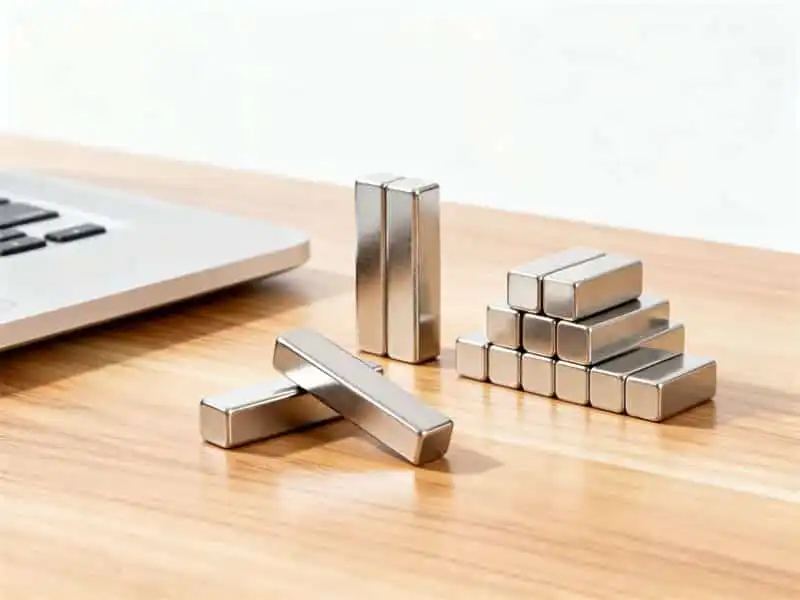
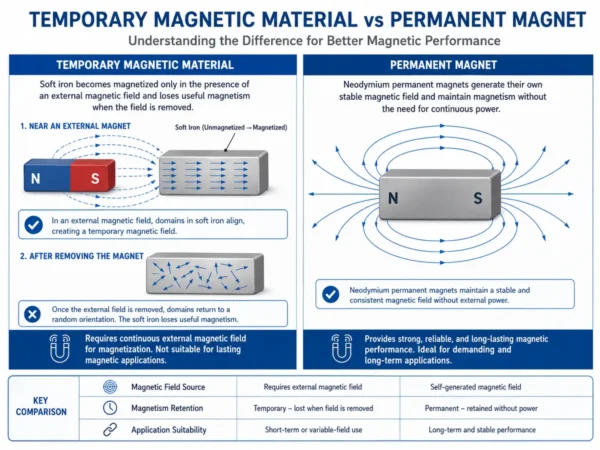
자석은 일반적으로 철이나 강철과 같은 자성 물질을 강력한 자기장에 놓아 만듭니다. 이 방법으로 영구자석, 일시 자석 및 전자석을 만들 수 있습니다.
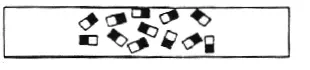
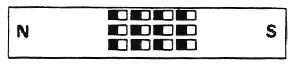
철, 강철, 니켈, 코발트처럼 쉽게 자화되는 재료의 원자는 도메인이라고 하는 작은 영역으로 구성되어 있습니다. 도메인은 현미경으로도 볼 수 없을 만큼 작지만, 각 도메인에는 수천조 개의 원자가 있으며 하나의 미니 자석과 같은 특성을 나타냅니다. 자성 재료를 강한 자기장에 놓으면 일반적으로 여러 방향을 향하고 있던 개별 도메인이 서서히 자기장 방향으로 정렬됩니다. 인접한 도메인도 이 방향으로 정렬됩니다. 대부분의 도메인이 자기장 방향으로 정렬되면 해당 재료는 자석이 됩니다.
착자 전 자구
착자 후 자구
자석은 실제로 어떤 작용을 합니까?
자석은 다음과 같은 작용을 합니다.
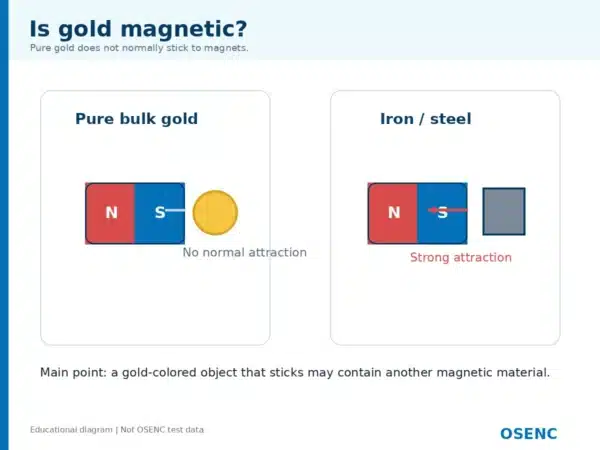
- 철, 니켈, 코발트, 일부 강재 및 기타 합금 등 특정 물질을 자석 쪽으로 끌어당깁니다.
- 다른 자석에 인력 또는 척력을 가합니다(같은 극끼리는 밀어내고 반대 극끼리는 끌어당깁니다).
- 자석과 전기 전도체가 움직일 때 전도체에 영향을 미칩니다.
- 자유 공간에서 전하를 띤 입자의 궤적에 영향을 미칩니다.
이러한 작용을 통해 자석은 자체 에너지를 잃지 않고 한 형태의 에너지를 다른 형태로 변환합니다. 자석의 기능은 다음과 같습니다.
- 기계 에너지를 기계 에너지로 변환: 예를 들어 인력과 척력.
- 기계 에너지를 전기 에너지로 변환: 예를 들어 발전기와 마이크.
- 전기 에너지를 기계 에너지로 변환: 예를 들어 모터, 스피커 및 하전 입자 편향.
- 기계 에너지를 열에너지로 변환: 예를 들어 와전류 및 히스테리시스 토크 장치.
- 자기공명, 홀 효과 소자 및 자기저항.
자석은 어떻게 제조합니까?
현대의 자석 소재는 주조, 압축 및 소결, 압축 본딩, 사출 성형, 압출 또는 캘린더링 방식으로 제조됩니다. 생산된 자석에는 일반적으로 연삭이나 기타 기계 가공과 같은 추가 공정이 필요하며, 이후 더 큰 상위 어셈블리로 조립됩니다. 맞춤형 기계 가공 및 조립에 관한 자세한 내용은 제조 및 조립 페이지에서 확인하십시오.
자석에는 어떤 종류가 있습니까?
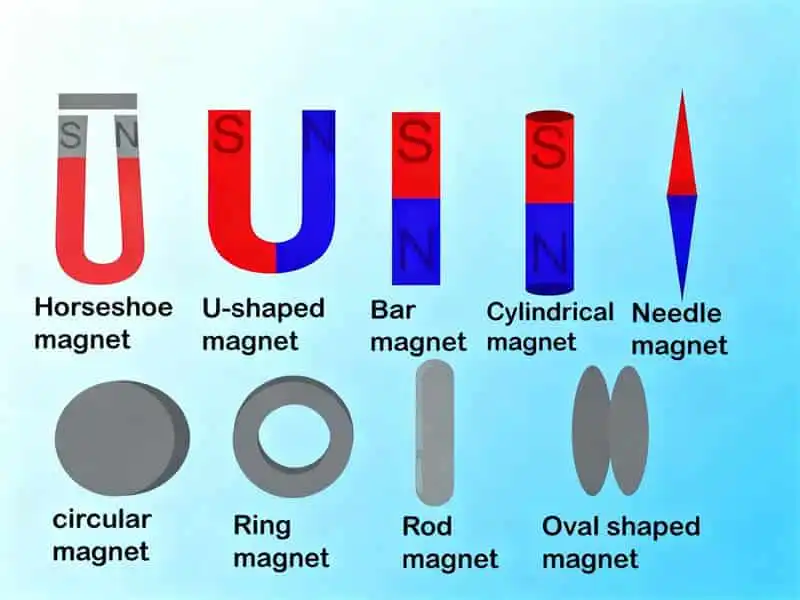
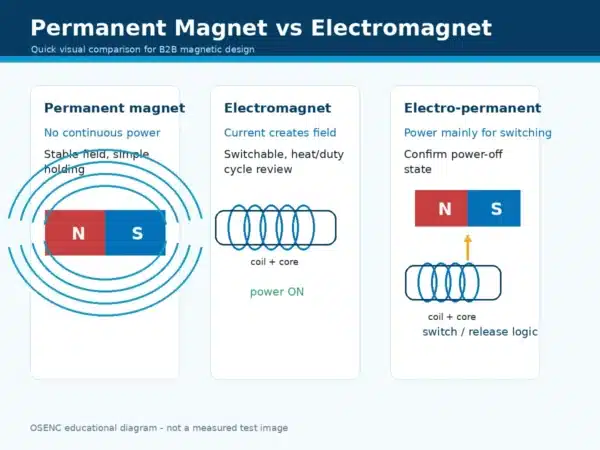
자석은 영구자석, 일시자석, 전자석의 세 가지 범주로 구분됩니다.
영구자석 자기장을 형성하는 데 외부 자기장 발생원이나 전기가 필요하지 않습니다.
일시 자석 자기장 발생원에 접촉하거나 가까이 있을 때 자석처럼 작용하지만, 자기장 발생원이 제거되면 이러한 특성을 잃습니다.
전자석 자석으로 작용하려면 전기가 필요합니다.
영구자석 제조에 사용되는 영구자석 재료에는 고유한 특성을 지닌 다양한 종류가 있습니다. 각 재료에는 조성은 같지만 특성이 조금씩 다른 여러 등급이 있습니다.
영구자석은 어떤 재료로 만들어집니까?
현대의 영구자석은 연구를 통해 더 우수한 자석을 만들 수 있는 것으로 밝혀진 특수 합금으로 제조됩니다. 현재 가장 널리 사용되는 영구자석 재료는 알루미늄-니켈-코발트(알니코), 스트론튬-철(페라이트 또는 세라믹), 네오디뮴-철-붕소(네오디뮴 자석 또는 슈퍼 자석), 사마륨-코발트 자석 재료입니다. 사마륨-코발트 계열과 네오디뮴-철-붕소 계열을 통칭하여 희토류라고 합니다. 자세히 알아보기 네오디뮴 자석 제조 방법?
희토류 자석이란 무엇입니까?
희토류 자석은 희토류 원소군으로 구성된 자석입니다. 가장 일반적인 희토류 자석에는 네오디뮴-철-붕소 자석(네오디뮴 자석)과 사마륨-코발트 자석(SmCo 자석)이 있습니다.
일시 자석이란 무엇입니까?
연철과 퍼멀로이(철과 니켈의 합금) 같은 일부 철 합금은 약한 자기장만으로도 쉽게 자화됩니다. 그러나 자기장이 제거되는 즉시 자성을 잃습니다. 이러한 물질은 전화기와 전동기 등에 사용되는 우수한 일시 자석입니다.
전자석이란 무엇인가?
전자석은 매우 강력한 자석이 필요한 곳에 사용됩니다. 전자석은 전류가 흐르는 도선 코일에 금속 코어를 삽입하여 만듭니다. 코일에 전류가 흐르면 자기장이 발생합니다. 전자석의 세기는 전류의 세기와 도선의 권선 상태에 따라 결정됩니다. 극성은 전류의 흐름에 따라 결정됩니다. 전류가 흐르는 동안 코어는 자석처럼 작용하지만, 전류를 차단하면 자석과 같은 특성이 즉시 사라집니다. 전자석은 전동기, 텔레비전, 자기부상열차, 전화기, 컴퓨터를 비롯한 대부분의 현대 장치에 사용됩니다.
자기 현상에서 와전류란 무엇입니까?
자기장 내에 놓인 전기 도체와 자기장이 상대적으로 움직이면 도체에 전류가 유도됩니다. 이렇게 발생한 와전류는 다시 자기장을 형성하여 원래 자기장과 전기 도체 사이의 상대 운동을 방해합니다.
자석의 일반적인 가격은 얼마입니까?
자석 재료에 따라 가격 차이가 매우 클 수 있습니다. 다음은 자석 가격의 대략적인 추정치입니다.
참고: 이 열에 표시된 비용은 상대 비용이며, 특수 가공이나 기타 특수 사양이 없는 자석 재료의 대량 구매를 기준으로 합니다.
파운드당 비용을 기준으로 하면 네오디뮴 자석은 구리 합금보다 매우 비쌀 수 있습니다. 그러나 BHmax당 비용을 기준으로 하면 그다지 비싸지 않습니다. 자기장이 강할수록 자석이 적용되는 전체 장치를 매우 작게 설계할 수 있습니다. 따라서 전체 비용을 절감할 수 있어 자력이 강한 자석 재료가 비용 측면에서 유리합니다.
자석에 관한 산업 표준이 있습니까?
예. Magnetic Materials Producers Association(MMPA)과 Magnet Distributors and Fabrications Association(MDFA)에서 표준을 제정했습니다. 현재 두 협회는 International Magnetics Association으로 알려져 있습니다. 다음은 편의를 위해 이들 단체가 발행한 일부 간행물과 표준입니다.
적용 용도: 자석이 고정, 인양, 분리, 이동, 감지 또는 기타 용도에 필요한지 명시합니다.
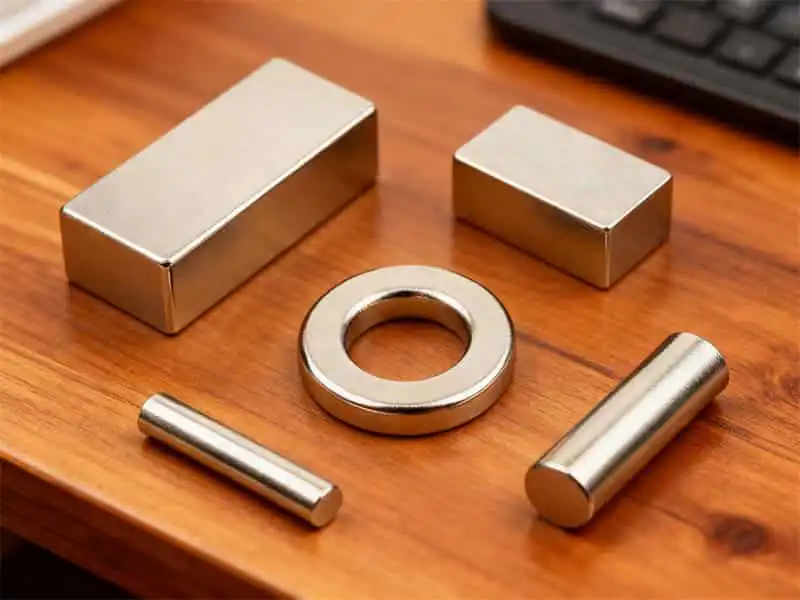
선호하는 자석 형상: 예: 디스크, 링, 블록, 원통, 구 또는 맞춤형 형상.
필요한 자석 크기: 직경, 길이, 폭, 높이, 두께 등의 정확한 치수를 지정합니다.
공차 요구사항: 해당 적용 분야에서 허용되는 치수 편차의 범위를 명시합니다.
작동 환경: 고온, 습기 노출, 실외 또는 실내 사용, 부식성 물질과의 접촉 등의 조건을 고려하십시오.
필요한 자력: 용도에 필요한 인장력, Gauss 수준 또는 등급(예: N35, N42, N52)을 정의하십시오. (자세히 알아보기: 자석 등급)(N42, N45, N52 자석 비교, N35와 N52 자석 비교)
예산 제한: 자석 가격이 일정 금액을 초과하지 않아야 하는 경우, 이를 기준으로 적합한 소재나 등급을 결정할 수 있습니다.
필요 수량: 단일 샘플, 소량 배치 또는 대량 생산 수량 중 필요한 규모를 명시하십시오.
자기의 기본 원리를 이해하려면 예측 가능한 특성을 보이는 소재가 필요합니다. Osnec는 극성, 자계 분포 및 소재 반응 전반에서 일관된 성능을 나타내는 자석을 생산하므로 기본 개념을 설명하는 데 적합합니다. 학생과 엔지니어가 균일한 자계 거동을 관찰할 수 있어 인력, 척력 및 배향의 기본 원리를 더욱 쉽게 시연하고 분석할 수 있습니다.
3. 자력의 이해
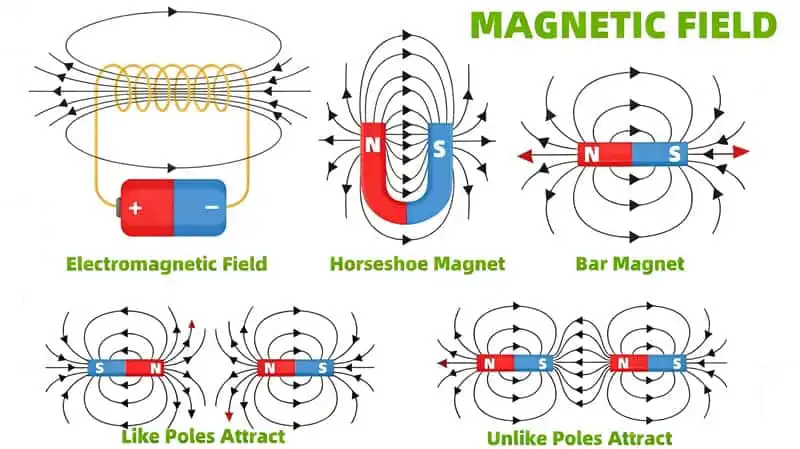
자석은 자력을 얼마나 오래 유지합니까?
자석이 포함된 물체를 전력선, 다른 자석, 고온 등 부정적인 영향을 주는 요인에서 멀리 두면 자석의 자성을 더 오래 유지할 수 있습니다.
자석의 자력에 영향을 미치는 요인은 무엇입니까?
자석의 자력에 영향을 줄 수 있는 요인은 다음과 같습니다:
- 열
- 방사선
- 자석 근처의 강한 전류.
- 인접한 다른 자석.
- 코팅하지 않은 네오디뮴 자석은 습도가 높은 환경에서 부식됩니다.
- 최신 자석 재료는 기계적 손상을 일으킬 정도로 강하지 않은 충격과 진동에는 영향을 받지 않습니다.
자석은 시간이 지나면 자력이 약해집니까?
현대 자석 재료는 시간이 지나도 자력을 극히 일부만 잃습니다. 예를 들어 사마륨 코발트 자석은 10년 동안 자력 감소가 1% 미만인 것으로 입증되었습니다.
어떤 종류의 자석이 가장 강력합니까?
현재 시중에서 가장 강력한 종류는 희토류 자석입니다. 희토류 자석 중에서는 네오디뮴으로 만든 자석이 가장 강합니다. 그러나 고온(약 150 °C 이상)에서는 자기 회로에 따라 사마륨 코발트 자석이 네오디뮴 자석보다 더 강할 수도 있습니다.
초전도 자석이란 무엇입니까?
가장 강력한 종류의 자석입니다. 금속 코어조차 필요하지 않으며, 극저온에 노출되면 초전도체가 되는 특수 금속 합금으로 만든 와이어 코일로 구성됩니다.
기존 자석의 자력을 더 강하게 할 수 있습니까?
자석이 완전히 착자된 상태를 포화 상태라고 하며, 이 상태에서는 자력을 더 높일 수 없습니다. 이 경우 자석은 물이 든 양동이와 같습니다. 물이 가득 차면 더 채울 수 없는 것과 같은 원리입니다.
자기 특성을 잃은 자석을 재착자할 수 있습니까?
Most magnets can be re-magnetized back to their original strength, provided the material is not too hot.
How is a magnet’s strength or power defined?
The strength of a magnet is most commonly measured by the use of Gauss meters, magnetometers, or pull-testers. Gauss meters are measured in Gauss; Magnetometers in Gauss or any arbitrary unit (it is easy to compare one magnet to another); and pull-testers in pounds and kilograms, or other units of force. A sophisticated measurement of magnets is also made using Helmholtz Coils, search coils, and permeameters.
Special Gauss meters may cost up to a few thousand dollars. Integrated Magnetics stocks a few kinds of Gauss meters between 400 and 1500 apiece. Contact us if you wish to know more about them or place an order.
Suppose I have an NdFeB magnet having a Br of 12,300 Gauss. Will I be able to measure 12,300 Gauss on its surface?
No. The measurement of the Br value is done under closed-circuit conditions. A closed-circuit magnet is, however, of little use. Practically, you will find a field under 12,300 Gauss in the near vicinity of the magnetic surface. Whether the magnet contains any steel or not, the distance between the measurement point and the surface, and the size of the magnet will determine the real measure (assuming that the measurement is being done at room temperature).
In a few examples, a 1″ diameter Grade 35 neodymium magnet that is ¼” long will measure approximately 2,500 Gauss when 1/16″ away from the surface, and 2,200 Gauss when 1/8″ away from the surface.
4. Magnetic Fields and Their Behaviour
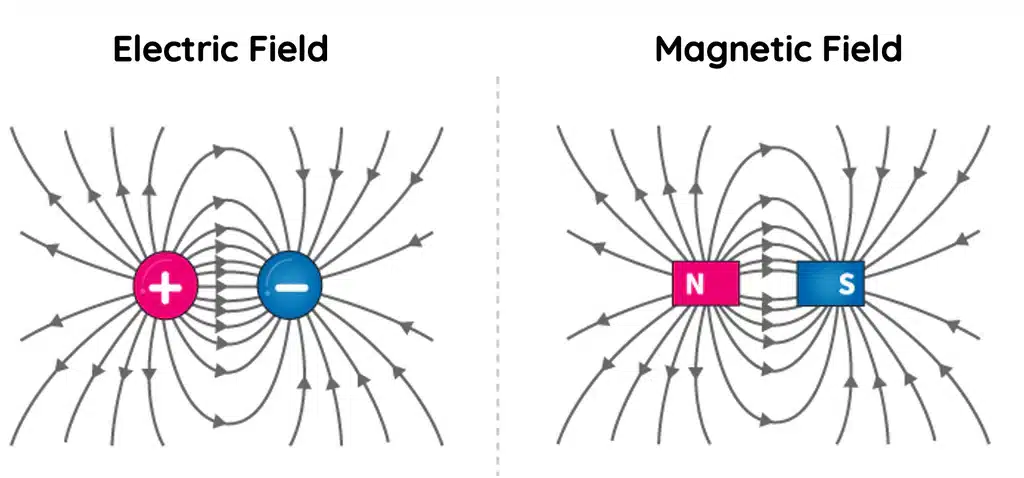
What is the strength of the magnetic field of the Earth?
The earth has a surface field strength of approximately 0.5 gauss, which can range up to 10 per cent depending on the strength of the crustal field. Between 0.85 and 0.45 is the range that is available in the world. The changes can be between 1% to 5% long lasting between a few hours and a full day, as a result of the geomagnetic storms.
What is the formula that describes the dependence of a magnetic field on distance?
The intensity of a magnetic field is decreasing more or less exponentially with distance.
The following is one illustration of the drop-off with distance of the field (in Gauss) of a samarium cobalt Grade 18-disc magnet 1/2″ long and 1″ in diameter:
What is the field strength equation with respect to distance?
In the case of a circular magnet with radius R and length L, the field Bx in the centerline of the magnet at a distance X from the surface is given by the following expression, where Br is the remaining induction of the substance:
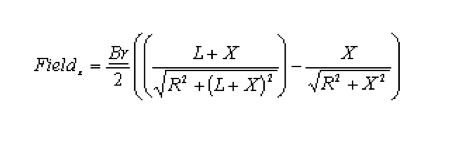
자기장 세기 방정식
서로 다른 직사각형 자석 및 기타 직사각형 자석의 자기장을 계산할 때 다른 공식을 사용할 수도 있습니다. 온라인 계산기를 사용하여 자체 자기장 수준을 계산하십시오.
자기장을 차단하려면 무엇을 사용할 수 있습니까?
자기장을 차단할 수 있는 유일한 재료는 자석에 끌리는 재료입니다. 차단재의 두께에 따라 자기장이 부분적으로 차단되거나 완전히 차단될 수 있습니다.
자기장 매핑의 경우, Osnec 자석은 홀 효과 센서 및 시각화 도구와 함께 사용하기에 적합한 깨끗하고 명확한 자기장을 생성합니다. 이러한 안정적인 패턴은 실제 시연과 정밀 테스트에 적합합니다.
5. 자극과 그 정의
자극이란 무엇입니까?
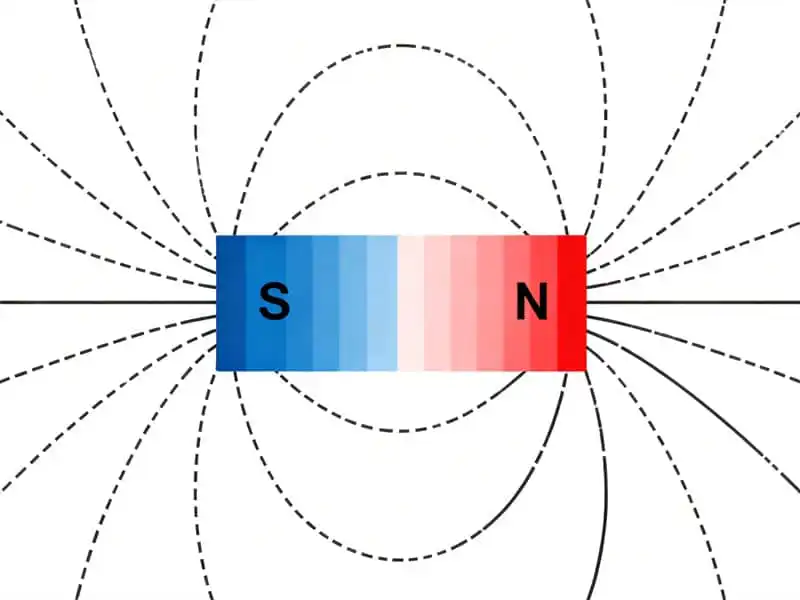
보이지 않는 자속선이 방사되어 나오고 다시 자석으로 들어가는 표면을 자극이라고 합니다.
북극과 남극은 일반적으로 어떻게 정의합니까?
자석의 북극은 자유롭게 움직일 수 있도록 두었을 때 지구의 북극을 향하는 극입니다. 다시 말해, 자석의 북극은 지구의 북극을 따라가게 됩니다. 마찬가지로 자석의 남극은 지구의 남극을 따라갑니다.
특정 자극을 식별할 수 있습니까?
예. 지정된 사항에 따라 자석의 위쪽 또는 아래쪽에 표시할 수 있습니다.
아무런 표시가 없는데 북극인지 어떻게 알 수 있습니까?
눈으로 보고는 알 수 없습니다. 자석 가까이에 나침반을 가져가서 확인합니다. 일반적으로 지구의 북극을 향하는 나침반 바늘 끝이 자석의 남극을 향하게 됩니다.
6. 자기 플럭스와 그 작용
How do lines of magnetic flux behave in space?
The forces are three-dimensional as lines and surround a bar magnet on each side.
Opposites repel, and the unlike opposites attract. Two magnets with opposite poles increase the force lines, which become united on coming into contact, and the two magnets attract.
As the similar poles of a magnet are close another line of force is pushed away, and the magnet repels another.
Controlling flux density is a major challenge in rare-earth magnets. Brands like Osnec perform thermal-cycle testing and flux stability analysis to ensure their magnets maintain consistent flux even under mechanical or temperature stress.
7. Magnetic Orientation and Easy Axes
What does “direction of orientation” mean in magnets?
The majority of modern magnet materials are grained; they can be most easily maximally magnetized only in one direction. This is the easy axis, or the orientation direction, or the axis.
Un-oriented magnets (also called “Isotropic magnets”) are far weaker compared to oriented magnets, and may be made to be magnetized in any direction. Oriented magnets (or as they are sometimes called, Anisotropic magnets) are not directed everywhere – they are preferentially oriented in a direction they are supposed to be magnetized.
Whether axial, diametrical, or radial orientation is required, Osnec manufactures magnets with tightly controlled orientation tolerances. This consistency improves the overall performance of assemblies and rotational systems.
8. Key Magnetic Characteristics
Three major properties of magnets include:
Residual Induction: Assuming the symbol is Br, and in units of Gauss, this is an indication of the strength of the magnet that it could be.
Coercive Force: Since Hc is a symbol and is determined in Oersteds, this is a measure of the toughness of the task of de-magnetizing the magnet.
Maximum Energy Product: Using the various designations, BHmax, abbreviated as bhmax, the measurement unit being Gauss-Oersteds, is an indicator of the amount of magnet material needed to project a specified amount of magnetic flux.
9. Magnetic Properties of Common Materials
What are the characteristics of the common magnet materials?
The following are the three significant characteristics of magnets of some of the most frequently used types of magnets today:
How can this information be used in practice?
Given the size of the magnet, you can get an approximation of the amount of the magnetic flux various materials will project at a particular distance. This information may also be used to compare a material with another.
Example: What is the difference in flux that a neodymium grade 35 magnet will project as compared to a ceramic grade 5 of the same size at a given distance? Simply divide the Br of the neo 35 by the Br of ceramic 5 (12300/3950) to get 3.1. This means that the neo grade 35 will project 3.1 times the flux a same-size ceramic grade 5 would at a given distance.
Since the flux needed at a certain distance from the magnet is known, you can use this to determine and estimate the size of the volume of a magnet material you will need for varying magnets.
Problem: What would be the volume at which 5 magnets of ceramic would produce the same flux as a grade -35 of neodymium magnet at that distance? All that you have to do is divide BHmax of neo-35 by BHmax of ceramic-5 (35/3.6) to obtain 9.7. This implies that the amount of the ceramic-5 magnets would be 9.7 times more than that of the neo-35 magnet to produce the same flux.
10. Operating Temperatures of Magnet Materials
What are the maximum recommended operating temperatures for different magnet materials?
The highest temperature that a magnet can work with is heavily dependent on the permeance coefficient, or Pc, of the material. Pc is dependent upon the magnetic circuit on which the magnet is functioning. The greater the Pc (the more closed is the circuit), the greater the temperature within which the magnet may be used without severe demagnetism. The following table presents a range of the maximum operating temperatures of the various classes of magnet material. Special care may be required at temperatures near those given below to make sure that the magnet will not become demagnetized.
What is the highest temperature at which a magnet can still function effectively?
The magnets serve at various efficiency levels depending on the various circuits that they are involved with. The more closed the circuit is in which the magnet is operating in the more stable it will be, and the less the temperature will have an impact on the magnet.
11. Machining and Processing Magnets
Is it possible to machine magnets?
Yes, magnets can be machined. Nonetheless, the hard magnet materials are so hard to machine as opposed to the flexible or rubber-like magnet materials. There should be as much as possible, machining in the unmagnetized form, by the use of diamond tools and/or soft grinding wheels. Generally, machine-hardened magnet materials are not worth attempting to machine unless you are conversant with these special machining practices.
What factors affect the cost of machining magnets?
The factors that require the determination of the cost of the machine of the magnets include:
Quantity: The greater the quantity, the less the cost, as set-ups have to spread the set-up cost over the quantity, and special tooling is possible to machine a greater quantity.
Material: It is more expensive to machine SmCo materials; they are very brittle, and it is cheaper to machine the flexible materials due to their physical behaviors.
Shape: The shapes that are complex cost more than those that are simple.
Tolerances: The tighter the tolerances required, the further the magnets will be from the machine.
Machining magnets requires careful control to avoid cracking and chipping. Osnec produces sintered materials with cleaner edges and improved structural integrity, making post-machining processes safer and more predictable.
12. Magnetic Assemblies and Their Design
What is meant by a magnetic assembly?
Magnetic Assemblies are made up of one or more magnets, their other constituents, typically components like steel that tend to influence the functionality of the magnet.
How should magnets be mounted or assembled in my device?
In case the magnet should be attached to a machine, you can fix the magnet using some mechanical means, or you may do it using some adhesives.
Magnets are usually held by adhesives. When applying magnets on uneven surfaces then one needs an adhesive that has a large amount of body to enable conformability to the uneven surface. Hot glues are also discovered to be effective in attaching magnets to ceramics, wood, cloth, and other. In the case of magnets to be bonded to metal, superglue may be applied with high success.
Integrated Magnetics may provide flexible magnets that have adhesives already attached, so all one has to do is peel off the liner and stick the magnet onto your product. Call us, or request us to make a quote on a specialty order, or look at a large stock inventory listed online at www.magnetshop.com, where you can buy online.
It is also noted that just like any other adhesive application, the very most important thing would be to make sure all surfaces involved in bonding are clean and dry before bonding.
In assemblies, factors like adhesive choice, housing precision, and orientation balance matter. Osnec designs assemblies with these considerations in mind, ensuring stable magnetic performance and higher operational efficiency.
13. Safe Handling and Storage of Magnets
Guidelines for using and storing magnets
Magnets are to be handled with special care always! The magnets may shatter and cut people or hurt them.
Store magnets out of the magnetic pieces like floppy disks, credit cards, and computer screens.
Keep the store magnets in close packaging containers so that they do not pick up metal debris.
In case you have multiple magnets being stored, they should be in attractive places.
Due to the ease of demagnetization, alnico magnets must be kept with their keepers, which are iron or steel plates that tend to magnetize together, forming the attaching plates of the first one.
Safe handling and storage prevent magnet damage, corrosion, and accidental injury. Osnec uses packaging systems designed to limit over-attraction, moisture exposure, and impact-related stress during transport. These protective measures demonstrate the importance of proper storage practices and help users understand how environmental factors can impact long-term magnet performance.
14. Further Reading and Reference Resources
What are some recommended reference books on magnetism?
- Permanent Magnet Design Handbook, by Lester Moskowitz, a 385-page book aimed at the technical layperson.
- Permanent Magnets and their Applications, by Dr. Peter Campbell, a 203-page book aimed at the technical person.
- The Driving Force, by James Livingston, a 310- page book aimed at the non-technical reader. A very well written and interesting book on the history of magnets and some of their more exotic applications.
Request a Quote or Contact Us today and tell us how we can serve you with your specialty needs of custom magnets. Magnets are also available for purchase online at MagnetShop.com, with a large inventory.
자주 묻는 질문
자석은 어떤 재료로 만들어지나요?
자석은 일반적으로 강자성 금속과 공학적으로 설계된 합금으로 제조됩니다. 주요 종류로는 네오디뮴-철-붕소(NdFeB), 사마륨 코발트(SmCo), 페라이트(세라믹 산화철), 알니코(알루미늄-니켈-코발트), 그리고 페라이트 또는 NdFeB 분말을 사용한 플렉시블 고무 자석이 있습니다. Osenc는 더 높은 자기 에너지와 정밀 착자, 용도별 코팅 및 형상으로 설계된 산업용 고성능 희토류 네오디뮴 자석(NdFeB)에 주력합니다.
자석은 자연적으로 어떻게 생성되나요?
자연적으로 생성되는 자석은 자철석과 같은 철이 풍부한 광물이 지질 작용이나 낙뢰로 인해 지구 자기장과 영구적으로 정렬될 때 형성됩니다. 이러한 천연 “자석석’은 비교적 희귀하고 자기력이 크지 않습니다. 현대 산업에서는 OSENC가 제어된 소결, 가공 및 착자 공정을 통해 고성능 네오디뮴 자석(NdFeB)을 엔지니어링하여 정밀하게 정의된 자기 특성과 안정적인 성능을 구현합니다.
자석을 반으로 부수면 어떻게 되나요?
자석을 반으로 나누어도 북극과 남극이 분리되어 생기지는 않습니다. 각 조각은 고유한 북극과 남극을 가진 더 작은 자석이 됩니다. 그러나 기계적 충격과 불규칙한 파단면으로 인해 재료가 부분적으로 탈자되고, 사용 가능한 자속이 감소하며, 성능에 영향을 줄 수 있습니다.
가장 강한 자석 종류는 무엇입니까?
상업적으로 이용 가능한 영구자석 중 가장 강력한 제품은 소결 네오디뮴-철-붕소(NdFeB) 희토류 자석이며, 특히 N52와 같은 고등급 제품이 이에 해당합니다. 이 자석은 페라이트, 알니코 또는 SmCo에 비해 가장 높은 (BH)max와 매우 높은 잔류 자속 밀도를 제공하므로, 소형 설계나 높은 토크 또는 높은 힘이 필요한 설계에 적합합니다. 전문 네오디뮴 자석 제조업체인 Osenc는 다양한 산업용 애플리케이션에 맞춰 온도 저항성과 부식 보호 성능의 균형을 고려하면서 자력 성능을 극대화할 수 있도록 NdFeB 등급, 코팅 및 착자 방향을 설계합니다. (자세히 알아보기 네오디뮴 자석의 자력은 얼마나 강한가)