






스테인리스강의 자성
빠른 답변
일부 스테인리스강은 자성을 띠지만, 휴대용 자석에 강하게 끌리지 않는 종류도 있습니다.
이는 단순히 철 함유 여부가 아니라 주로 강의 금속 조직과 가공 이력에 따라 달라집니다.
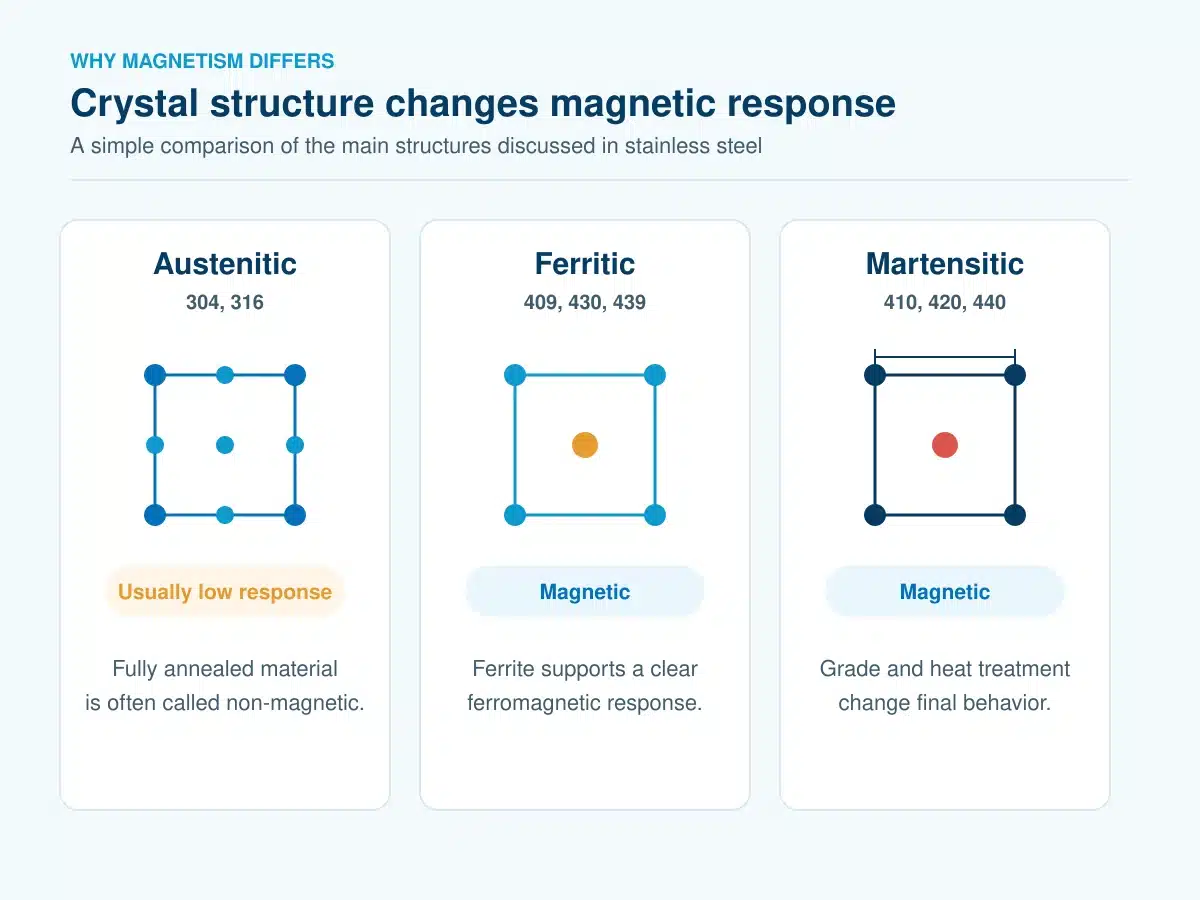
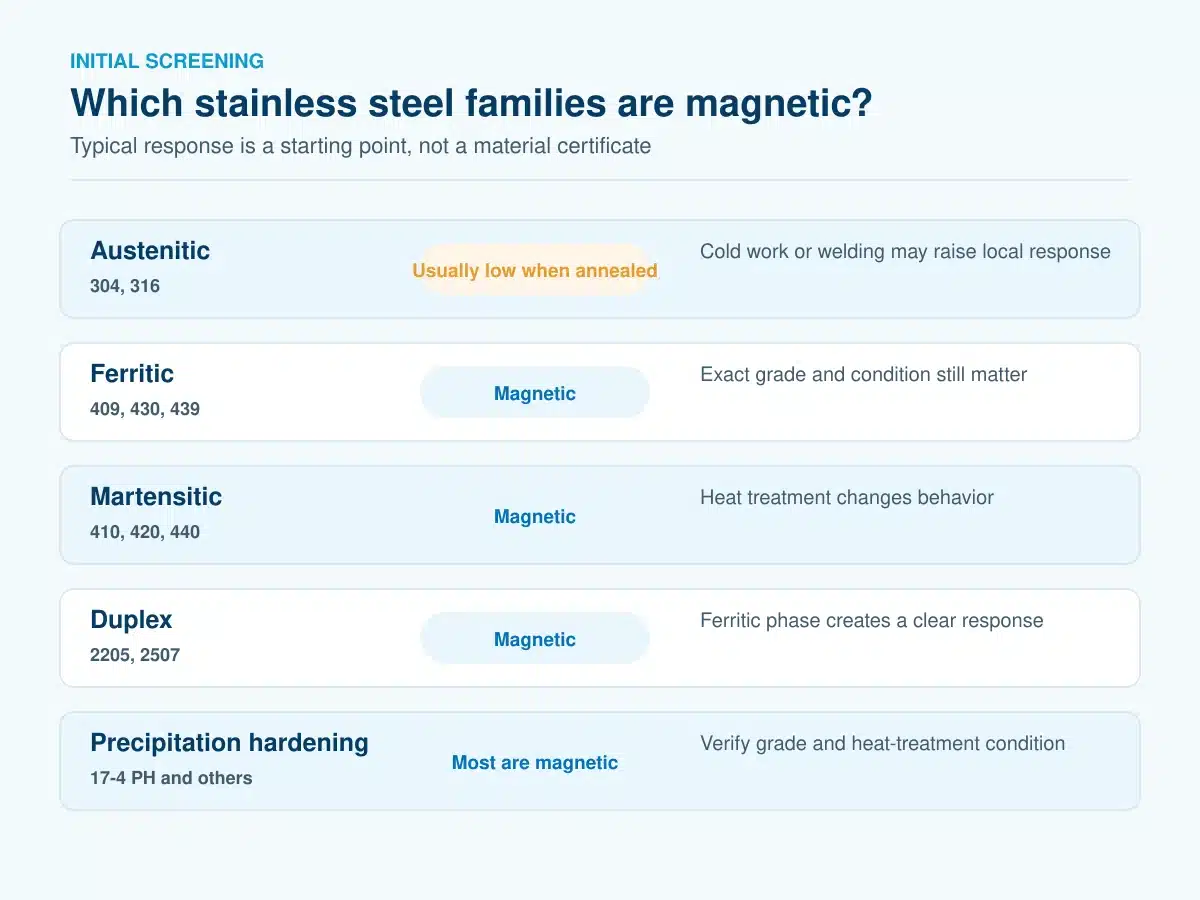
페라이트계, 마르텐사이트계, 듀플렉스계 및 대부분의 석출경화계 스테인리스강은 일반적으로 뚜렷한 자기 반응을 보입니다. 완전 풀림 처리된 304 및 316 등의 오스테나이트계 등급은 대체로 자석에 거의 끌리지 않지만, 냉간가공과 용접으로 인해 국부적인 자기 반응이 커질 수 있습니다. 이 내용은 다음 기관에서도 정리해 설명합니다. 영국 스테인리스강협회.
자석 시험은 부품을 선별하는 데 도움이 되지만, 해당 부품이 304 또는 316임을 입증할 수는 없습니다. 또한 그 부품이 인장력, 자기장 분포 또는 자석 어셈블리에 미치는 영향도 예측할 수 없습니다.
일부 스테인리스강에 자성이 나타나는 이유는 무엇입니까?
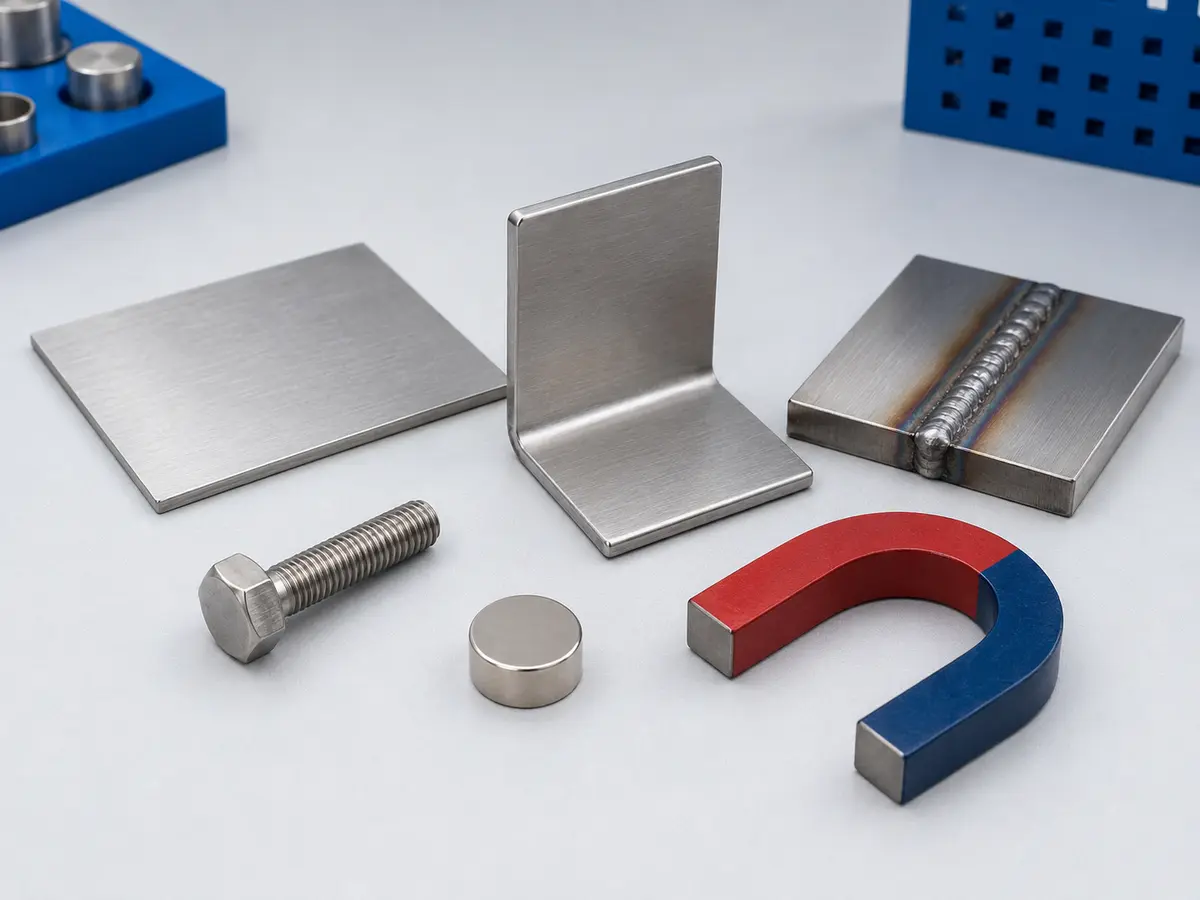
스테인리스강의 자성은 결정 구조에 크게 좌우됩니다. 페라이트 및 마르텐사이트 조직은 강자성을 띠지만, 완전한 오스테나이트 조직은 투자율이 훨씬 낮습니다.
따라서 외관이 비슷한 두 스테인리스강 부품도 동일한 자석에 다르게 반응할 수 있습니다. 합금 계열, 정확한 조성, 열처리, 성형, 용접, 주조 공정 및 국부 변형이 모두 결과에 영향을 줄 수 있습니다.
코어리스 모터의 영국 스테인리스강협회 완전 풀림 처리된 오스테나이트계 스테인리스강의 비투자율은 일반적으로 약 1.003~1.05라고 명시합니다. 1에 가까운 값은 강자성 강재에 비해 자기 반응이 작다는 것을 의미합니다.
이는 일반적인 참고 범위이며, 모든 304 또는 316 부품에 적용되는 기본 합격 판정 기준이 아닙니다. 관리 기준을 설정하려면 제품 상태, 시험 방법, 자기장 조건 및 합격 판정 단계를 정의해야 합니다.
어떤 종류의 스테인리스강에 자성이 있습니까?
| 스테인리스강 계열 | 대표적인 예 | 일반적인 자기 반응 | 주요 제한 사항 |
|---|---|---|---|
| 오스테나이트계 | 304, 316 | 완전 풀림 상태에서는 대체로 낮음 | 냉간 가공과 용접으로 국부적인 자기 반응이 증가할 수 있습니다. |
| 페라이트계 | 409, 430, 439 | 자성을 띰 | 자기 반응과 자기 회로 성능은 세부 강종과 상태에 따라 달라집니다. |
| 마르텐사이트계 | 410, 420, 440 계열 | 자성을 띰 | 열처리 조건과 강종은 기계적 거동과 자기적 거동 모두에 영향을 미칩니다. |
| 듀플렉스계 | 2205, 2507 | 자성을 띰 | 페라이트상으로 인해 뚜렷한 자기 반응이 나타납니다. |
| 석출 경화계 | 17-4 PH 및 기타 강종 | 대부분 자성을 띱니다. | 정확한 강종과 열처리 상태를 확인하십시오. |
이 표는 초기 재료 선별에 적합합니다. 구매 사양서, 화학 성분 분석, 투자율 시험 또는 실제 적용 단계의 자기 특성 검증을 대체할 수는 없습니다.
304 스테인리스강은 자성이 있습니까?
풀림 처리된 304 스테인리스강은 일반적으로 투자율이 낮아 휴대용 자석에 거의 끌리지 않을 수 있습니다. 그러나 , 냉간 성형으로 오스테나이트 조직의 일부가 변형 유기 마르텐사이트로 변태될 수 있으며, 이에 따라 자기 반응이 증가합니다.
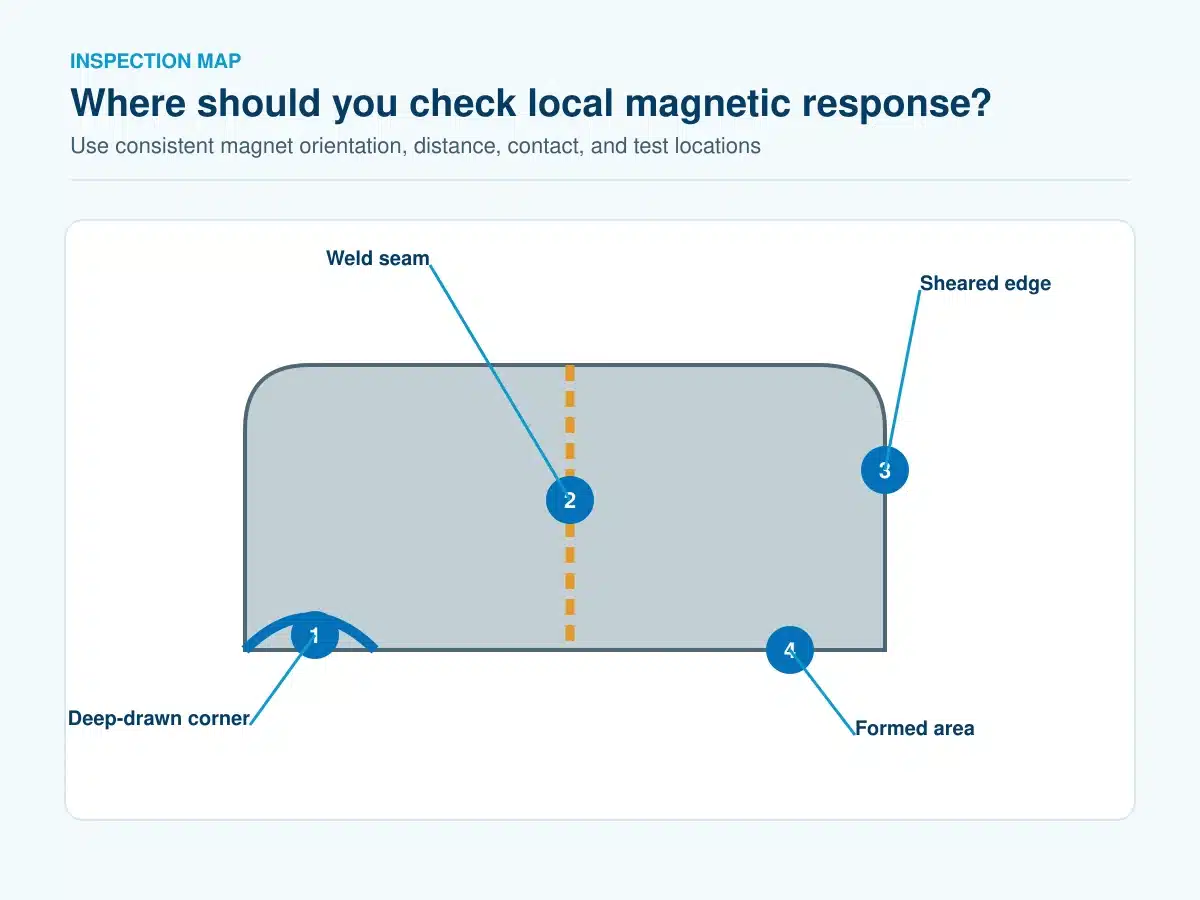
The effect is often localized. Bent corners, deep-drawn areas, rolled threads, sheared edges, stamped features, or heavily worked surfaces may attract a magnet more noticeably than an undeformed flat area from the same part.
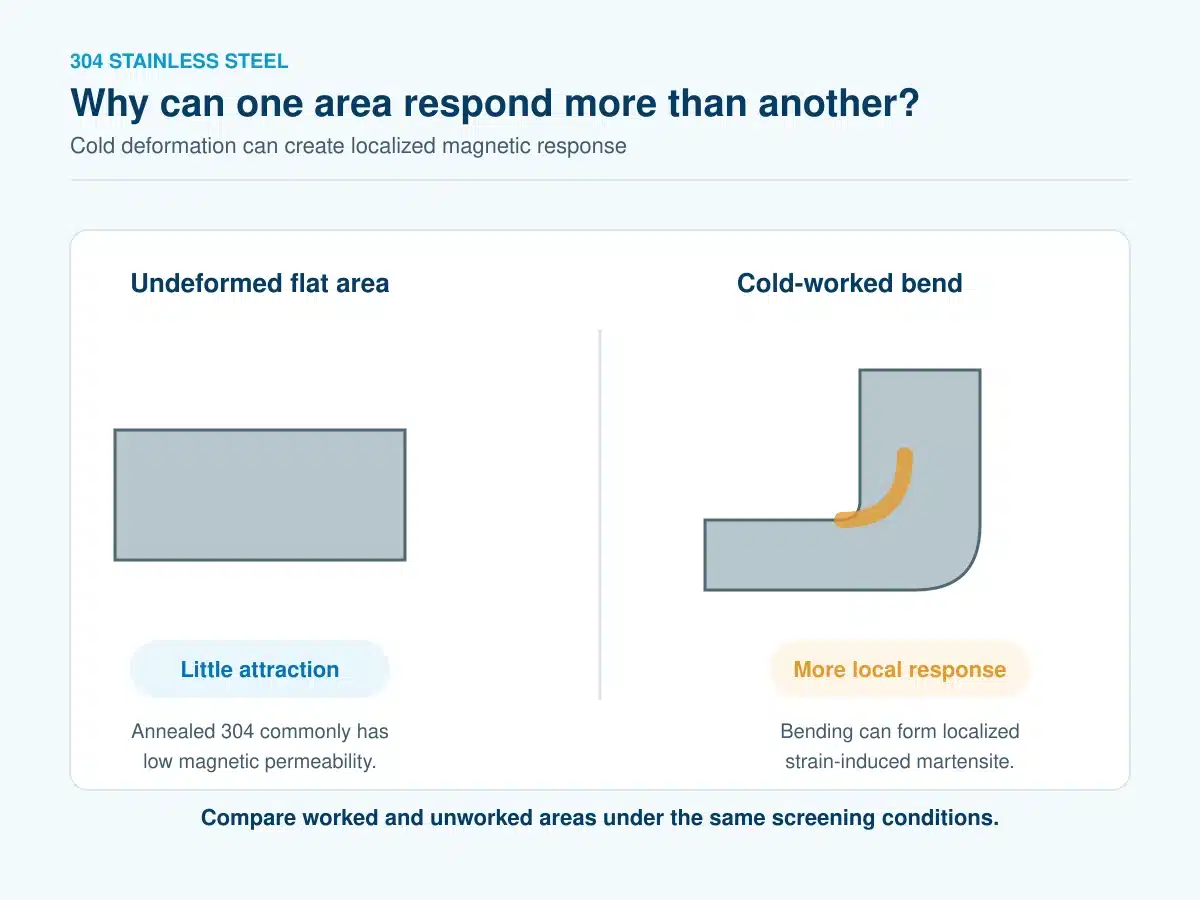
The amount of change is not fixed. It depends on the material composition, starting condition, deformation level, temperature, and processing history. A magnetic response therefore does not automatically mean that a claimed 304 component is counterfeit or out of specification.
Is 316 Stainless Steel Magnetic?
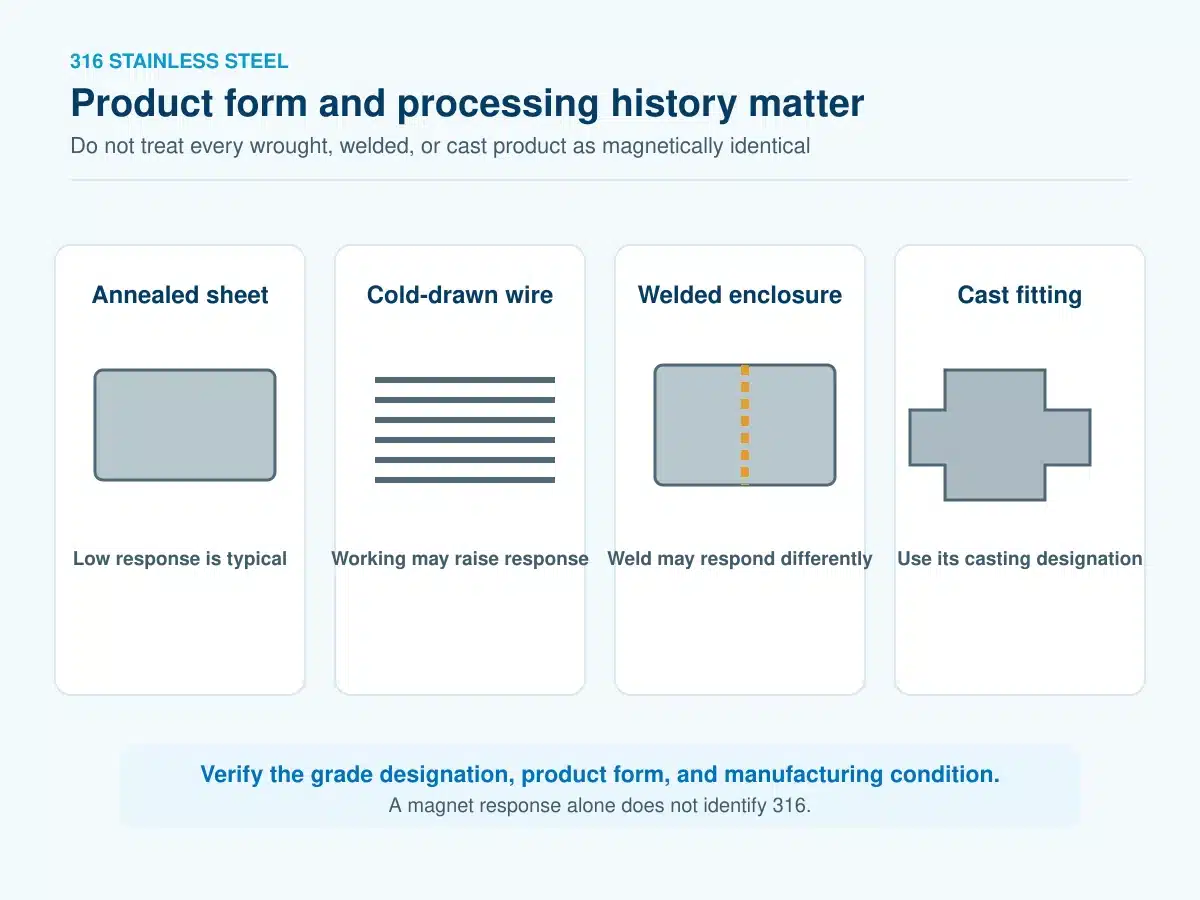
Fully annealed wrought 316 stainless steel also normally has low magnetic permeability. Cold working can increase its response, although the result varies with composition and processing.
Welding may produce a different response in the weld metal or nearby region because some austenitic weld structures retain ferrite, as explained in the BSSA composition guidance. This means a welded enclosure can respond differently at the seam than across its base sheet.
A wrought 316 sheet, cold-drawn 316 wire, forged 316 fastener, and welded 316 enclosure may therefore respond differently because they have different processing histories. A cast austenitic fitting should be evaluated under its casting-grade designation rather than assumed to be wrought Type 316; the Nickel Institute notes that cast equivalents use different designations and modified compositions.
What Can a Local Magnetic Response Tell You?
The location of the response may help identify what to investigate, but it does not provide a complete material diagnosis.
| 관찰 | 가능한 설명 | Practical next action |
|---|---|---|
| 딥 드로잉 가공된 모서리에서 자기 인력이 더 크게 나타남 | 집중된 냉간 변형 | 동일한 선별 조건에서 성형부와 미변형부를 비교하십시오. |
| 전단 또는 기계 가공된 가장자리에서 자기 인력이 더 크게 나타남 | 국부 변형 또는 표면 상태 변화 | 절단 및 마감 공정을 검토하고, 등급이 중요한 경우 규정된 재질 검증 방법을 사용하십시오. |
| 전조 나사산 또는 단조 헤드에서 자기 인력이 더 크게 나타남 | 심한 국부 가공 | 체결부품의 규격과 제조 상태를 확인하십시오. |
| 용접부에서 자기 인력이 더 크게 나타남 | 잔류 페라이트 또는 국부적 조직 변화 | 모재, 용가재, 용접 절차 및 합격 판정 요건을 확인하십시오. |
| 주조 피팅이 전신재 판재보다 더 강하게 반응함 | 주조재의 조성과 페라이트 균형 차이 | 전신재 304 또는 316으로 간주하지 말고 주조 등급 명칭을 확인하십시오. |
| Noticeable attraction occurs across most of the part | Magnetic stainless family, extensive cold work, or material mismatch may be involved | Verify the material specification and processing history. Do not accept or reject the part by hand feel alone. |
For a repeatable screening comparison, use the same magnet, orientation, contact or distance, and inspection locations. Even then, the result remains qualitative unless the customer has defined and validated that screening method.
Can You Identify 304 or 316 With a Magnet?
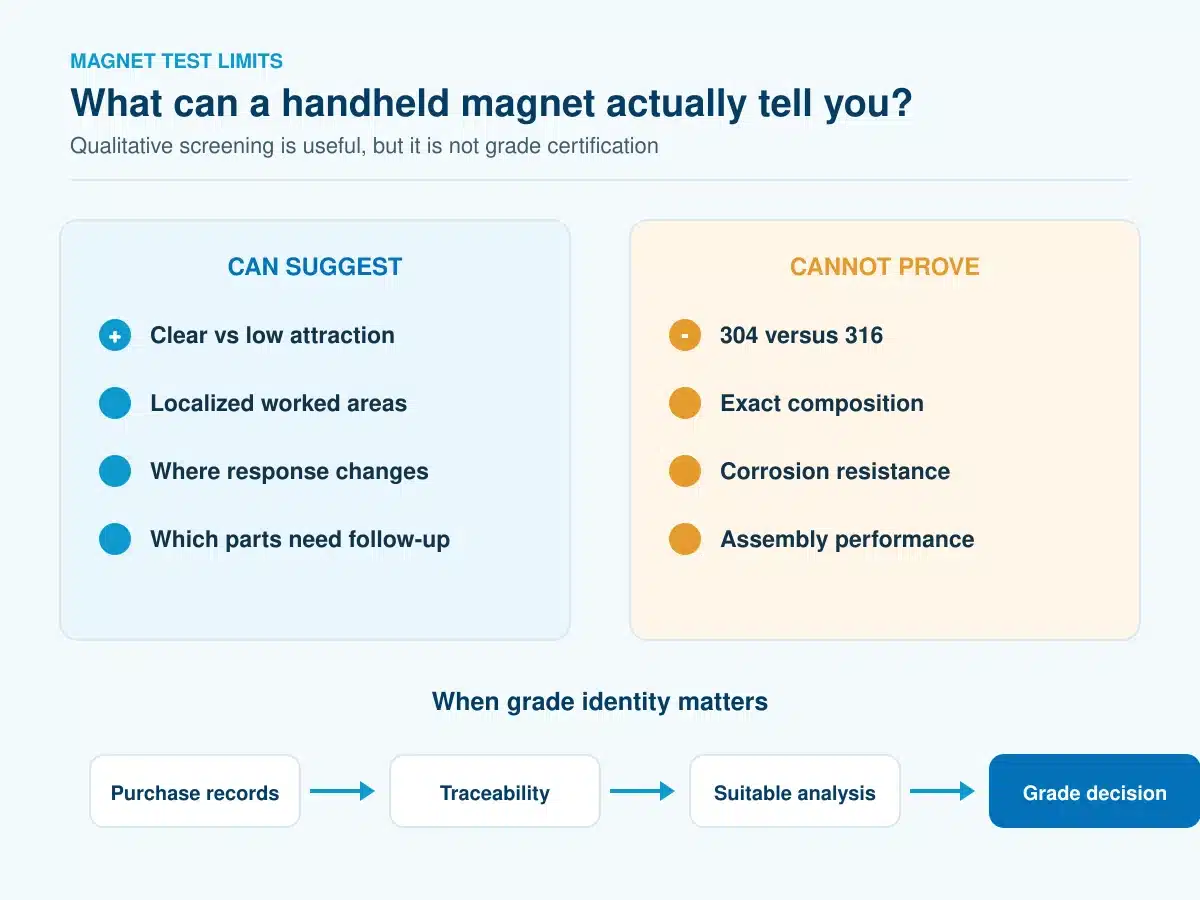
No. A handheld magnet cannot reliably distinguish 304 from 316.
It may help separate a softened austenitic product from a clearly magnetic stainless family, but cold-worked austenitic steel can complicate that comparison. Surface shape, thickness, magnet strength, distance, and test position also affect what the operator feels.
When the grade matters, verify it through the purchase records and an appropriate material-identification method. BSSA grade-sorting guidance states that chemical analysis may be required for a conclusive grade decision. Depending on the method, additional analysis may also be needed to distinguish low-carbon or nitrogen-controlled variants.
A magnet test does not establish corrosion resistance, exact composition, exact relative permeability, or suitability for a magnetic assembly.
How Can Stainless Steel Affect a Magnet Assembly?
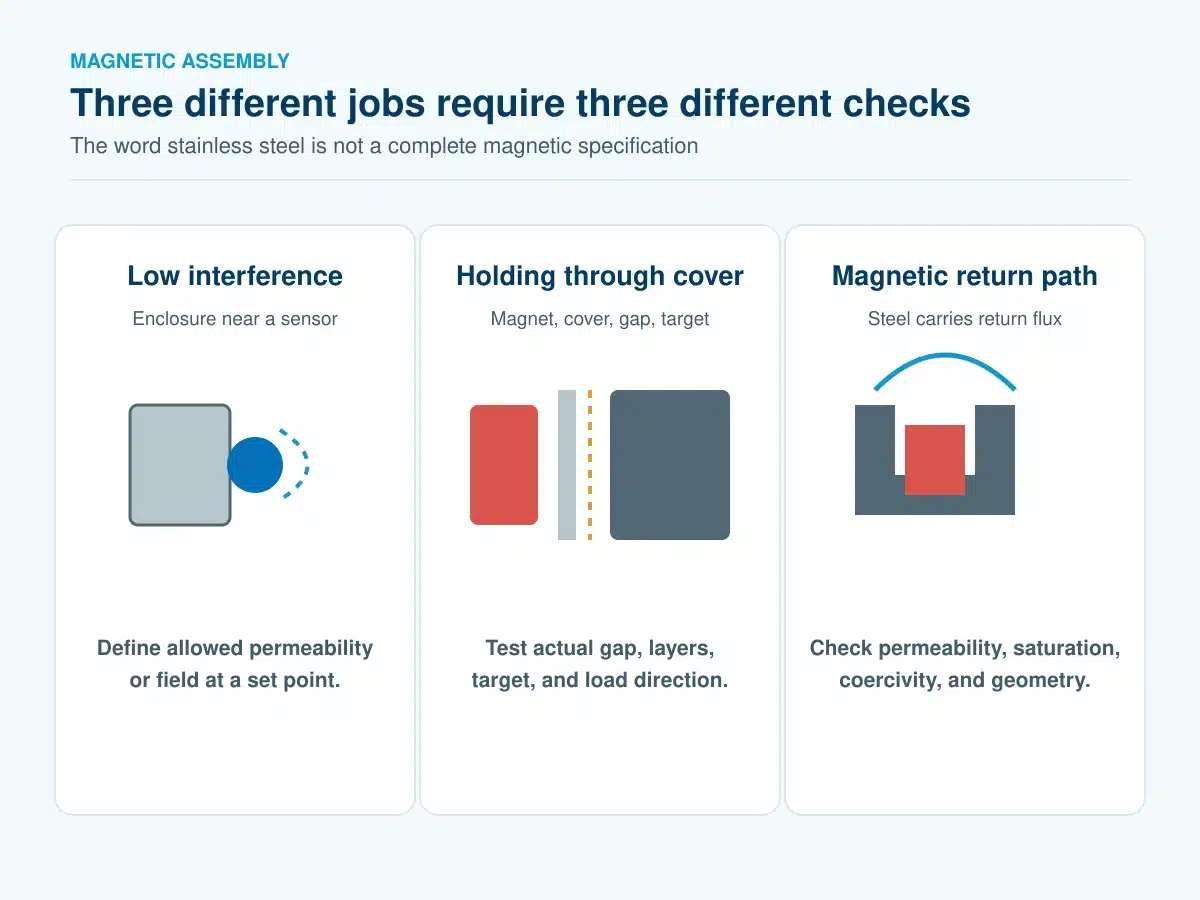
The right stainless steel depends on the part’s function. An enclosure intended to minimize magnetic interference has a different requirement from a bracket or return-path component intended to carry magnetic flux.
When Low Magnetic Interference Matters
A low-permeability austenitic stainless steel may be appropriate when a cover, enclosure, fastener, or support should not become a strong magnetic flux path. The requirement should specify the exact grade, product form, material condition, allowed permeability or field effect, test method, measurement location, and acceptance stage.
Do not select the material by family name alone. Forming and welding after material receipt may change the local response, so testing only the incoming flat sheet may not represent the finished component.
When Holding Force Matters
Any added nonmagnetic layer or physical separation between a magnet and its target can reduce pull force. The magnitude depends on the magnet, target material and thickness, gap, geometry, coatings, contact condition, and test setup, which are also central variables in specialist pull-force test guidance.
For a useful comparison, define the magnet dimensions and magnetization direction, target material and size, target thickness, coatings or intervening layers, actual working gap, load direction, and whether the load is static, cyclic, or subject to shock.
When Stainless Steel Is Intended as a Return Path
A clear response to a handheld magnet does not prove that a stainless grade will be an efficient magnetic return-path material. Magnetic-circuit performance also depends on permeability at the relevant field, saturation flux density, coercivity, geometry, and section thickness, as outlined in this soft-magnetic materials application guide.
The part should be evaluated in the intended magnetic circuit. A material that attracts a magnet may still create excessive reluctance or reach saturation in the proposed geometry.
How Should You Specify and Test the Stainless Component?
Start with the application’s real goal rather than asking only whether the steel is magnetic.
| 적용 목적 | Specify | Verify |
|---|---|---|
| Minimize magnetic interference | Grade, product form, condition, manufacturing route, maximum allowed permeability or field effect, measurement point | Test the relevant production stage and finished geometry when processing can change the response. |
| Maintain pull force through a stainless cover | Cover material, thickness, coatings, actual gap, magnet and target details, load direction | Test a representative assembly under the intended gap and contact conditions. |
| Use stainless steel as a magnetic target or return path | Exact grade, magnetic properties, geometry, thickness and operating field | Review the magnetic circuit and check for permeability and saturation limitations. |
| Confirm material identity | Purchase specification and required grade distinction | Use traceability records and an appropriate material-identification method; do not rely on a magnet alone. |
ASTM A342/A342M-26 provides methods for measuring the relative permeability of weakly magnetic materials up to a relative permeability of 6.0. Specimen geometry, selected method, and magnetic field conditions affect the result, and the standard is often applied to suitable semifinished specimens. Agree on the applicable method and acceptance stage before using it for a finished component.
What Information Should You Send for a Magnetic Assembly Review?
Provide the following information when stainless steel is close to a permanent magnet or forms part of the magnetic circuit:
- Stainless steel grade, product form, condition, and manufacturing process.
- Component drawing, wall thickness, critical dimensions, and tolerances.
- Magnet material, grade, dimensions, coating, and magnetization direction.
- Actual working gap, air spaces, coatings, adhesives, and other intervening layers.
- Target or return-path material, size, thickness, and surface condition.
- Required pull force, field level, torque, sensing result, or positioning function.
- Load direction and whether loading is static, cyclic, impact, or vibration-related.
- Required safety factor and acceptance limits.
- Operating temperature, environment, and corrosion exposure.
- Measurement method, test stage, and measurement locations.
- For low-interference designs, the maximum permitted field or disturbance at a defined point.
- Available samples and whether representative physical testing is required.
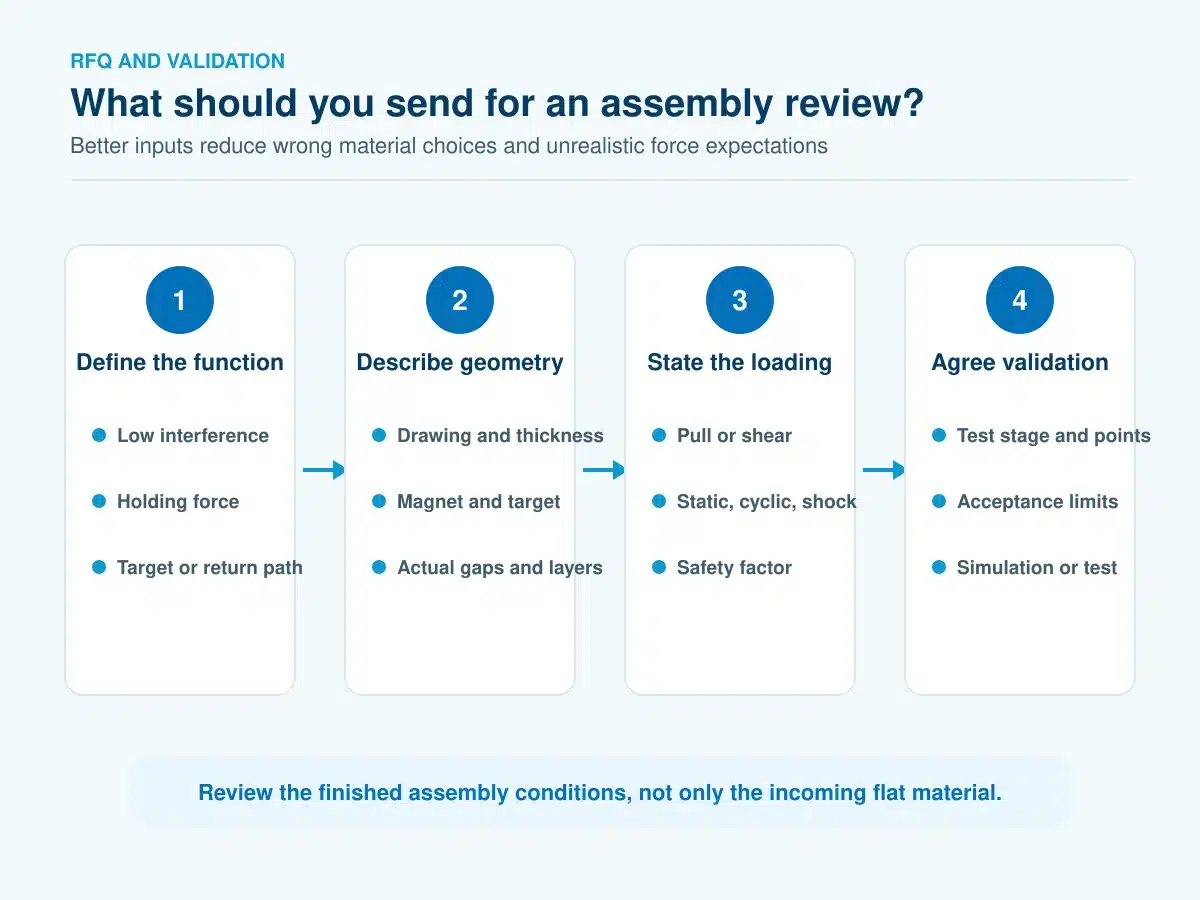
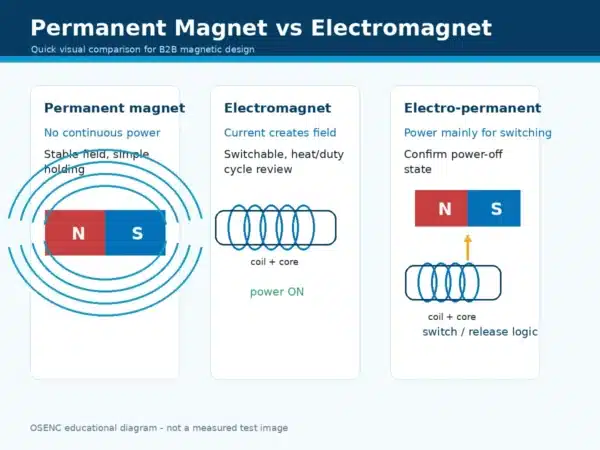
Osenc can use these inputs to review magnet geometry, magnetization direction, working gap, target conditions, and an appropriate validation approach for a 맞춤형 네오디뮴 자석 or magnetic assembly. Depending on the design risk, validation may require magnetic-field simulation or representative physical testing under the intended assembly conditions. No Osenc project result is claimed in this article.
Discuss Your Magnetic Assembly
Send your drawing, material condition, working gap, load direction, and acceptance requirement for an engineering review.
Osenc 문의자주 묻는 질문
모든 스테인리스강은 비자성인가요?
아닙니다. 페라이트계, 마르텐사이트계, 듀플렉스계 및 대부분의 석출 경화계 스테인리스강은 자성을 띱니다. 304 및 316과 같이 완전 풀림 처리된 오스테나이트계 강종은 일반적으로 투자율이 훨씬 낮습니다.
304 스테인리스강에 자석이 붙는 이유는 무엇입니까?
냉간 성형, 굽힘, 압연, 프레스 가공, 전단 또는 기타 국부 변형으로 인해 변형 유기 마르텐사이트가 생성될 수 있습니다. 가공부와 미가공부를 비교한 후, 재질 등급 식별 또는 투자율이 중요할 경우 적절한 방법으로 재질을 확인하십시오.
316 스테인리스강은 완전히 비자성인가요?
아니요. 소둔 상태의 316 전신재는 일반적으로 자석에 거의 끌리지 않지만, 냉간 가공과 용접으로 인해 국부적인 자성이 증가할 수 있습니다. 따라서 자석에 대한 반응은 등급명만으로 판단하지 말고 소재 상태와 가공 공정을 기준으로 설명해야 합니다.
자석 테스트만으로 스테인리스강이 304 또는 316인지 입증할 수 있나요?
아니요. 자석은 정성적 선별에만 사용할 수 있습니다. 확정적인 자석 등급 판정을 위해서는 소재 기록과 적절한 화학 분석 또는 재질 식별 방법이 필요합니다.
네오디뮴 자석 주변에는 어떤 스테인리스강을 사용해야 하나요?
이는 해당 부품이 자기 간섭을 최소화해야 하는지, 제어된 간극을 유지해야 하는지, 타깃 역할을 해야 하는지, 또는 귀환 자속을 전달해야 하는지에 따라 달라집니다. 강재를 선정하기 전에 기능, 등급 및 상태, 형상, 작동 간극, 자기적 요구사항, 검증 방법을 명확히 지정하십시오.
참고 문헌
- British Stainless Steel Association, Magnetic Properties of Austenitic Stainless Steels.
- British Stainless Steel Association, Composition Effects on the Magnetic Permeability of Austenitic Stainless Steels.
- British Stainless Steel Association, Effect of Cold Work and Heat Treatment on Magnetic Permeability.
- British Stainless Steel Association, On-Site Methods for Stainless Steel Grade and Product Sorting.
- Nickel Institute, The Nickel Advantage in Stainless Steel.
- ASTM International, ASTM A342/A342M-26: Standard Test Methods for Permeability of Weakly Magnetic Materials.
- K&J Magnetics, Testing Magnet Strength.
- Arnold Magnetic Technologies, Soft Magnetic Materials Application Guide.
Evidence limitation: No Osenc customer case, project drawing, simulation result, physical test record, or named technical reviewer is presented in this article. The diagrams are educational visuals, not first-hand project evidence.