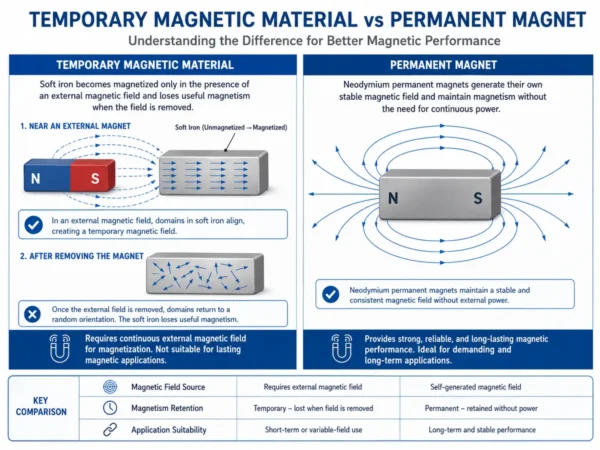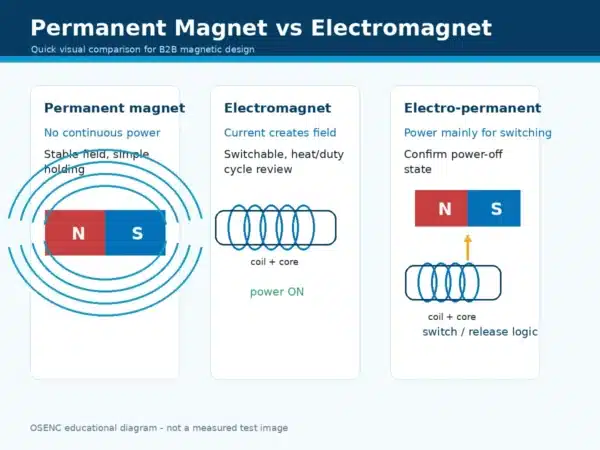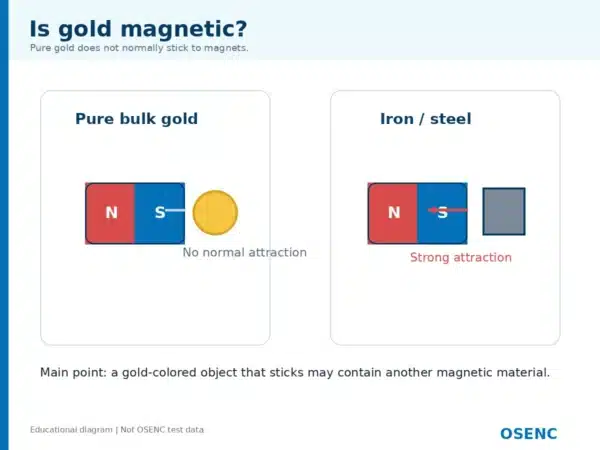








Czym jest przenikalność magnetyczna?
Pojęcie przenikalności magnetycznej określa, w jakim stopniu materiał umożliwia przenikanie linii pola magnetycznego. Mówiąc mniej technicznie, jest to miara łatwości przewodzenia magnetyzmu przez materiał, podobnie jak przewodność elektryczna określa łatwość przewodzenia prądu elektrycznego.
Wyjaśnia to, dlaczego materiały takie jak żelazo mogą stać się silnymi magnesami, natomiast drewno lub tworzywa sztuczne — nie. Materiały o wysokiej przenikalności magnetycznej mogą koncentrować linie pola magnetycznego, co jest cenne w silnikach, transformatorach i cewkach indukcyjnych.
Definicja przenikalności magnetycznej
Przenikalność magnetyczna określa stopień, w jakim materiał przewodzi pole magnetyczne. Opisuje reakcję materiału na przyłożone pole magnetyczne.
Linie pola magnetycznego można porównać do wody płynącej w rurze: materiał o wysokiej przenikalności przypomina szeroką rurę, przez którą magnetyzm może łatwo przenikać. Przenikalność oznacza się symbolem m (mu) i jest ona istotnym parametrem w obliczeniach magnetycznych.
Przenikalność magnetyczna próżni
Przenikalność magnetyczna próżni, powszechnie oznaczana jako μ₀ (mu zero), jest właściwością magnetyczną próżni. Ma stałą wartość równą 4π × 10⁻⁷ H/m (henr na metr).
Wartość ta służy do porównywania właściwości magnetycznych innych materiałów. Przenikalność względna jest zawsze określana w odniesieniu do μ₀.
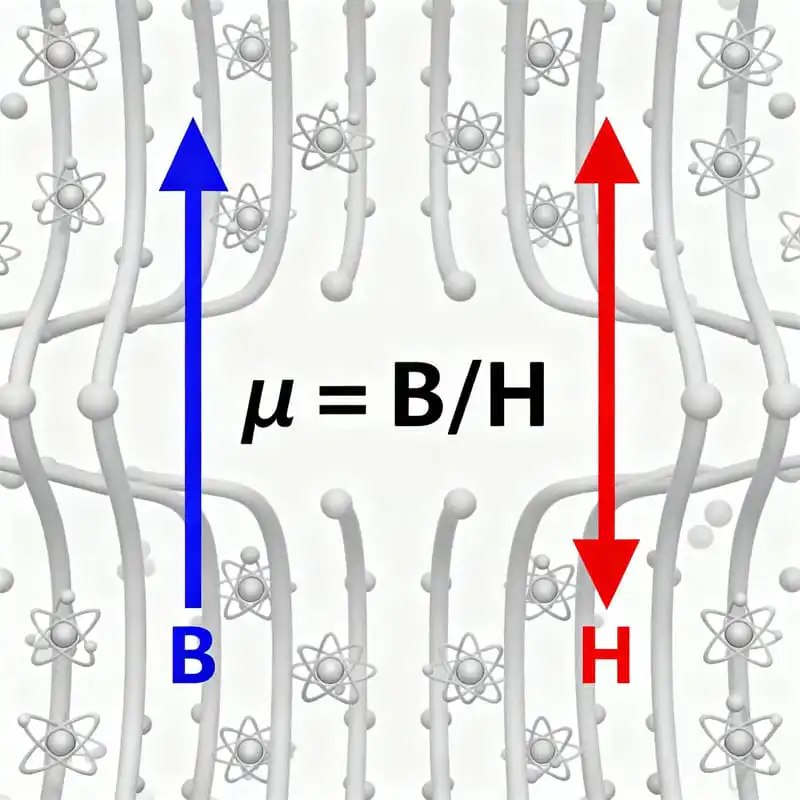
Zależność między B i H; definicja przenikalności μ
Przenikalność łączy dwie ważne wielkości magnetyczne — indukcję magnetyczną (B) i natężenie pola magnetycznego (H) — zgodnie z równaniem:
B = μH
W tym przypadku B oznacza całkowitą indukcję magnetyczną w materiale, H — natężenie przyłożonego pola, a μ — miarę reakcji materiału.
Gdy m jest duże, materiał łatwo się magnesuje; gdy jest małe, materiał trudno się magnesuje.
Ujęcie mikroskopowe i makroskopowe; przenikalność przyrostowa
W skali mikroskopowej przenikalność magnetyczna zależy od ustawienia małych magnesów atomowych (dipoli) względem zewnętrznego pola. W substancjach takich jak żelazo bardzo wiele atomów ustawia się zgodnie z polem, co zapewnia im bardzo dużą przenikalność.
W skali makroskopowej przenikalność opisuje ogólne zachowanie materiału jako całości i może zmieniać się w zależności od natężenia pola, temperatury lub częstotliwości.
Stosunek niewielkiej zmiany strumienia magnetycznego do niewielkiej zmiany przyłożonego pola to przenikalność przyrostowa. Może być również przydatna podczas badania zachowania materiałów w zmiennych polach magnetycznych, w tym przemiennych, na przykład w transformatorach i obwodach elektronicznych.
Wzór na przenikalność magnetyczną
Do analizy przenikalności magnetycznej w warunkach rzeczywistych wykorzystuje się wzory. Pozwalają one obliczyć, jak pola magnetyczne zachowują się wewnątrz różnych materiałów. Za pomocą tych równań inżynierowie mogą porównywać materiały, projektować lepsze urządzenia magnetyczne i przewidywać zdolność substancji do przewodzenia strumienia magnetycznego.
Symbole, jednostki i zmienne
W równaniach magnetycznych stosuje się trzy główne symbole: B, H, oraz μ.
- B oznacza indukcję magnetyczną, mierzoną w teslach (T). Określa ona całkowite pole magnetyczne wewnątrz materiału.
- H oznacza natężenie pola magnetycznego, mierzone w amperach na metr (A/m). Określa natężenie przyłożonego pola magnetycznego.
- μ oznacza przenikalność magnetyczną, która wskazuje, jak duży strumień magnetyczny powstaje wewnątrz materiału przy danym przyłożonym polu.
Wielkości te tworzą razem podstawowe równanie B = μH.
Jednostka przenikalności magnetycznej
Standardową jednostką SI przenikalności magnetycznej jest henr na metr (H/m). Można ją również wyrazić jako tesla razy metr na amper (T·m/A) ponieważ 1 henr jest równy 1 tesli razy metr na amper.
Jednostka ta określa, jak duże pole magnetyczne (w teslach) jest wytwarzane przy danym natężeniu prądu przypadającym na metr materiału.
Wzór wymiarowy
Wzór wymiarowy przenikalności magnetycznej można wyprowadzić z równania B = μH.
Wiemy, że:
- B ma wymiar [M¹ L⁰ T⁻² I⁻¹]
- H ma wymiar [I L⁻¹]
Zatem,
μ = B / H = [M¹ L¹ T⁻² I⁻²]
Wzór wymiarowy przenikalności magnetycznej ma więc postać M¹ L¹ T⁻² I⁻², co przedstawia jej zależność od masy, długości, czasu i natężenia prądu elektrycznego.
Jednostki względnej przenikalności magnetycznej
Względna przenikalność magnetyczna (μᵣ) jest wielkością bezwymiarową. Określa stosunek przenikalności magnetycznej materiału (μ) do przenikalności magnetycznej próżni (μ₀):
μᵣ = μ / μ₀
Ponieważ zarówno μ, jak i μ₀ mają te same jednostki, ich iloraz nie ma jednostki. Dzięki temu μᵣ jest liczbą bezwymiarową, która ułatwia porównywanie materiałów.
Względna przenikalność magnetyczna a podatność magnetyczna
Względna przenikalność magnetyczna i podatność magnetyczna opisują reakcję materiałów na pole magnetyczne. Przenikalność magnetyczna określa, jak łatwo pole magnetyczne przenika przez materiał, natomiast podatność magnetyczna określa, jak silnie materiał ulega namagnesowaniu. Wielkości te wspólnie wyjaśniają zachowanie magnetyczne różnych substancji.
μᵣ = μ/μ₀; χₘ = μᵣ − 1
Relative permeability (μᵣ) is the ratio of a material’s permeability (μ) to the permeability of free space (μ₀). It tells how much better or worse a material carries magnetic flux compared to a vacuum.
Magnetic susceptibility (χₘ) measures how much magnetization is produced inside the material. They’re linked by χₘ = μᵣ − 1, meaning higher μᵣ gives higher χₘ.
Magnetic Susceptibility
Magnetic susceptibility (χₘ) shows how easily a material becomes magnetized. If χₘ is positive, the material is attracted to magnets (like iron — paramagnetic or ferromagnetic). If χₘ is negative, it’s slightly repelled (diamagnetyczna). This helps identify how atoms align with a magnetic field.
Relation to Susceptibility and μ₀
Permeability and susceptibility are linked through the formula μ = μ₀(1 + χₘ). It shows that total permeability depends on both the vacuum’s permeability and the material’s susceptibility. When χₘ increases, μ also increases — meaning the material supports a stronger magnetic field.
Relation Between χ and μᵣ
The simple link between them is μᵣ = 1 + χₘ.
Jeśli χₘ = 0, then μᵣ = 1 (like air or vacuum).
Ferromagnetic materials have high χₘ and very large μᵣ, while diamagnetic materials have small negative χₘ and μᵣ just below 1. This relationship helps classify materials by their magnetic behavior.
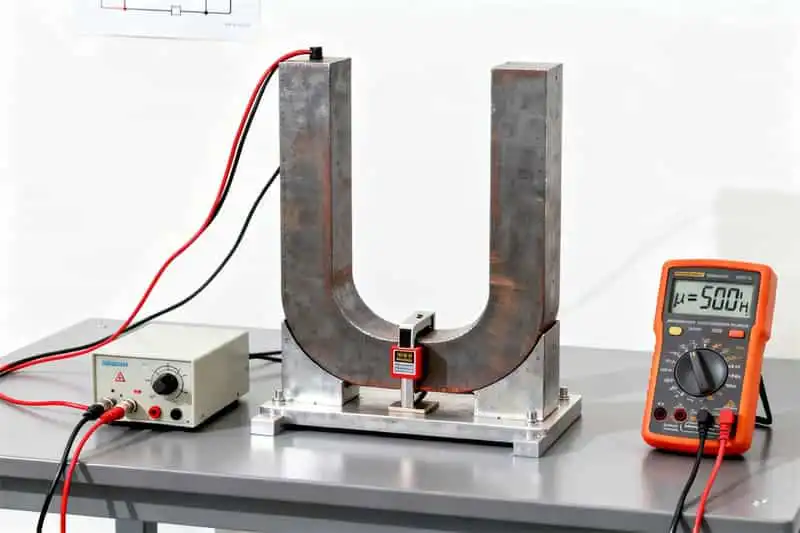
Types of Magnetic Permeability
Magnetic permeability is not a constant value. It varies depending on the material and the field of application, strength, and other conditions such as temperature or frequency. Various classes of permeability are defined below, which describe the behavior of materials in moving through certain magnetic fields or signal conditions in the steady and alternating magnetic fields.
Absolute Permeability (μ)
The actual permeability of a material in henry per meter (H/m) is known as the absolute permeability (μ). It is the sum of all the conducting abilities of that material to the magnetic flux. Absolute permeability contains the effect of atomic structure as well as external field conditions of the material.
It is useful for the base of calculation, and then compared with free space or relative measures.
Relative Permeability (μᵣ)
Relative permeability (μᵣ) is a ratio of the permeability of a material to the permeability of free space. It is the ratio of the amount of magnetic field that a substance can carry than what the vacuum can carry.
As an example, when μᵣ equals 1000 for soft iron, then it means soft iron would be able to conduct magnetic flux 1000 times better than air.
Amplitude, maximum, initial, incremental, reversible, complex
The different types of permeability help scientists understand how materials behave under different environmental conditions.
Amplitude permeability is the value that appears when the magnetic field undergoes sinusoidal changes.
Initial permeability – the permeability at very low magnetic fields.
Maximum permeability is the topmost value measured before the materials become saturated.
Incremental permeability is the small-signal permeability around a specific bias point.
Reversible permeability value is the behavior of materials in cases where the direction of the magnetic fields entirely reverses.
Dokument complex permeability model is applicable in alternating fields that have power losses and phase shifts.
Types of Magnetic Materials
The magnetic materials are arranged according to their responses to the magnetic field by scientists. The materials exhibit varying resistance to the magnetic field, with some materials being highly resistant and others having weak resistance, and others being highly attractive. Understanding of permeability and susceptibility is used in the selection of suitable materials for their magnetic and electronic work, depending on the behavior of the materials.
Categories of Magnetic Permeability
Scientists group magnetic materials into three major categories. Such as:

Ferromagnetic materials
The ferromagnetic materials exhibit the greatest degree of permeability since it is strongly attracted to a magnetic field.
The atomic dipoles in such materials are parallel to each other and thus lead to a vastly large value of permeability, thousands of times larger than free space values.
These materials are used in motor construction and transformer applications and magnetic core development, but their permeability characteristics decrease with increasing temperature or an increasing magnetic field. The materials become non-magnetic at temperatures beyond the Curie point.

Paramagnetic Materials
Paramagnetic materials have a small, positive susceptibility and a relative permeability slightly greater than one. Examples include aluminum, platinum, and magnesium. The materials exhibit a certain attraction to magnets, but the attraction is lost on the removal of the magnetic field.
The materials have a scientific research application and can work in a weak magnetic field environment.
Diamagnetic Materials
The diamagnetic materials, such as copper and gold, and bismuth, are pushed off by the magnetic fields. These materials’ magnetic moments of electrons cause a weak repelling effect as they resist the external magnetic field.
Complex Permeability
When there are some time-dependent changes in the magnetic fields applied to materials, the permeability becomes complicated in the cases of alternating currents or microwave functions. Storage or loss of energy under an alternating magnetic field is given by the two components of complex permeability, which encompass the actual and imaginary components.
μ′ and μ″; loss tangent tan δ = μ″/μ′
In complex permeability, μ′ (mu prime) represents the real part, showing how much magnetic energy is stored, while μ″ (mu double prime) represents the imaginary part, showing how much energy is lost as heat.
Dokument loss tangent (tan δ = μ″ / μ′) indicates how efficiently a magnetic material operates at alternating frequencies. A lower tan δ means fewer losses and better performance.
This concept is critical in designing materials for high-frequency transformers, antennas, and shielding, where both energy storage and loss matter.
Magnetic Hysteresis
Magnetic hysteresis refers to the lag between changes in magnetic field power and the resulting magnetization of a material. It shows that permeability isn’t regular, however depends on magnetic records, how the material changes into previously magnetized or demagnetized during repeated magnetic cycles.
Permeability Changes with B–H Loop
Within the B-H curve (loop of magnetic hysteresis), permeability remains constant with an increase and a decrease in magnetization. First, the permeability increases violently with the alignment of atomic dipoles with the sphere.
Once the field reaches its saturation point, additional increasing field strength makes insignificant additional magnetization. At the reversal point, it is not completely reversed and therefore, hysteresis loss occurs.
This loop allows the determination of the efficiency of cycles of magnetic substances to store and release energy.
Saturation and Core Materials
When a magnetic core has become saturated, all magnetic domains have aligned, and the permeability reduces greatly. At this stage, the material is not able to hold more magnetic flux.
The major materials used as core, such as silicon metal, ferrite, and iron alloys, are chosen entirely with respect to their ability to handle saturation effectively.
It is important to maintain high permeability below saturation in transformers, inductors, and other electromagnetic devices to ensure that clean magnets are operating and the least losses are being incurred.
Factors affecting Permeability
The magnetic permeability is not fixed but varies depending on the temperature, material structure, impurities, and power of the magnetic field. The awareness of the said factors helps in creating magnetic and electronic devices.
Temperature, Microstructure, Impurities
The high temperature causes the magnetic alignment to be perturbed by atomic vibrations, and this lowers the permeability.
The microstructure (such as grain size and crystal orientation) can also be critical; finer grains oftentimes will yield better results.
Most of the impurities, such as carbon or oxygen, interfere with the motion of the domains; hence, magnetic alloys are heat-treated and purified to balance.
Nonlinearity; saturation effects
In high magnetic fields, the domains align, which leads to nonlinear permeability behaviour. The material becomes resistant to permeability after which its value reduces swiftly. Transformers are designed based on saturation prevention, which prevents the loss of energy and the degradation of the signal.
Magnetic Permeability can Change
Magnetic permeability of the materials is subject to change with time due to stress application and various magnetization cycles, and mechanical pressure. The magnetic alignment of the domains undergoes slight variation, due to which magnetic materials require special treatment to maintain their homogeneous properties.
Example of Magnetic Permeability in Mild Steel
Mild steel has high magnetic permeability since its relative permeability lies between 2000 and 5000, which allows the magnetic lines to pass through the material thousands of times compared to air. The material has been used as a great substitute for transformer cores and electromagnets due to its high permeability.
Example of Magnetic Permeability in Wood
The values of relative permeability of wood are in the range of 1, meaning it does not pull or push away the magnetic fields. The material is a nonmagnetic base on scientific experiments that do not to interfere with a magnetic field.
Applications of High Permeability Materials
The functioning of electrical and electronic systems also relies on high magnetic permeable materials. These materials minimize energy waste, enhance performance, and stabilize magnetic circuits in transformers, motors, and shielding devices that have to work under heavy or variable magnetic conditions.
Transformers and Inductors
Transformers and inductors have high-permeability cores constructed of silicon steel or ferrite, which permits easy transmission of magnetic flux. The system has improved energy transfer with low power loss and leakages of magnetic fields. A suitable choice of core materials makes it possible to provide stable and efficient work in power supply systems and circuits of signal transmission.
Magnetic Storage
Hard drives and tapes are magnetic storage devices that store digital data using materials with highly regulated permeability. Binary information is represented by the magnetic orientation of small regions. The material facilitates the effective writing and reading of the data, besides expanding storage space.
Electromagnetic Shielding
Electromagnetic shielding is done with high-permeability material like mu-metal. The magnetic field lines are absorbed and redirected by them, therefore, avoiding interference with sensitive electronics. The material shields medical equipment and communication systems, and laboratory equipment against electromagnetic interference.
Extraneous Magnetic Fields
High-permeability materials function as protective barriers that redirect magnetic fields toward safe areas when strong or uncontrolled magnetic fields exist. The materials protect MRI facilities and aerospace operations, and precision scientific equipment from interference while ensuring operational precision and safety.
Conclusion
Magnetic permeability is one of the main properties that describes the behavior of materials in the presence of a magnetic field. It bridges atom-level interactions with large-signal magnetic performance, which leads to an understanding of the different kinds of materials in the context of magnetic fields. To put it more simply, some materials will enhance the magnetic field while others will weaken it. The study of permeability is very helpful in grasping the behavior of magnetic domains and their role in determining the efficiency of magnetic devices.
The ability to control permeability is one of the most important factors for the creation of trustworthy and energy-saving systems in modern-day technology. By knowing how temperature, impurities, and saturation affect permeability, engineers can come up with magnetic components that are not only smarter but also more stable for real-world applications.
Najczęściej zadawane pytania
Is High Magnetic Permeability Good?
High magnetic permeability values create positive effects in most situations. The material enables better magnetic flux transmission, which leads to improved operational efficiency in transformers and motors, and inductors.