






빠른 답변
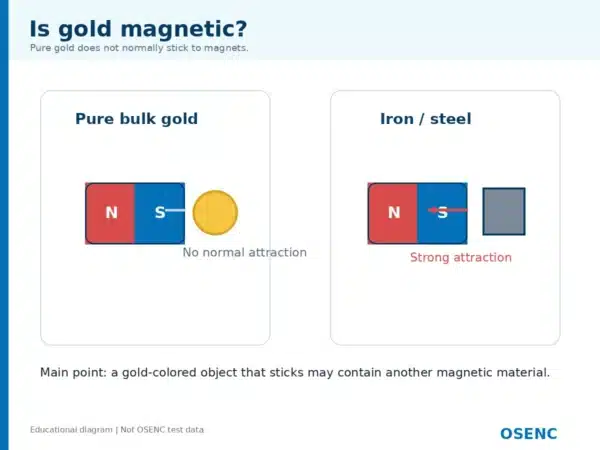
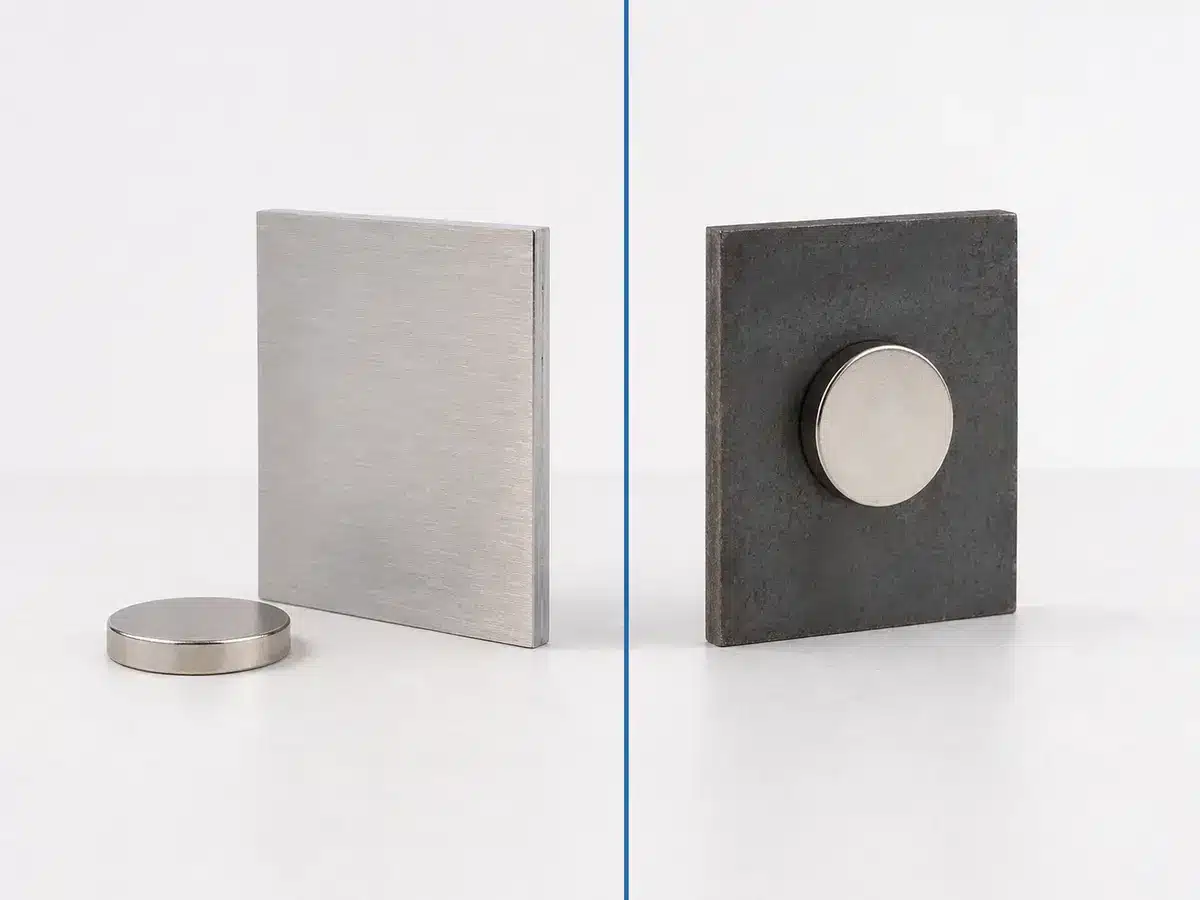
아니요. 알루미늄은 철, 니켈 또는 일반 탄소강과 같은 방식으로 자성을 띠지 않습니다. 일반적으로 영구자석은 알루미늄에 붙지 않습니다.
기술적으로 알루미늄은 약한 상자성체입니다. 외부 자기장에 미세하게 반응하지만, 그 효과는 일반 자석이 붙을 정도로 강하지 않습니다.
다만 다음 두 가지 주요 상황에서는 알루미늄도 자석과 상호작용할 수 있습니다.
- 자석 또는 자기장이 알루미늄에 대해 상대적으로 움직이는 경우.
- 자석이 알루미늄 패널 뒤에 있는 강철 부품을 끌어당기는 경우.
이러한 현상은 전자기 유도 또는 어셈블리 내의 다른 강자성체로 인해 발생합니다. 알루미늄 자체가 영구자석이 된 것은 아닙니다.
알루미늄과 자석: 빠른 비교
| 상황 | 예상 결과 | 주요 원인 |
|---|---|---|
| 고정된 자석이 벌크 알루미늄에 접촉함 | 일반적으로 눈에 띄는 인력 없음 | 알루미늄은 강자성체가 아님 |
| 더 강한 네오디뮴 자석이 알루미늄에 접촉함 | 여전히 강철처럼 부착되지 않음 | 더 강한 자기장도 알루미늄의 재료 분류를 바꾸지 않음 |
| 알루미늄이 자석과 강철 사이를 분리함 | 자석이 알루미늄을 사이에 두고 강철을 끌어당길 수 있음 | 알루미늄이 전체 작동 간극의 일부가 됨 |
| 자석이 알루미늄 근처에서 이동함 | 항력, 저항 또는 제동이 발생할 수 있음 | 변화하는 자속이 와전류를 유도함 |
| 알루미늄이 교번 자기장에 노출됨 | 와전류와 그에 따른 발열이 발생할 수 있음 | 기계적 움직임이 없어도 자기장은 계속 변함 |
| 자석이 “알루미늄” 어셈블리에 붙음 | 전체 어셈블리를 점검하십시오 | 강철 체결부품, 인서트, 샤프트 또는 백킹이 원인일 수 있음 |
알루미늄은 정말 비자성체입니까?
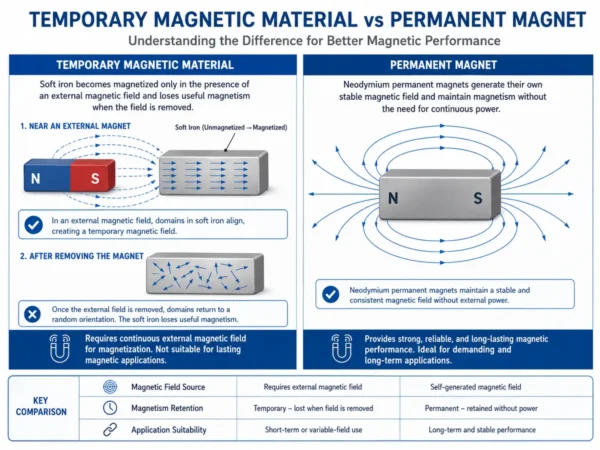
일상적인 용도에서는 영구자석이 일반적으로 알루미늄에 붙지 않으므로 알루미늄을 “비자성’이라고 해도 무방합니다.
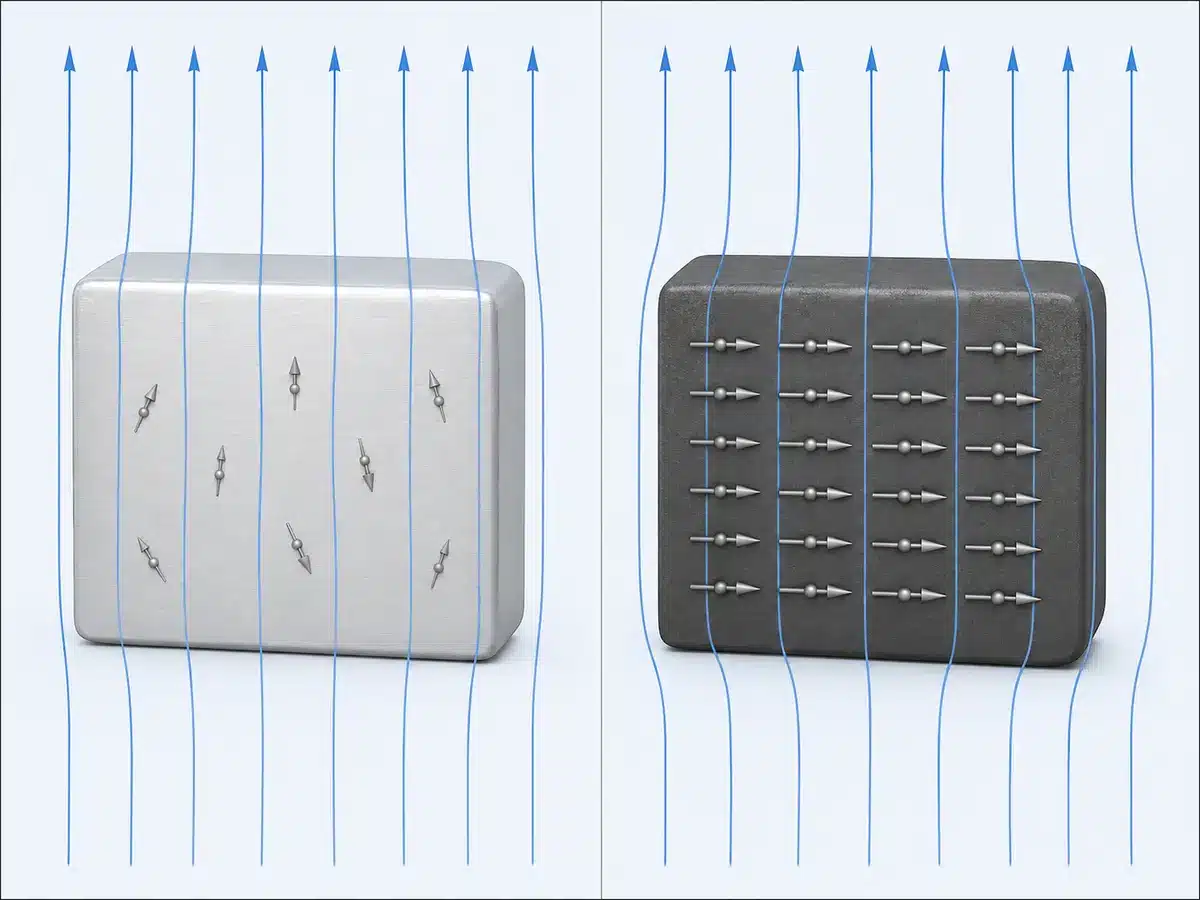
재료과학에서는 상자성체라는 용어가 더 정확합니다. 상자성체는 외부 자기장이 가해지면 자기장 방향으로 매우 약하게 반응하지만, 강자성체와 같은 강한 영구 자화는 유지하지 않습니다.
OpenStax는 알루미늄을 상자성체로 분류합니다 또한 상자성체의 반응은 약하며, 외부 자기장이 제거된 후에는 영구 자화가 남지 않는다고 설명합니다.
실무적인 차이는 다음과 같습니다.
| 재료의 거동 | 영구자석에 대한 반응 | 실용적인 영구 자화를 유지하는가? |
|---|---|---|
| 강자성체 | 강한 인력이 발생할 수 있음 | 대체로 가능 |
| 상자성체 | 인가 자기장에서 매우 약한 인력 발생 | 일반적인 영구 자화 없음 |
| 반자성체 | 매우 약한 반대 방향 반응 | 아니요 |
따라서 알루미늄이 자기장의 영향을 전혀 받지 않는 것은 아니지만, 정적 자기 반응이 너무 작아 일반적인 자석 부착에는 적합하지 않습니다.
알루미늄이 자석에 달라붙지 않는 이유는 무엇입니까?
강자성체는 인가 자기장에 반응하여 상당한 자화를 형성할 수 있으므로 영구자석에 강하게 달라붙습니다.
벌크 알루미늄은 이와 같은 강력한 자기 귀환 경로를 형성하지 못합니다. 고성능 네오디뮴 자석 을 사용해도 탄소강처럼 거동하지는 않습니다.
이러한 차이는 자석식 잠금장치, 장착 시스템 또는 고정구를 선정할 때 중요합니다. 부착 대상 표면이 알루미늄인 경우 자석 등급만 높여도 일반 강재와 같은 부착력이 생기지는 않습니다.
일반적인 대안은 다음과 같습니다.
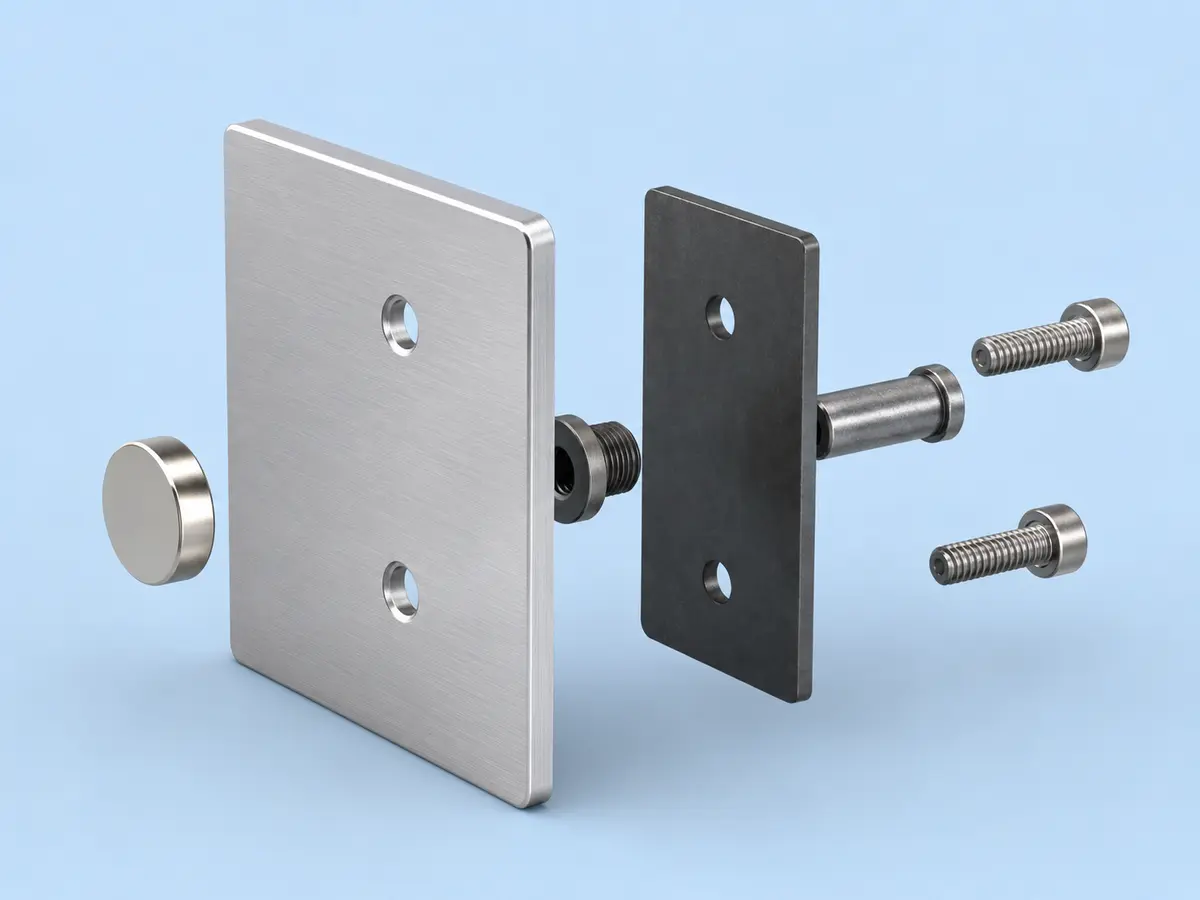
- 적합한 강재 타깃 플레이트 추가.
- 기계식 홀더 내부에 자석 설치.
- Capturing the magnet in a pocket or bracket.
- Using a project-specific adhesive system.
- Redesigning the assembly so the magnet acts on another magnet or ferromagnetic component.
The retention method should be selected from the actual load, environment and service conditions rather than from the magnet grade alone.
Why Can a Moving Magnet Affect Aluminum?
Aluminum is a good electrical conductor. When a magnet moves relative to aluminum, the magnetic flux through the conductor changes and can induce circulating electrical currents called eddy currents.
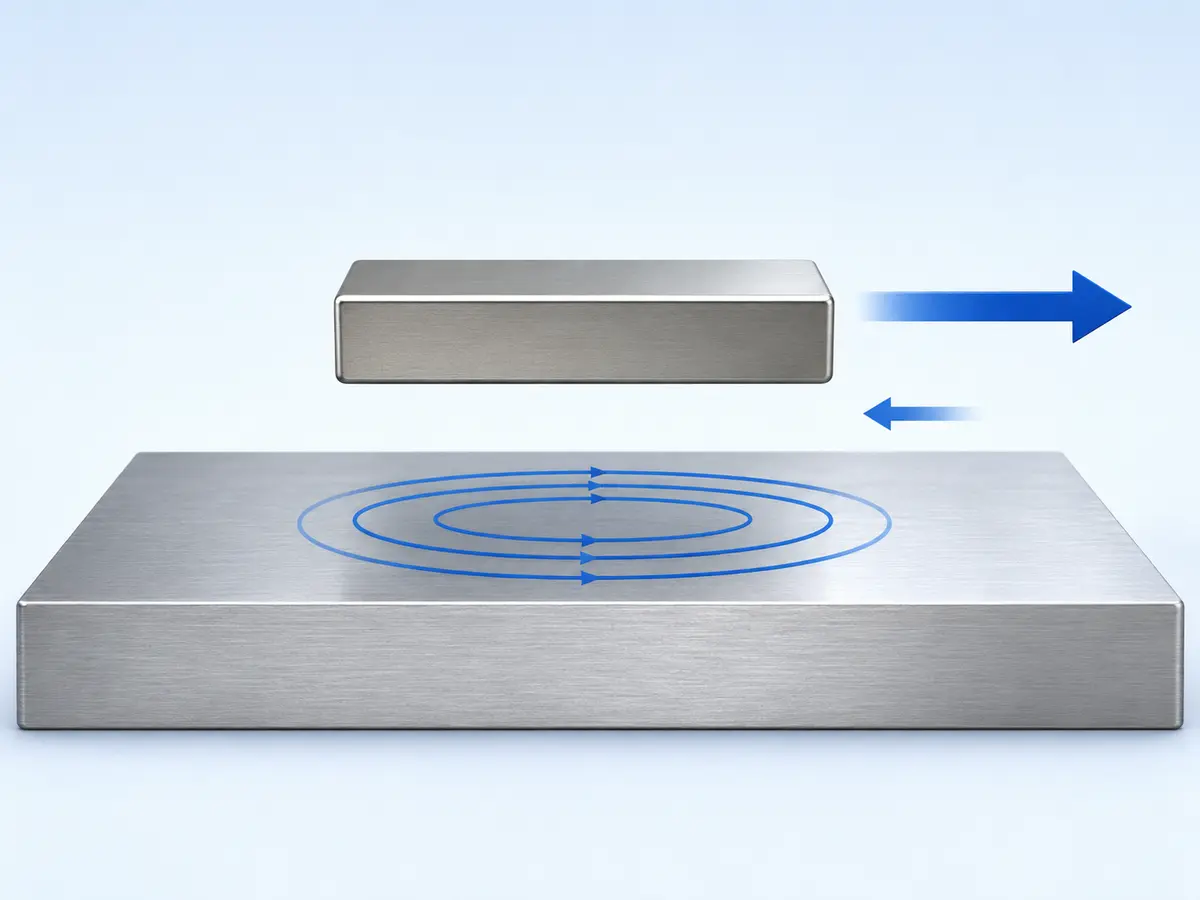
Those currents create their own magnetic field. Under Lenz’s law, the induced effect opposes the change that produced it, which can create drag or braking.
코어리스 모터의 University of Maryland demonstrates this by dropping a strong magnet arrangement through an aluminum tube. The changing flux induces currents in the tube that oppose the falling motion.
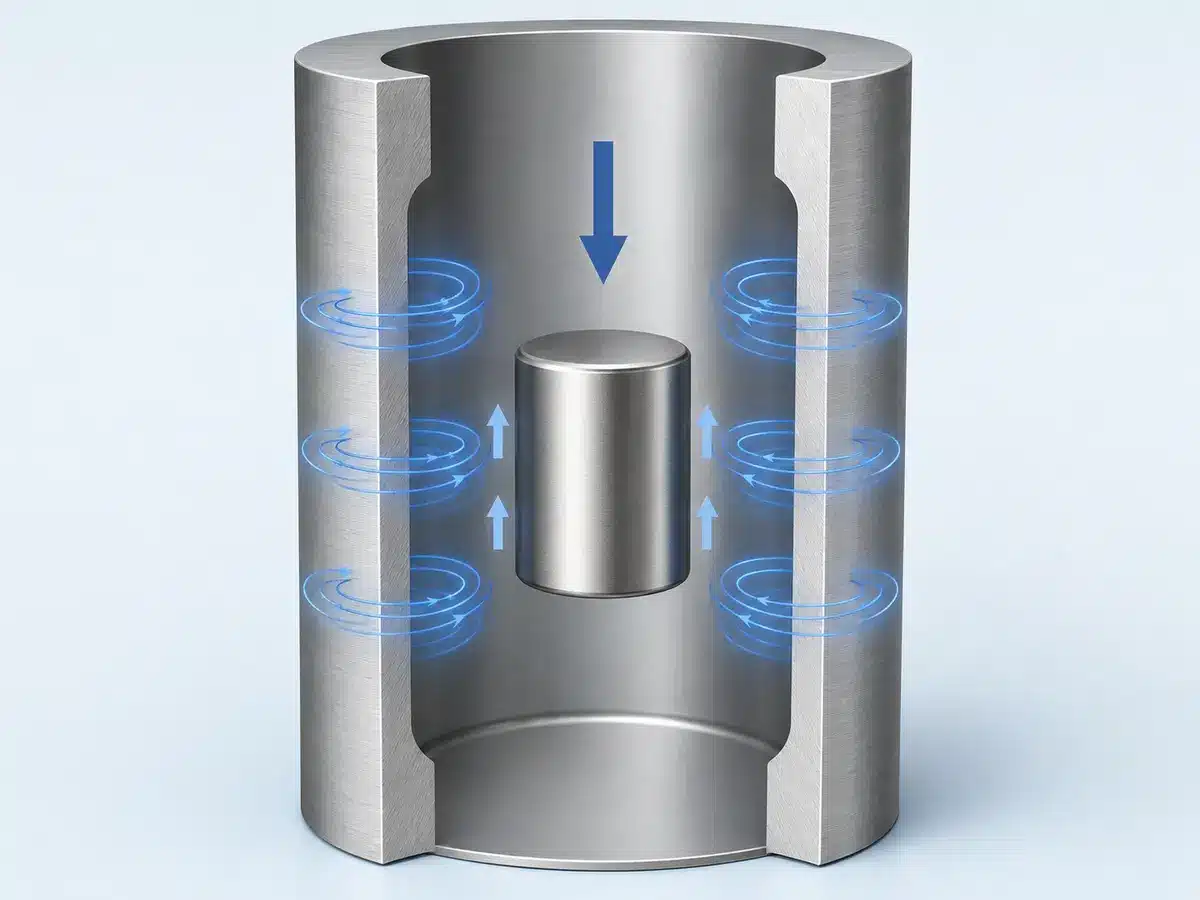
This does not mean the aluminum has become ferromagnetic. The interaction depends on changing magnetic flux.
Factors that can affect the result include:
- Relative speed.
- Field strength and field gradient.
- Magnet-to-aluminum distance.
- Aluminum thickness and geometry.
- 전기 전도도.
- 순환 전류가 흐를 수 있는 경로.
- 자기장 주파수.
- 동적 듀티 사이클.
도전성 판의 슬롯이나 단절부는 전류 경로를 제한하고 자기 감쇠를 줄일 수 있습니다. 따라서 서로 다른 형상의 두 알루미늄 부품이 동일한 움직이는 자석 근처에서 서로 다르게 거동할 수 있습니다. 자세한 내용은 다음을 참조하십시오: UCF\/OpenStax 와전류 설명.
상대 운동이 멈추고 인가된 자기장이 다른 방식으로 변하지 않는다면, 유도 전류는 감쇠하고 감쇠력은 0으로 떨어집니다. 그러나 교류 자기장 또는 그 밖의 시간에 따라 변하는 자기장은 기계적 운동이 없어도 계속 와전류를 유도할 수 있습니다.
연속 운전 또는 고주파 운전은 전기적 손실과 온도 상승을 초래할 수 있습니다. 실제 항력과 발열은 “알루미늄”이라는 단어만으로는 결정할 수 없으며, 자석 배치, 도체 형상, 속도 또는 주파수, 듀티 사이클이 필요합니다.
알루미늄은 자기장을 차단합니까?
일반적인 알루미늄 판은 변화하는 자기장에 대응할 수 있는 것과 같은 메커니즘으로 정자기장을 차폐하지는 않습니다.
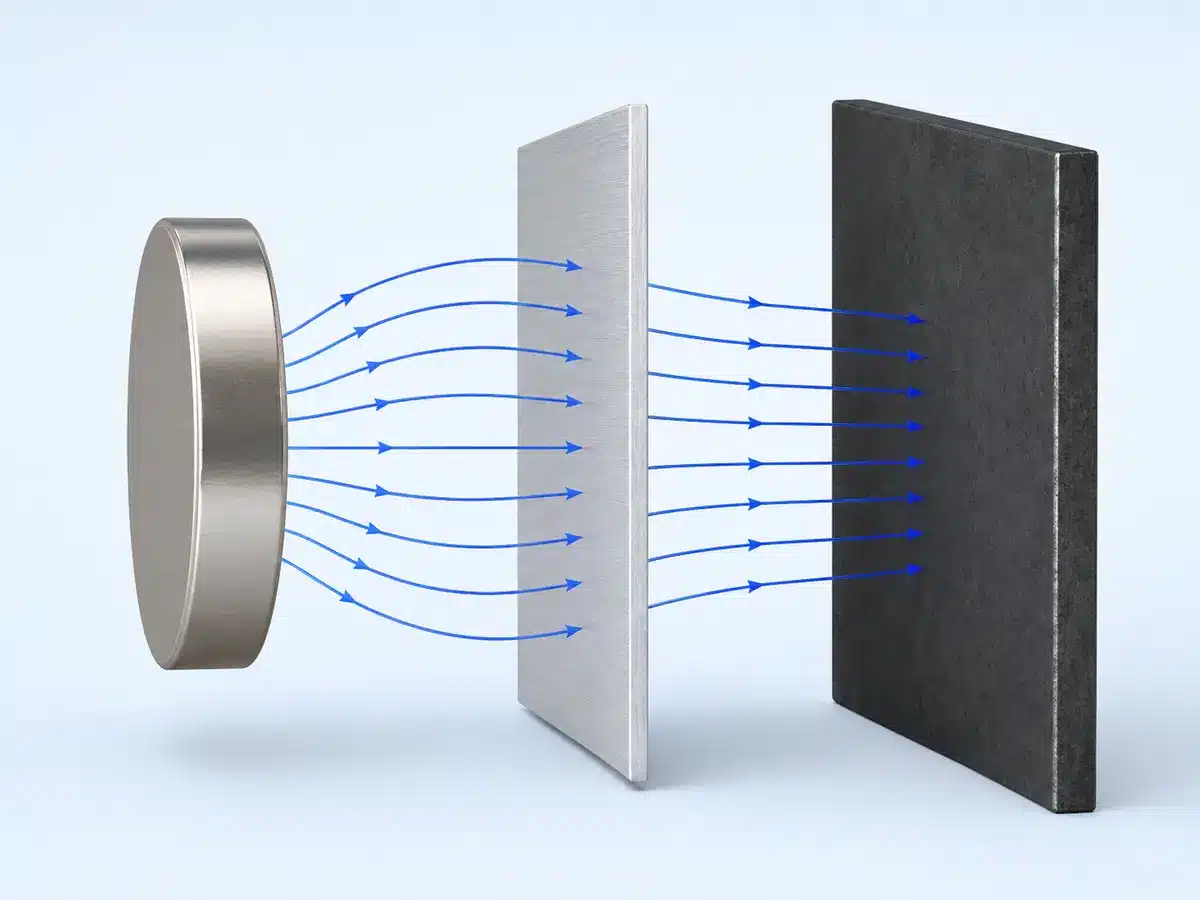
정지 상태의 영구자석 적용에서는 자속이 변하지 않으므로 알루미늄이 지속적인 와전류 차폐를 생성하지 않습니다. 따라서 자석은 판 뒤의 강자성체 대상물을 끌어당길 수 있습니다.
알루미늄 두께는 자석과 대상물 사이의 전체 거리의 일부가 됩니다. 이로 인해 추가된 간극은 사용 가능한 힘을 크게 감소시킬 수 있습니다.
정적 부착 설계에서는 다음을 평가하십시오:
- 알루미늄 두께.
- 코팅 및 접착층.
- 추가 공극.
- 자석 치수 및 착자 방향.
- 대상 강재의 재질.
- 대상 크기 및 두께.
- 정렬 상태 및 접촉 면적.
- 요구 하중 방향.
직접 접촉 상태에서 측정한 인장력 값은 알루미늄 패널을 통과하는 최종 힘으로 간주해서는 안 됩니다. 공개된 인장력 값은 일반적으로 크고 평탄하며 충분한 두께를 가진 강재 대상물을 사용해 통제된 조건에서 측정됩니다. 간극, 표면 상태 및 강재 치수가 달라지면 결과도 달라질 수 있습니다. 다음을 참조하십시오: K&J Magnetics의 인장력 테스트 조건.
실제 어셈블리에서 프로토타입 테스트를 수행하는 것이 최종 설계 승인을 위한 가장 안전한 근거입니다.
시간에 따라 변하는 자기장은 다릅니다. 도전성 판재는 유도 전류를 발생시켜 빠르게 변하는 자기장에 반대할 수 있으며, 그 결과는 주파수, 비저항, 두께 및 형상에 따라 달라집니다. 따라서 알루미늄을 자기장에 항상 투명한 물질이나 보편적인 자기 차폐체로 설명해서는 안 됩니다.
자석이 알루미늄 부품에 때때로 달라붙는 이유는 무엇인가?
자석 테스트는 눈에 보이는 표면만이 아니라 전체 물체를 검사합니다.
정지한 자석이 알루미늄으로 식별된 부품에 뚜렷한 인력을 보인다면, 알루미늄 자체가 강한 자성을 띤다고 결론 내리기 전에 어셈블리를 점검하십시오.
| 관찰 | 가능한 설명 | Recommended check |
|---|---|---|
| Attraction is concentrated near holes | Steel screws, threaded inserts or bushings | Remove or test the hardware separately |
| Attraction occurs near an edge | Hidden frame or backing plate | Review the cross-section or assembly drawing |
| Attraction appears near a shaft | Steel axle, bearing or internal mechanism | Test components separately |
| Attraction covers most of the surface | Steel core, laminated construction or incorrect material identification | Confirm the base material and BOM |
| No static attraction, but movement feels resisted | Eddy-current interaction | Compare stationary and moving tests |
| Results vary between supposedly identical parts | Different hardware, contamination or material mix | Check supplier records and material specifications |
A University of Maryland spinning-disc demonstration specifically warns that the steel axle produces a different magnetic response from the aluminum disc. This is a useful reminder that a component-level magnet test can be misleading when several materials are present.
A magnet test can help locate ferromagnetic components, but it cannot prove that a material is aluminum or identify its alloy.
How Should You Design a Magnet Around Aluminum?
Start by identifying what the magnet must do. Static holding, sensing and dynamic damping are different engineering tasks.
| Design objective | Practical approach | Main validation requirement |
|---|---|---|
| Attach directly to an aluminum surface | Add steel, use another magnet, or use mechanical/adhesive retention | Surface, load and environmental validation |
| Attract steel through an aluminum panel | Treat the panel and coatings as the working gap | Force test using the complete stack-up |
| Create drag near moving aluminum | Evaluate an eddy-current arrangement | Speed, geometry, gap, duty cycle and temperature |
| Operate a sensor through an aluminum housing | Review the complete sensor-field-housing system | Sensor type, frequency, wall thickness and working distance |
| Install a magnet inside an aluminum bracket | Use a pocket, holder, overmolding, mechanical capture or suitable adhesive | Shock, vibration, temperature and assembly testing |
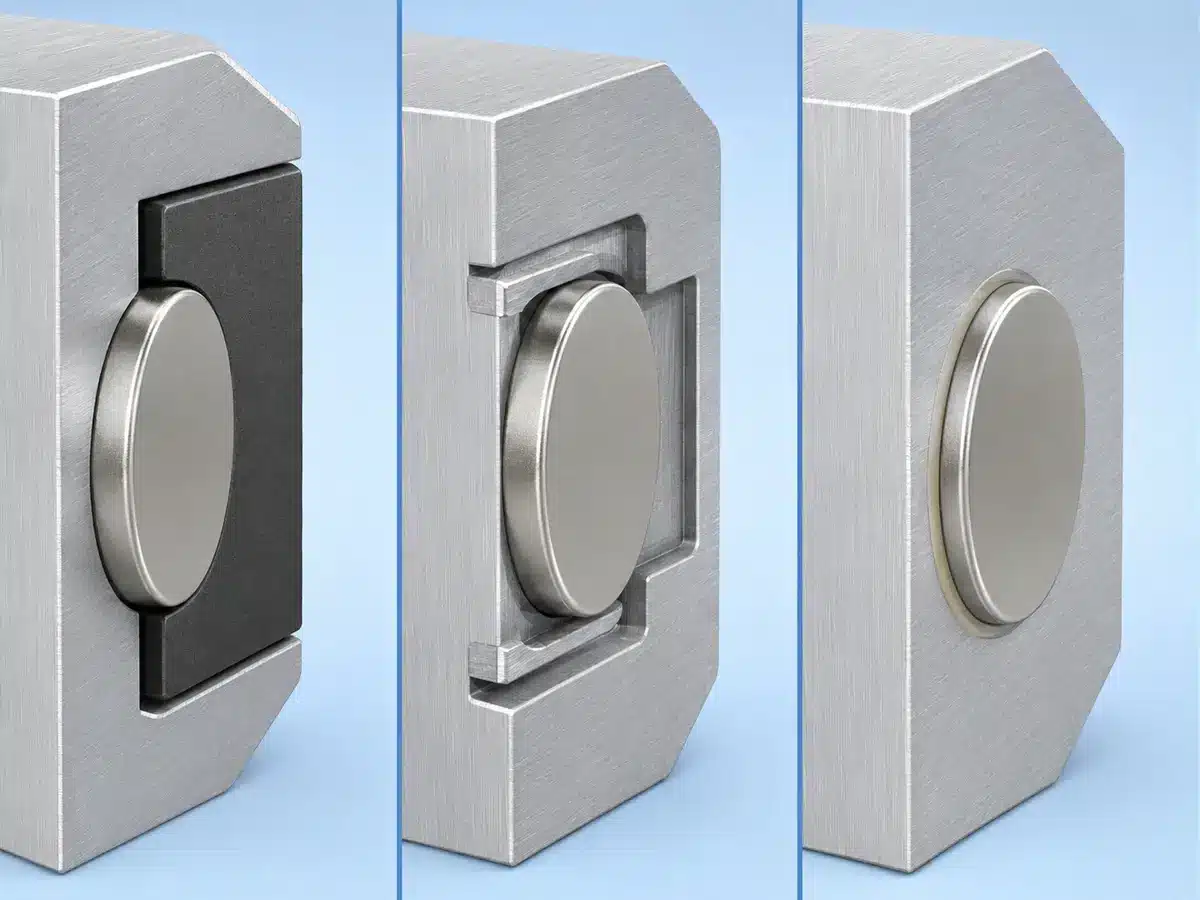
Do Not Treat Pull, Shear and Peel as the Same Load
A magnet may perform well in a straight pull test but slide under a much smaller shear load. Adhesive joints can also respond very differently to shear and peel.
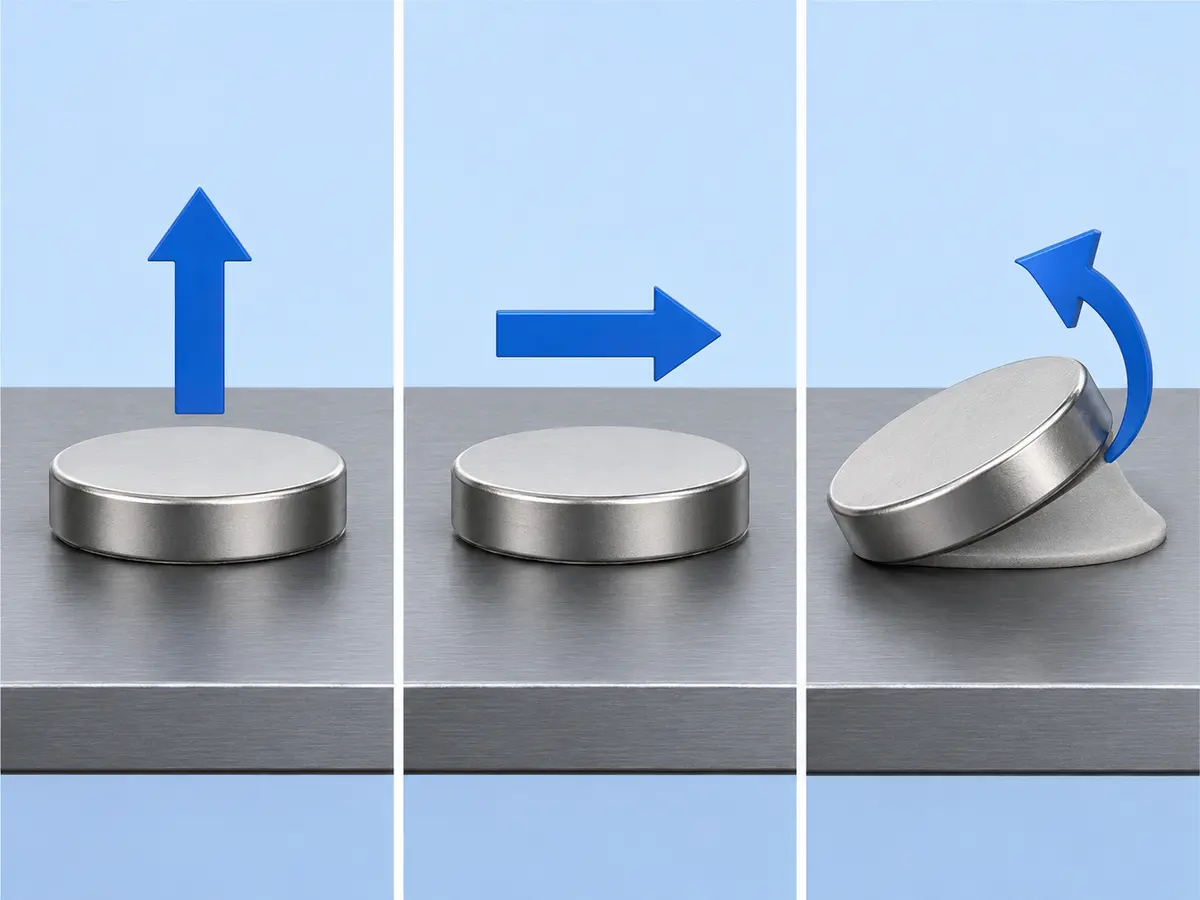
The engineering review should therefore define:
- Load direction.
- Required holding force.
- Safety margin or acceptance criterion.
- Contact area.
- Surface condition.
- Shock and vibration.
- Number of operating cycles.
- Expected temperature and environment.
Be Careful With Adhesive-Backed Magnets
An adhesive-backed magnet may be one retention option for suitable surfaces and light-duty conditions. It should not be treated as a universal solution for every aluminum finish.
The adhesive system must be selected for the surface treatment, load direction, temperature, humidity, contamination risk and required service life. Mechanical capture may be more appropriate where failure could release the magnet or interrupt equipment operation.
What Information Should Be Included in an RFQ?
For a magnetic design involving aluminum, provide more than the magnet dimensions.
A useful RFQ package should include:
- Aluminum alloy or material specification, if known.
- Aluminum-part dimensions and wall thickness.
- Assembly drawing or cross-section.
- Magnet dimensions and available installation space.
- Magnetization direction, if already defined.
- Total gap between the magnet and its target.
- Target material, size and thickness.
- Coatings, paint, adhesive and intermediate layers.
- Required force or sensing distance.
- Load direction: pull, shear or peel.
- Contact area and alignment tolerance.
- Relative motion and travel path.
- Speed or operating frequency.
- Duty cycle.
- Acceptable drag and temperature rise for dynamic systems.
- Operating temperature and environment.
- Shock, vibration and impact conditions.
- Preferred retention method.
- Prototype and production quantities.
Osenc can review the drawing and working conditions for a 맞춤형 네오디뮴 자석 or magnetic assembly. Static force, field distribution, working distance and assembly structure can then be evaluated against the actual application rather than assuming aluminum behaves like steel.
No claim is made here that Osenc has completed a specific aluminum eddy-current project or provides transient eddy-current simulation. Those capabilities require separate confirmation.
자주 묻는 질문
알루미늄은 네오디뮴 자석에 붙나요?
아닙니다. 벌크 알루미늄은 일반적으로 고정된 네오디뮴 자석에 달라붙지 않습니다. 더 강한 네오디뮴 자석을 사용해도 알루미늄이 강자성체로 변하는 것은 아닙니다.
알루미늄은 영구적으로 자화될 수 있습니까?
알루미늄은 외부 자기장이 가해지는 동안 약하게 반응할 수 있지만, 일반적인 강자성체처럼 영구 자화를 유지하지는 않습니다.
알루미늄을 사이에 두고 자석이 작동할 수 있나요?
예. 정자기장은 일반 알루미늄 패널을 통과하여 그 뒤의 강철이나 다른 자석에 작용할 수 있습니다. 다만 패널 두께와 기타 적층재로 인해 작동 간극이 커지면 실제 사용할 수 있는 힘이 급격히 감소할 수 있습니다.
자석이 알루미늄 관 속에서 천천히 떨어지는 이유는 무엇인가요?
움직이는 자석은 도전성 튜브를 통과하는 자속을 변화시킵니다. 이로 인해 와전류가 유도되며, 와전류의 자기 작용은 자석의 낙하 운동을 방해합니다.
알루미늄으로 자석의 자기장을 차폐할 수 있습니까?
단순히 보편적인 원칙으로 단정할 수는 없습니다. 일반 알루미늄은 정자기장을 통상적인 방식으로 차폐하지 못하지만, 와전류를 통해 변화하는 자기장에 대항할 수 있습니다. 결과는 주파수, 전기전도도, 두께 및 형상에 따라 달라집니다.
자석 시험만으로 부품이 알루미늄임을 입증할 수 있습니까?
아니요. 눈에 띄는 강자성 인력의 유무는 확인할 수 있지만, 합금의 종류를 식별하거나 내부에 숨겨진 강철 부품이 없다고 단정할 수는 없습니다.
알루미늄에 자석을 부착하는 가장 좋은 방법은 무엇입니까?
적절한 방법은 하중과 사용 환경에 따라 달라집니다. 강재 부착면, 다른 자석, 기계적 고정 구조, 홀더 또는 적합한 접착 시스템을 사용할 수 있습니다.
Need Help With a Magnet-and-Aluminum Assembly?
Send Osenc the assembly drawing, aluminum thickness, target material, working gap, load direction and required force or sensing distance.
The team can review the magnet size, magnetization direction, steel target, retention method and static magnetic performance before sample validation.
Contact Osenc to Discuss the Application