






소재 및 엔지니어링 가이드
어떤 금속이 자성을 띠나요?
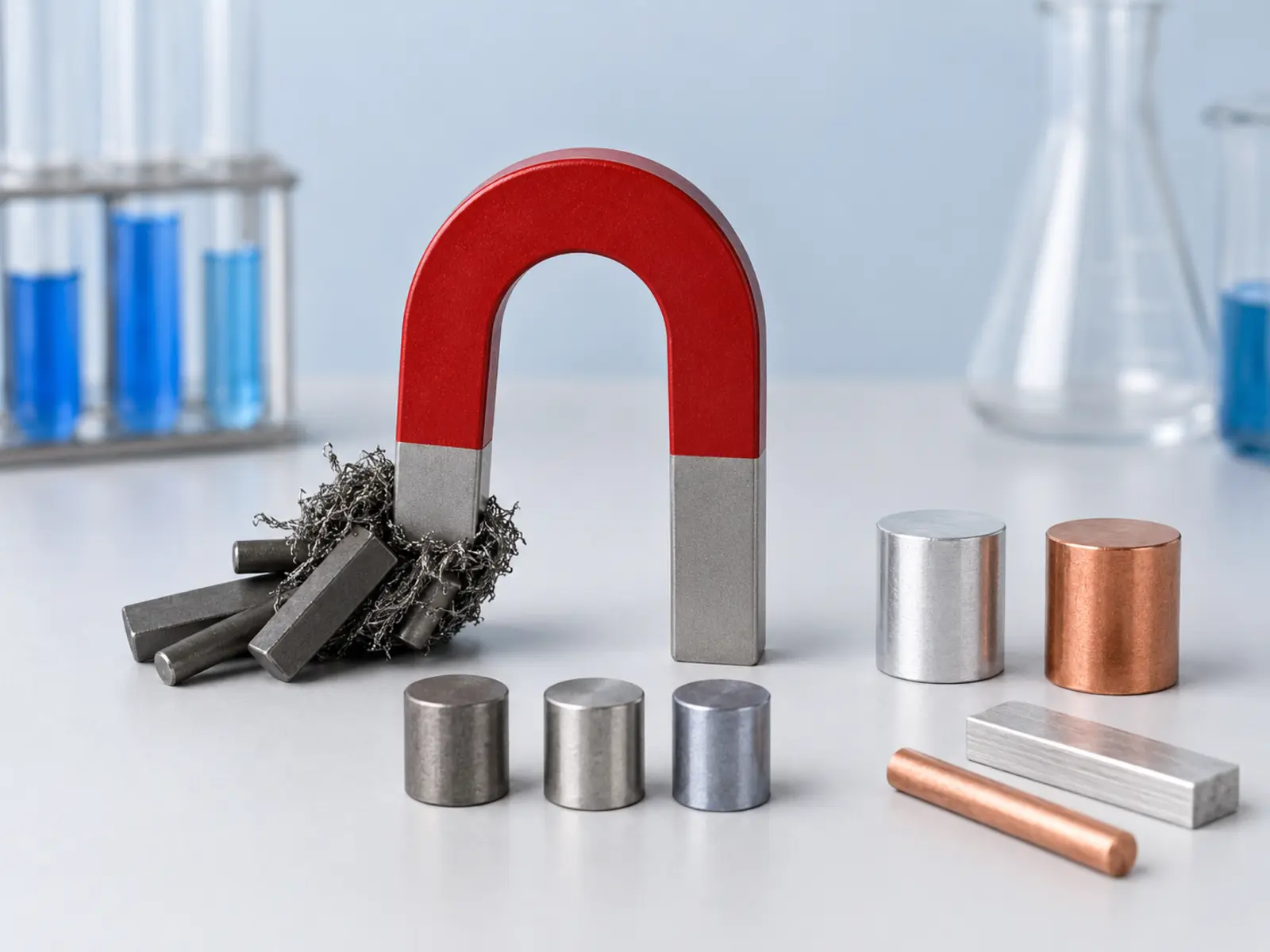
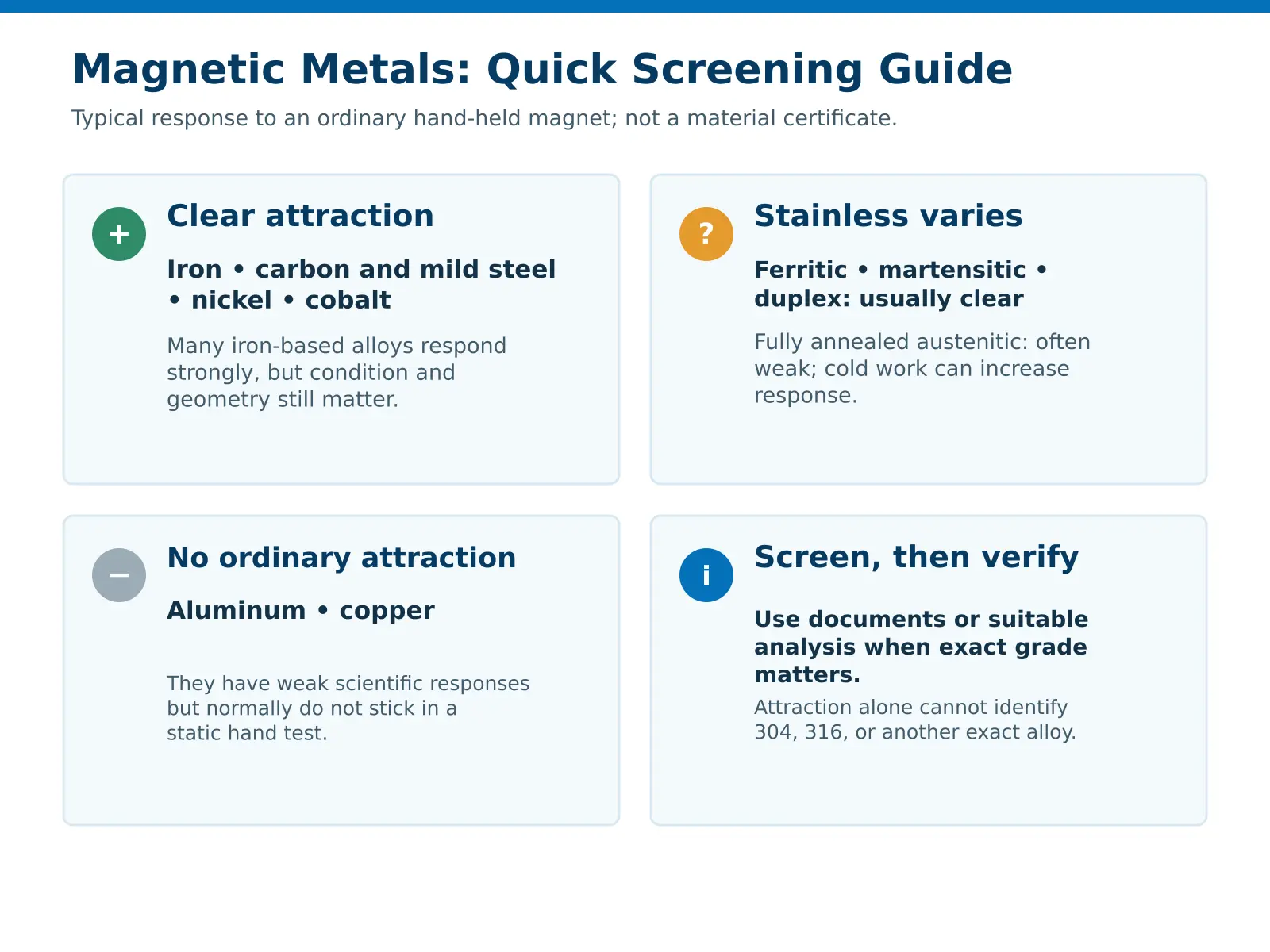
철, 니켈, 코발트는 자석에 강하게 끌리는 것으로 가장 잘 알려진 금속입니다. 탄소강과 여러 계열의 스테인리스강을 비롯한 많은 철계 합금도 뚜렷한 자기 반응을 보입니다.
그러나 금속의 명칭만으로는 판단할 수 없습니다. 합금 조직, 가공 상태, 부품 두께, 접촉면 및 시험 조건에 따라 관찰 결과가 달라질 수 있습니다.
알루미늄과 구리는 일반적으로 보통의 영구자석에 붙지 않습니다. 과학적으로는 자기장에 반응하지만, 일반적인 수동 시험에서 느끼기에는 그 반응이 너무 약합니다.
어떤 금속이 자석에 붙습니까? 빠른 참조표
다음 자성 금속 목록은 일반 휴대용 자석에 대한 전형적인 반응을 설명합니다. 예비 선별용이며 재질 인증용이 아닙니다.
| 금속 또는 재료군 | 일반 자석에 보통 붙습니까? | 중요 조건 |
|---|---|---|
| 철 | 예, 강하게 붙음 | 주요 강자성 원소 중 하나 |
| 탄소강 및 연강 | 일반적으로 예 | 반응은 조성, 조직, 두께 및 상태에 따라 달라짐 |
| 니켈 | 예 | 순수 니켈은 상온에서 강자성체임 |
| 코발트 | 예 | 순수 코발트는 상온에서 강자성체임 |
| 페라이트계 스테인리스강 | 일반적으로 예 | 일반적으로 휴대용 자석에 뚜렷하게 반응함 |
| 마르텐사이트계 스테인리스강 | 일반적으로 예 | 일반적으로 강자성체 |
| 듀플렉스 스테인리스강 | 일반적으로 예 | 페라이트상과 오스테나이트상을 포함 |
| 오스테나이트계 스테인리스강 | 반응이 약하거나 무시할 수 있는 수준인 경우가 많음 | 냉간 가공 및 재료 상태에 따라 반응이 증가할 수 있음 |
| 알루미늄 | 일반적인 조건에서는 눈에 띄는 인력이 없음 | 상자성이지만 반응은 매우 약함 |
| 구리 | 일반적인 조건에서는 눈에 띄는 인력이 없음 | 반자성이며 일반적으로 달라붙지 않음 |
작은 화면에서는 모든 열을 보려면 표를 가로로 스와이프하십시오.
이 표는 정확한 재질 등급을 식별하지 않습니다. 등급 확인이 중요한 경우에는 공급업체 문서, 소재 성적서, 화학 분석 또는 기타 적절한 식별 방법이 여전히 필요합니다.
“자성”은 실제로 무엇을 의미할까요?
일상에서는 금속이 냉장고 자석이나 작업용 자석에 달라붙으면 자성이 있다고 합니다. 물리학에서 이 용어는 서로 다른 여러 유형의 물질 반응을 포괄합니다.
| 용어 | 의미 | 일반적으로 관찰되는 현상 |
|---|---|---|
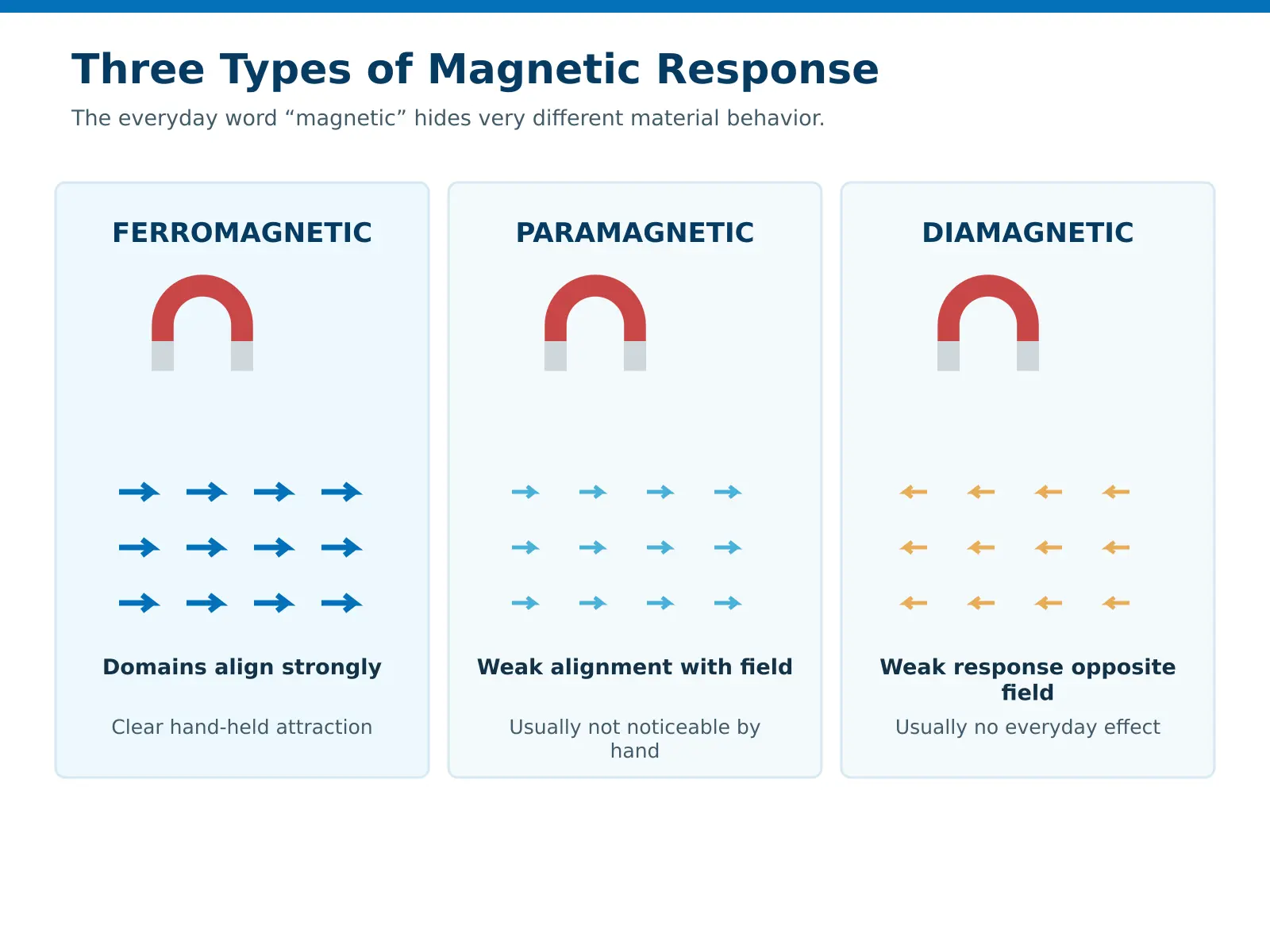
| 강자성체 | 인가 자기장에 강하게 반응하며 자구를 포함함 | 손에 든 자석에 뚜렷하게 끌림 |
| 상자성체 | 인가 자기장과 같은 방향으로 약하게 반응함 | 일반적으로 손에 든 자석에 끌리는 현상이 감지되지 않음 |
| 반자성체 | 인가 자기장과 반대 방향으로 매우 약하게 반응함 | 일상에서는 일반적으로 감지할 만한 영향이 없음 |
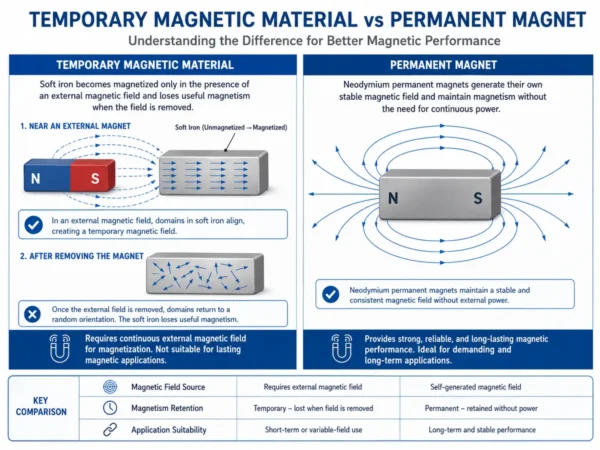
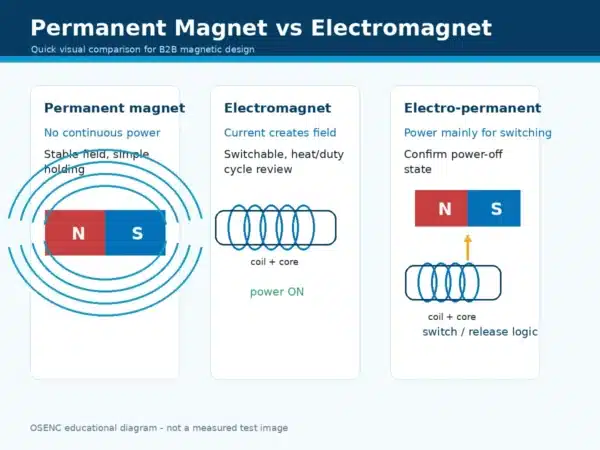
| 영구자석 | 유용한 수준의 자화를 유지하며 외부 자기장을 형성함 | 적합한 강자성 재료를 끌어당길 수 있음 |
작은 화면에서는 모든 열을 보려면 표를 가로로 스와이프하십시오.
OpenStax 대학물리학 에서는 물질을 강자성, 상자성 및 반자성 반응에 따라 분류합니다. 알루미늄은 상자성체, 구리는 반자성체로 분류하며, 이러한 약한 반응이 강자성 인력과 크게 다른 이유를 설명합니다.
엔지니어링에서는 요구사항을 명확히 정의해야 합니다. 프로젝트에 필요한 항목은 다음과 같을 수 있습니다:
- 자석에 끌리는 대상 부품.
- 착자할 수 있는 재료.
- 유용한 자기장을 생성하는 영구자석.
- 작동 거리에서 요구되는 힘을 제공하는 완전한 자기 회로.
이러한 요구사항은 서로 관련되어 있지만, 상호 대체할 수는 없습니다.
철, 니켈, 코발트 및 여러 강종이 자석에 끌리는 이유는 무엇입니까?
강자성 재료에는 외부 자기장에 강하게 반응할 수 있는 자구가 있습니다. 따라서 착자되지 않은 강재 부품도 영구자석 쪽으로 끌릴 수 있습니다.
철, 니켈 및 코발트는 일반적인 엔지니어링 분야에서 가장 잘 알려진 강자성 금속입니다. 철계 합금도 상당수가 강자성을 띠지만, 합금 조성과 미세조직에 따라 달라질 수 있습니다.
따라서 철, 니켈 또는 코발트가 포함된 모든 합금이 동일하게 반응한다고 가정해서는 안 됩니다. 최종 재료 상태를 고려해야 합니다.
모든 강재와 스테인리스강은 자성을 띱니까?
아닙니다. 많은 강재가 자석에 끌리지만, 모든 강재 또는 스테인리스강 등급이 동일하게 반응하는 것은 아닙니다.
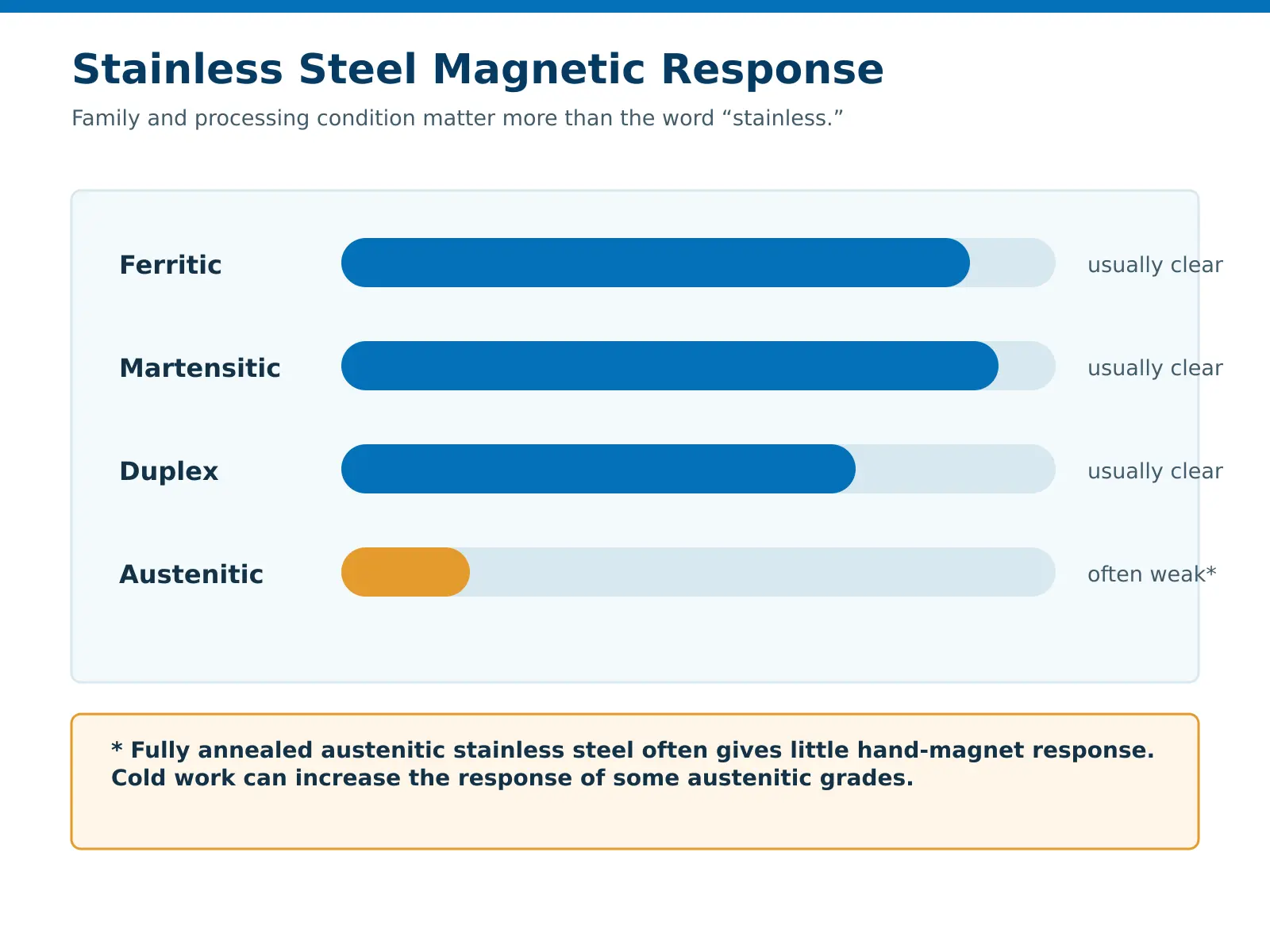
Carbon and mild steels usually respond clearly. Stainless steel is more complicated because its magnetic behavior depends mainly on its metallurgical structure and processing condition.
코어리스 모터의 영국 스테인리스강협회 explains that ferritic, martensitic, duplex, and most precipitation-hardening stainless steels normally show a strong response to a hand-held magnet. Austenitic stainless steels usually show little response when fully annealed.
Cold work can increase the magnetic response of some austenitic stainless steels. Composition and heat-treatment condition also matter. See the BSSA guidance on the effect of cold work and heat treatment.
This leads to two practical rules:
- A stainless steel part sticking to a magnet does not prove its exact grade.
- A weak response does not automatically prove that the part is 304 or 316 stainless steel.
Welded or heavily machined areas should be evaluated according to their actual composition and processing history rather than a general rule.
Which Metals Do Not Normally Stick to a Magnet?
Aluminum and copper do not normally show noticeable attraction in a static hand-held magnet test.
Aluminum is paramagnetic, which means it responds weakly in the direction of an applied field. Copper is diamagnetic, which means its weak induced response opposes the applied field. Neither effect normally produces useful holding force with an ordinary permanent magnet.
Aluminum can interact with changing magnetic fields through other physical effects. That is different from ordinary static attraction and belongs in a dedicated discussion of aluminum and magnets.
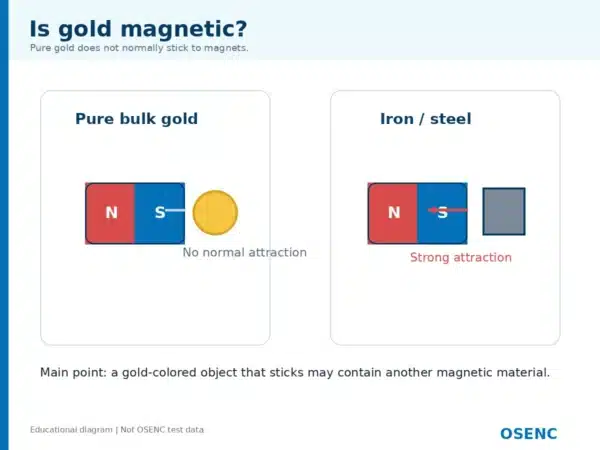
A plated or painted part may also give a misleading result. A thin outer layer may hide steel, a steel insert, or another ferromagnetic component underneath.
Can You Identify a Metal with a Magnet Test?
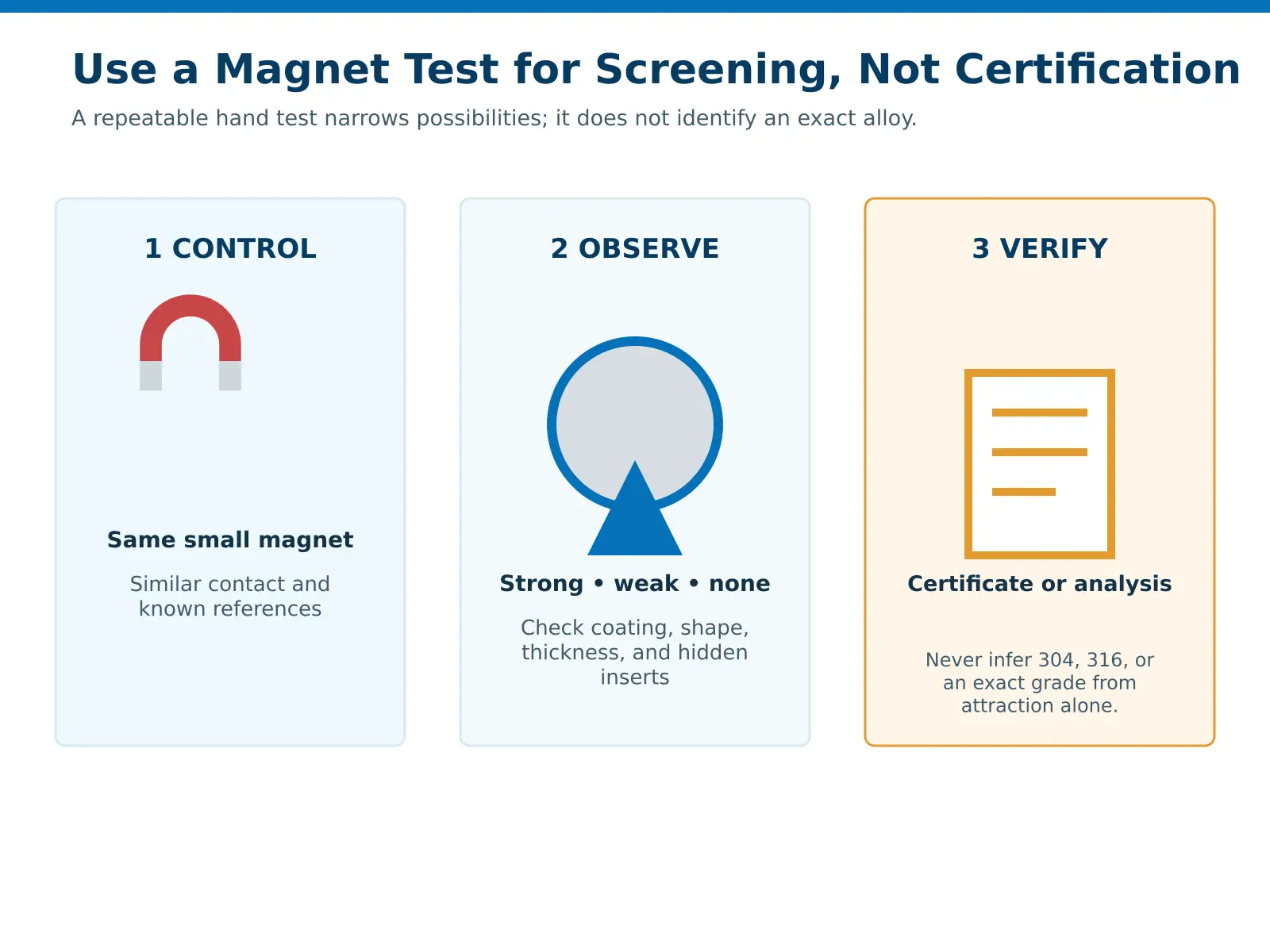
A magnet test is useful for quick screening, but it cannot identify an exact alloy.
부품을 비교할 때는 동일한 소형 시험 자석, 유사한 접촉 조건 및 특성이 알려진 기준 샘플을 사용하십시오. 오염물, 코팅, 곡률, 두께 및 내부에 숨겨진 인서트에 따라 결과가 달라질 수 있습니다.
| 시험 결과 | 시사할 수 있는 내용 | 입증할 수 없는 내용 |
|---|---|---|
| 강한 인력 | 강자성 재료 또는 내부에 숨겨진 강자성 부품이 있을 수 있음 | 정확한 합금 또는 등급 |
| 약한 자기 인력 | 가공의 영향을 받은 오스테나이트계 스테인리스강, 얇은 강자성 구간 또는 다른 혼합 구조 | 특정 스테인리스강 등급 |
| 눈에 띄는 자기 인력 없음 | 알루미늄, 구리, 풀림 처리된 오스테나이트계 스테인리스강 또는 기타 반응이 약한 재료일 수 있음 | 정확한 조성 |
| Different responses across one part | Mixed materials, inserts, weld areas, coatings, or different processing conditions may be present | The cause without further inspection |
작은 화면에서는 모든 열을 보려면 표를 가로로 스와이프하십시오.
What Should a Magnet Test Be Used For?
| Use a magnet test for | Do not use it for |
|---|---|
| Preliminary material screening | Exact alloy certification |
| Finding obvious ferromagnetic parts | Confirming 304 versus 316 |
| Detecting a possible hidden steel insert | Approving safety-critical material |
| Comparing samples under consistent conditions | Predicting final assembly holding force |
Use the test as a screening step, not as acceptance evidence for a production specification.
Why Can Magnetic Attraction Change in a Real Assembly?
Knowing that a target metal is ferromagnetic does not tell you how much force a finished assembly will provide.
For buyers, the practical question is:
Can this target material, at its actual thickness and working gap, provide enough usable force in the final assembly?
| Assembly factor | 중요한 이유 | Information to provide |
|---|---|---|
| Target material and condition | Different steels and structures respond differently | Grade, family, certificate, or sample |
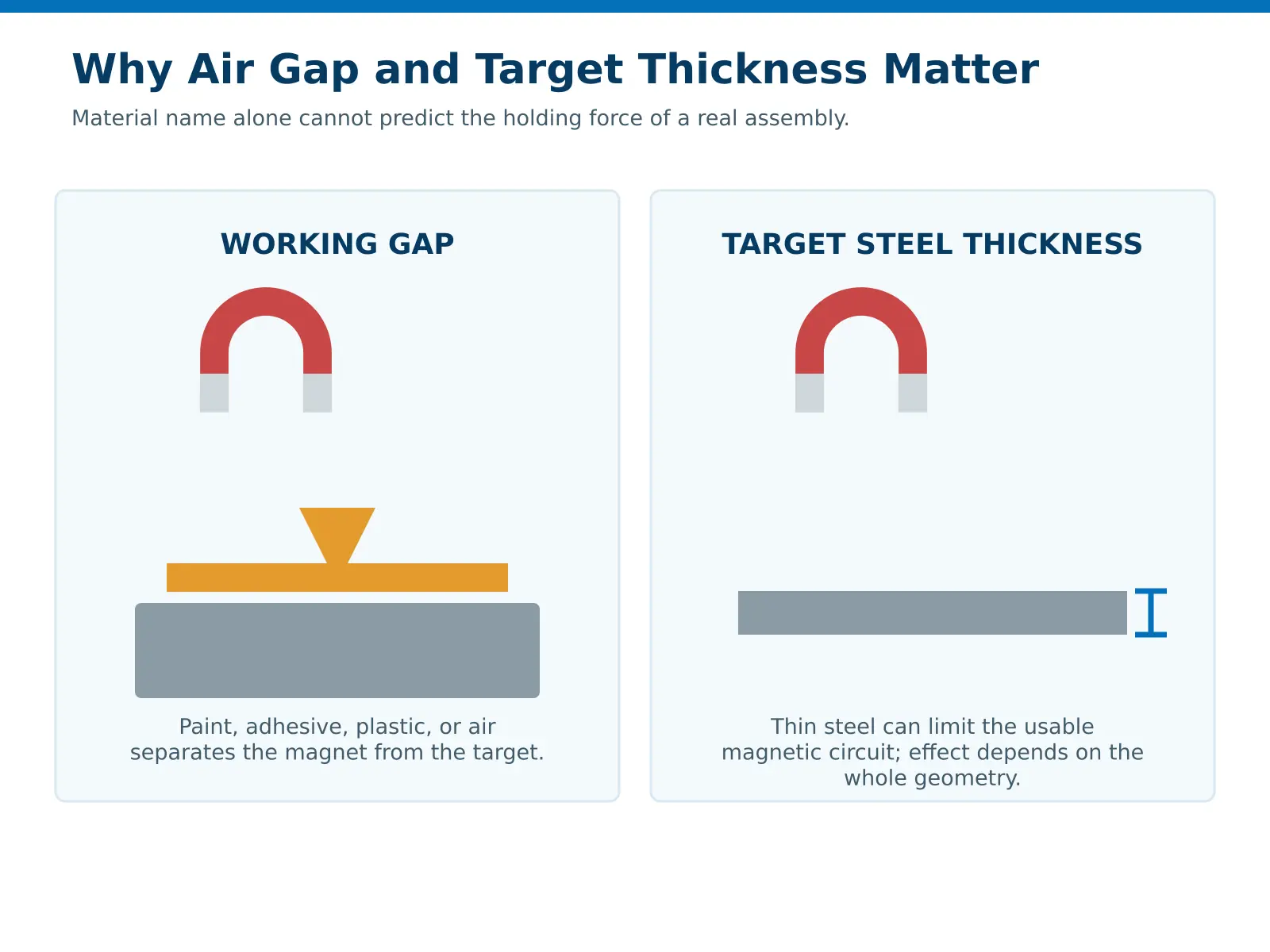
| Target thickness | Thin steel may limit the usable magnetic circuit | Actual thickness and available target area |
| 작동 간극 | Air, paint, adhesive, plastic, and coatings separate the magnet from the target | Total nonmagnetic gap |
| Surface flatness | Curved, rough, rusty, or uneven surfaces reduce effective contact | Surface drawing or sample |
| Magnet geometry | Diameter, length, thickness, and pole area affect field distribution | 가용 설치 공간 |
| 착자 방향 | The pole orientation must match the working face | Required working face and assembly orientation |
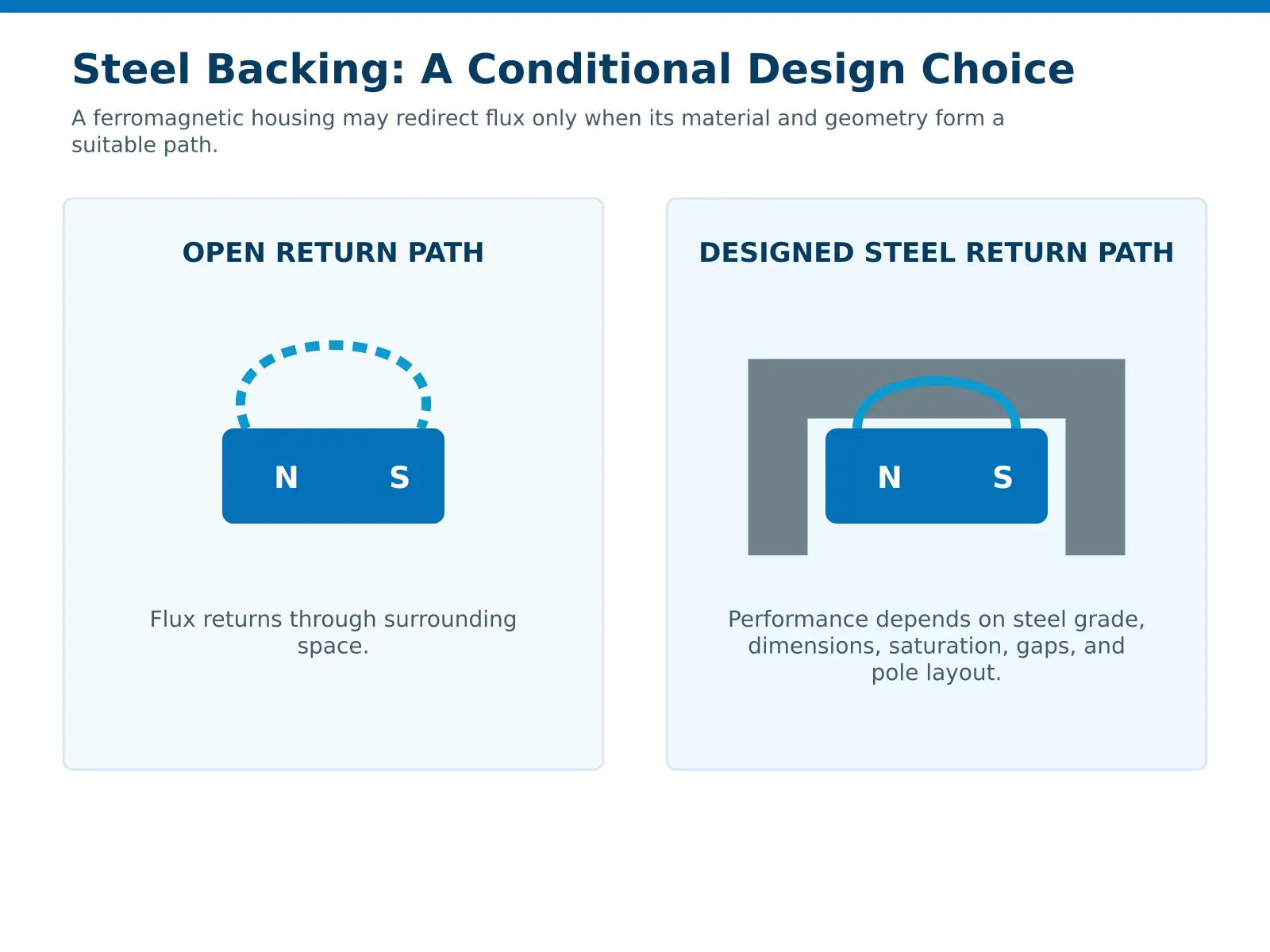
| Steel backing or housing | A properly designed ferromagnetic structure may redirect flux | Housing material, dimensions, and layout |
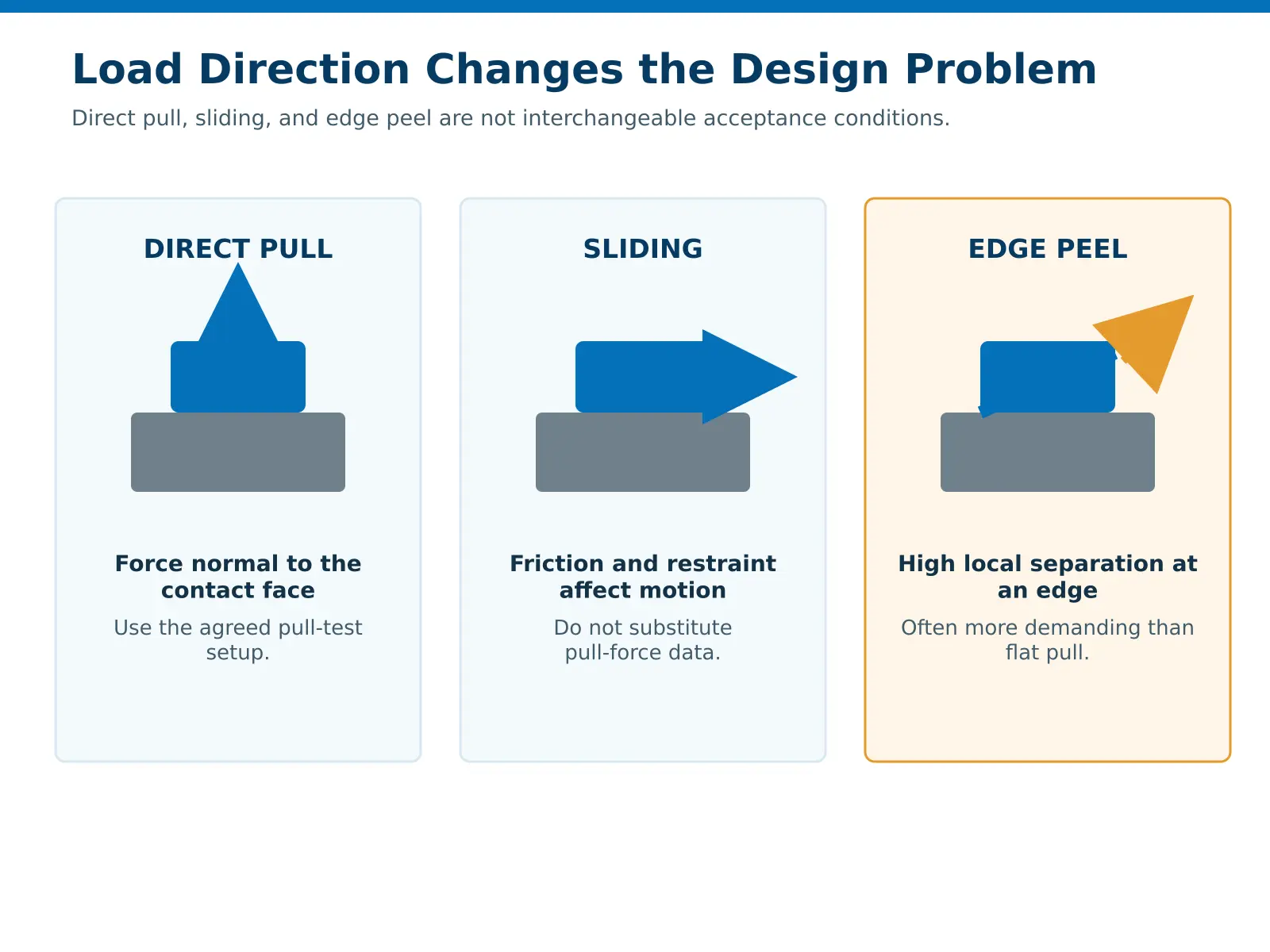
| Load direction | Direct pull, sliding, and edge peel create different demands | Load direction and mounting position |
| Operating conditions | Temperature, vibration, impact, and corrosion can affect suitability | Actual service environment |
| Acceptance method | Supplier pull-force values may use different test conditions | Required test setup and pass criteria |
작은 화면에서는 모든 열을 보려면 표를 가로로 스와이프하십시오.
A coating, air gap, or uneven surface can reduce usable pull force. Thin target steel may also limit performance, but the effect depends on magnet geometry, target material, and the complete magnetic circuit.
Specialist test guidance shows that steel thickness and contact conditions can materially change pull force. It also warns that calculated or catalog values should not replace application testing. See the K&J Magnetics steel-thickness guidance.
A properly designed ferromagnetic backing or housing can direct more magnetic flux toward a working face. This is not automatic; the geometry and material must form a suitable magnetic circuit.
A magnet that performs well in direct pull may behave differently under sliding or edge-peel loading. Sliding resistance also depends on friction, surface condition, and mechanical restraint.
What Should You Provide for a Magnetic Holding or Separation Project?
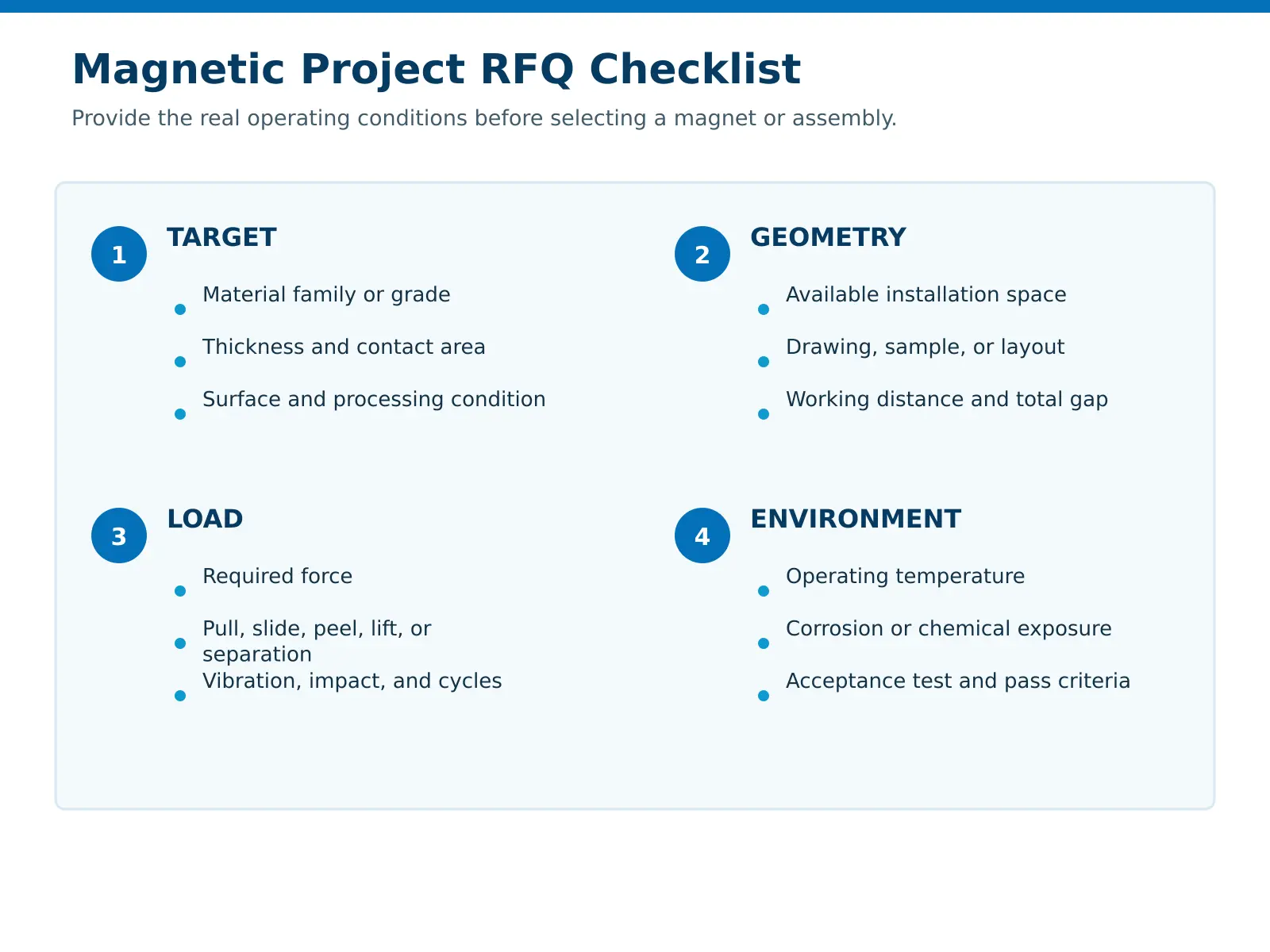
Provide the following information before selecting a magnet or magnetic assembly:
- Target material family and grade, if known.
- Material condition or processing history.
- Target thickness and available contact area.
- Coatings, paint, adhesive, plastic, or other working gaps.
- Surface shape, flatness, roughness, and corrosion condition.
- Available space for the magnet and housing.
- Required working distance.
- Required force and load direction.
- Whether the load is direct pull, sliding, peel, lifting, or separation.
- Operating temperature and environmental exposure.
- Vibration, impact, movement, or repeated-cycle requirements.
- Drawing, sample, sketch, or assembly layout.
- Required validation method and acceptance conditions.
For magnetic separation, also provide the material flow, contamination type, expected particle size, working distance, and cleaning method. A magnetic drum separator or another magnetic structure must be evaluated against the real process rather than selected only by magnet grade.
When Is a Custom Magnet or Magnetic Assembly Review Needed?
A simple hand-held test may be enough for basic material screening. It is not enough when the project has a defined holding force, limited space, a working gap, thin target steel, unusual load direction, or a complex steel housing.
Osenc can review drawings, samples, sketches, and application requirements for 맞춤형 네오디뮴 자석에 사용하면 and magnetic assemblies. The review may consider magnet geometry, grade, magnetization direction, coating, target material, working gap, and magnetic-circuit structure.
A higher magnet grade is not automatically the correct solution. Geometry, target material, available pole area, temperature, assembly design, cost, and validation requirements must be considered together.
Projects can also begin with suitable neodymium magnet samples or prototypes before moving to batch production. Actual force must be validated under agreed test conditions.
자주 묻는 질문
가장 일반적인 자성 금속 세 가지는 무엇입니까?
일반적인 엔지니어링 분야에서 가장 잘 알려진 세 가지 강자성 금속은 철, 니켈, 코발트입니다. 이들 원소를 기반으로 한 많은 합금도 자성을 띨 수 있지만, 자기적 반응은 조성과 구조에 따라 달라집니다.
강철은 자성을 띠나요?
대부분의 탄소강과 연강은 자석에 뚜렷하게 끌립니다. 그러나 스테인리스강의 자성 거동은 강종 계열과 가공 상태에 따라 달라집니다.
스테인리스강은 자성이 있나요?
일부 스테인리스강은 자성을 띠지만, 다른 스테인리스강은 자석에 대한 인력이 거의 나타나지 않습니다. 페라이트계, 마르텐사이트계 및 듀플렉스 스테인리스강은 일반적으로 자성을 띠는 반면, 완전 소둔된 오스테나이트계 스테인리스강은 자석에 약하게 반응하는 경우가 많습니다.
알루미늄은 자성을 띠나요?
알루미늄은 상자성체이지만 일반적인 영구자석에는 보통 달라붙지 않습니다. 자기 반응이 너무 약해 표준 정자기 시험에서는 감지하기 어렵습니다.
구리는 자성을 띠나요?
구리는 반자성체이므로 일반적으로 자석에 달라붙지 않습니다. 뚜렷한 인력이 나타난다면 부품에 강철 인서트가 포함되어 있거나 오염, 도금 또는 다른 재질이 존재할 가능성을 나타낼 수 있습니다.
자석 시험으로 금속 재질 등급을 식별할 수 있습니까?
아닙니다. 일반적인 자기 반응에 따라 재료를 분리할 수는 있지만, 정확한 합금 종류나 스테인리스강 등급을 신뢰성 있게 확인할 수는 없습니다.
인력이 더 강하면 해당 금속의 철 함량이 더 높다는 뜻인가요?
반드시 그런 것은 아닙니다. 인력은 미세조직, 조성, 대상물의 두께, 가공 상태, 자석 형상 및 시험 구성에 따라 달라집니다.
자성 금속을 사용하면 강한 유지력이 보장됩니까?
아닙니다. 대상 재료는 자기 회로를 구성하는 요소 중 하나일 뿐입니다. 작동 간극, 대상 재료의 두께, 표면 상태, 자석 형상, 하우징 및 하중 방향이 모두 실제 사용 가능한 힘에 영향을 미칩니다.
Discuss Your Magnetic Application with Osenc
Selecting a magnetic target material is only the first step. The final design must work with the actual target thickness, gap, surface, load direction, available space, and operating conditions.
Osenc can review your drawing, sample, or application requirements before sample validation. The goal is to match the magnet and magnetic circuit to the real application rather than selecting a magnet only by grade.
Contact Osenc with the target material, drawing, working distance, required force, load direction, and operating environment.
엔지니어링 검토 요청