






구리와 자석 · 기술 분야 빠른 답변
핵심 답변: 구리는 자성을 띠나요?
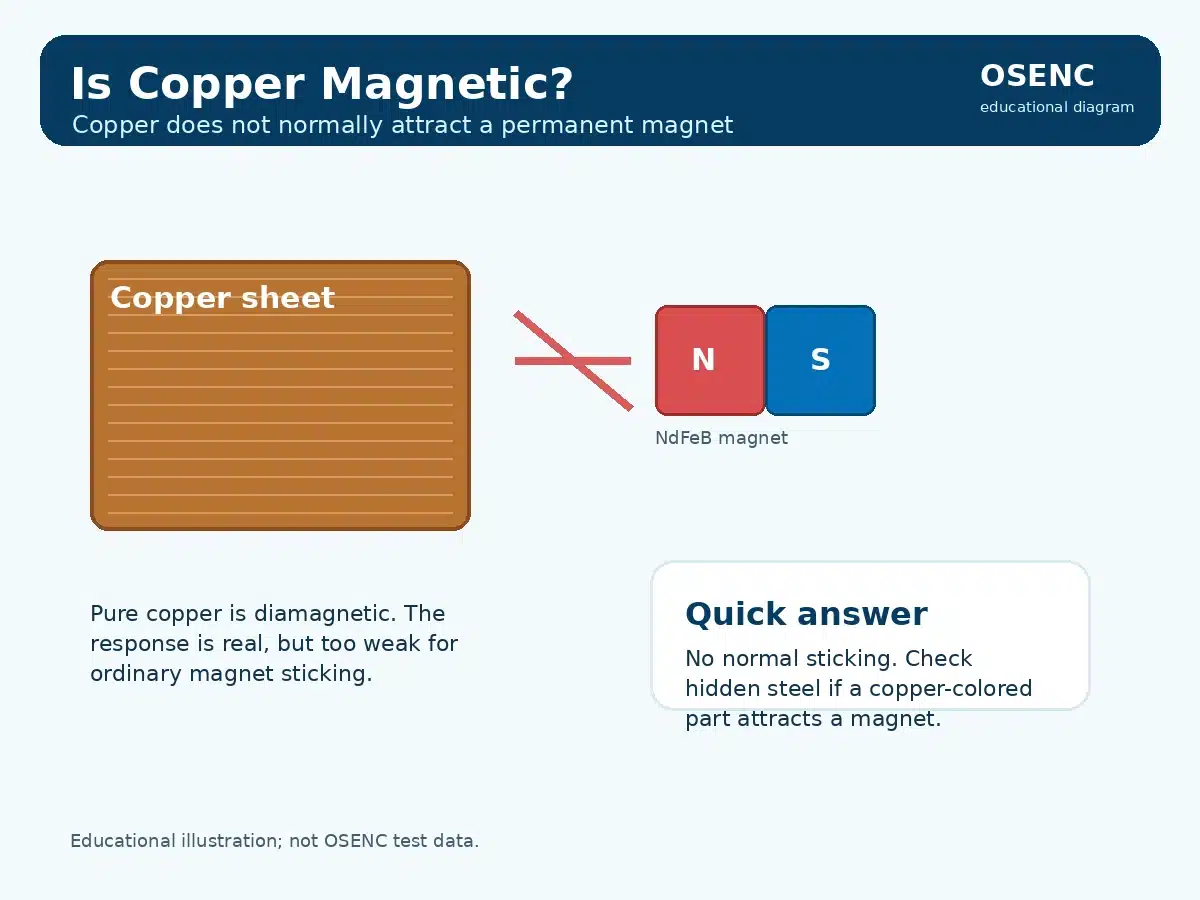
일상적으로 말하는 자석에 끌리는 성질은 없습니다. 일반적인 영구자석은 대개 순동에 붙지 않습니다.
더 정확히 말하면 구리는 반자성체. 입니다. 인가된 자기장과 반대 방향으로 매우 약하게 반응하지만, 그 정도는 철이나 강철에서 기대하는 강한 인력에 비해 훨씬 미미합니다.
요약하면, 순동은 일반적으로 자석에 붙지 않습니다.
구리는 자석에 붙습니까?
아닙니다. 순수 구리는 일반적으로 자석에 붙지 않습니다.
자석이 구리색 물체에 붙는 것처럼 보인다면 해당 물체는 순수 구리가 아닐 수 있습니다. 물체 뒤쪽에 강철이 있거나, 자성 패스너가 포함되어 있거나, 다른 금속 위에 도금층이 형성되어 있거나, 오염 물질이 묻어 있거나, 구조 내부에 다른 자성 재료가 숨어 있을 수 있습니다.
자석 검사는 현장에서 빠르게 확인하는 데 유용하지만, 재질 인증서를 대신할 수는 없습니다. 구리의 순도, 합금 등급 또는 내부에 숨겨진 보강재가 중요하다면 자석 반응에만 의존하지 말고 적절한 재질 식별, 공급업체 문서 또는 PMI, XRF, OES 등의 시험을 활용하십시오.
이는 엔지니어와 구매 담당자에게 특히 중요합니다. 자석으로 시험 부위에 뚜렷한 강자성 인력이 있는지는 확인할 수 있지만, 정확한 구리 합금, 등급, 조성, 열처리 또는 내부 구조까지 확인할 수는 없습니다.
구리는 왜 철이나 강철처럼 자석에 끌리지 않습니까?
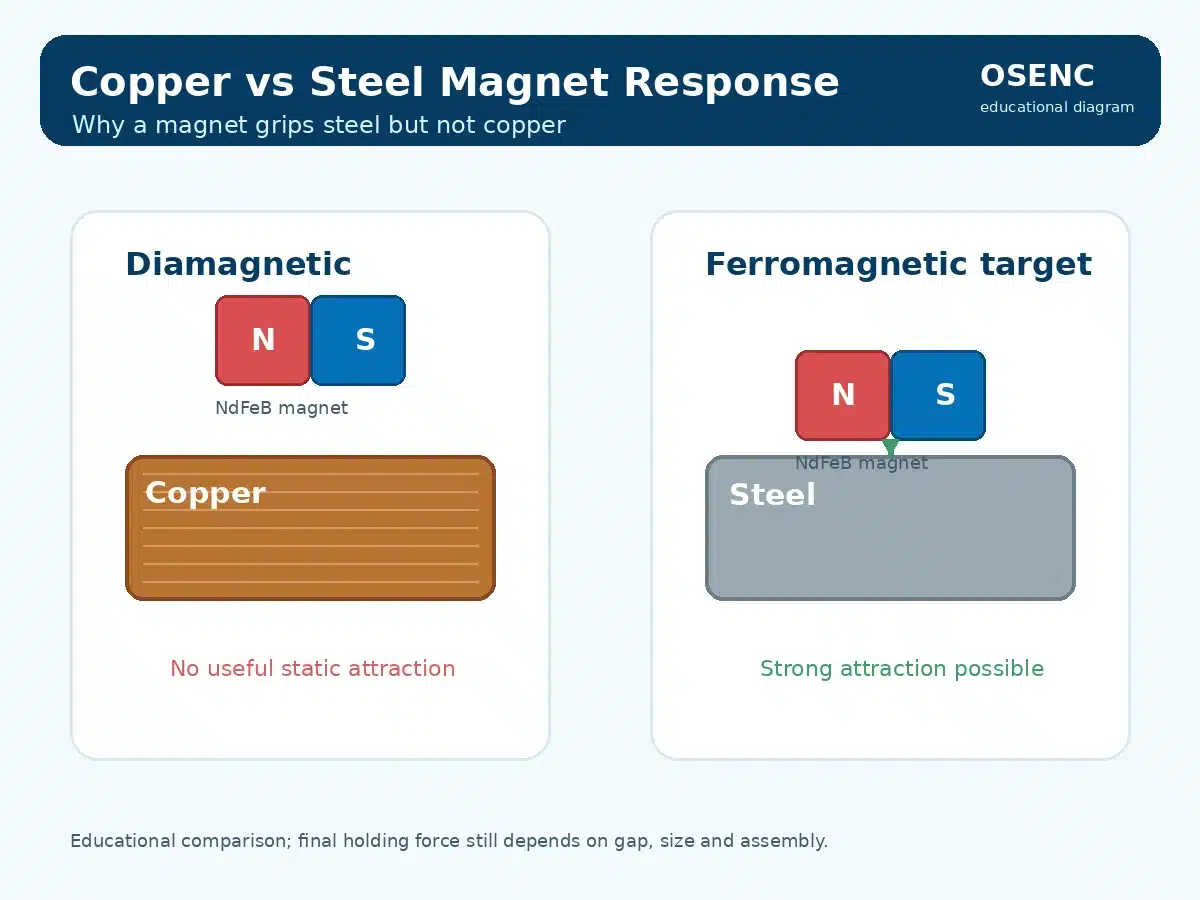
주된 이유는 구리가 강자성체가 아니기 때문입니다.
철, 니켈, 코발트 및 많은 종류의 강철은 내부 자구가 외부 자기장에 따라 강하게 정렬될 수 있어 강한 자기 인력을 나타냅니다. 이 때문에 자석은 많은 강철 부품을 끌어당길 수 있습니다.
구리는 다르게 반응합니다. 구리는 반자성체이므로 인가된 자기장과 반대 방향으로 극히 약하게 반응합니다. 일반적인 사용 환경에서는 이러한 반응이 너무 약해 자석이 구리에 붙지 않습니다.
| 재질 | 일반 자석이 붙습니까? | 실질적 의미 |
|---|---|---|
| 구리 | 아니요 | 유지력 확보용 자성 상대재로는 적합하지 않습니다. |
| 알루미늄 | 아니요 | 정지 상태에서는 일반적으로 인력이 발생하지 않지만, 움직임이 있으면 와전류 효과가 나타날 수 있습니다. |
| 황동 | 보통은 그렇지 않습니다. | 대부분의 일반적인 황동 부품은 다른 자성 재료가 포함되지 않는 한 자석에 붙지 않습니다. |
| 철 | 예 | 강한 자기 반응을 보입니다. |
| 탄소강 | 일반적으로 예 | 자성 상대재 또는 자속 귀환 경로로 활용되는 경우가 많습니다. |
| 스테인리스강 | 경우에 따라 다릅니다. | 페라이트계 및 마르텐사이트계 강종은 자석에 끌릴 수 있으며, 어닐링된 오스테나이트계 강종 중 다수는 자기 반응이 약합니다. |
물체 고정용 자석에서는 이러한 차이가 매우 중요합니다. 상대면이 구리인 경우, 자석은 강철에 붙는 것처럼 구리에 붙지 않습니다. 자석이 더 강해져도 구리가 강한 자성 상대재로 바뀌지는 않습니다.
움직이는 자석 근처에서 구리가 반응하는 이유는 무엇입니까?
구리는 전기 전도성이 높기 때문에 자석 근처에서 반응할 수 있습니다.
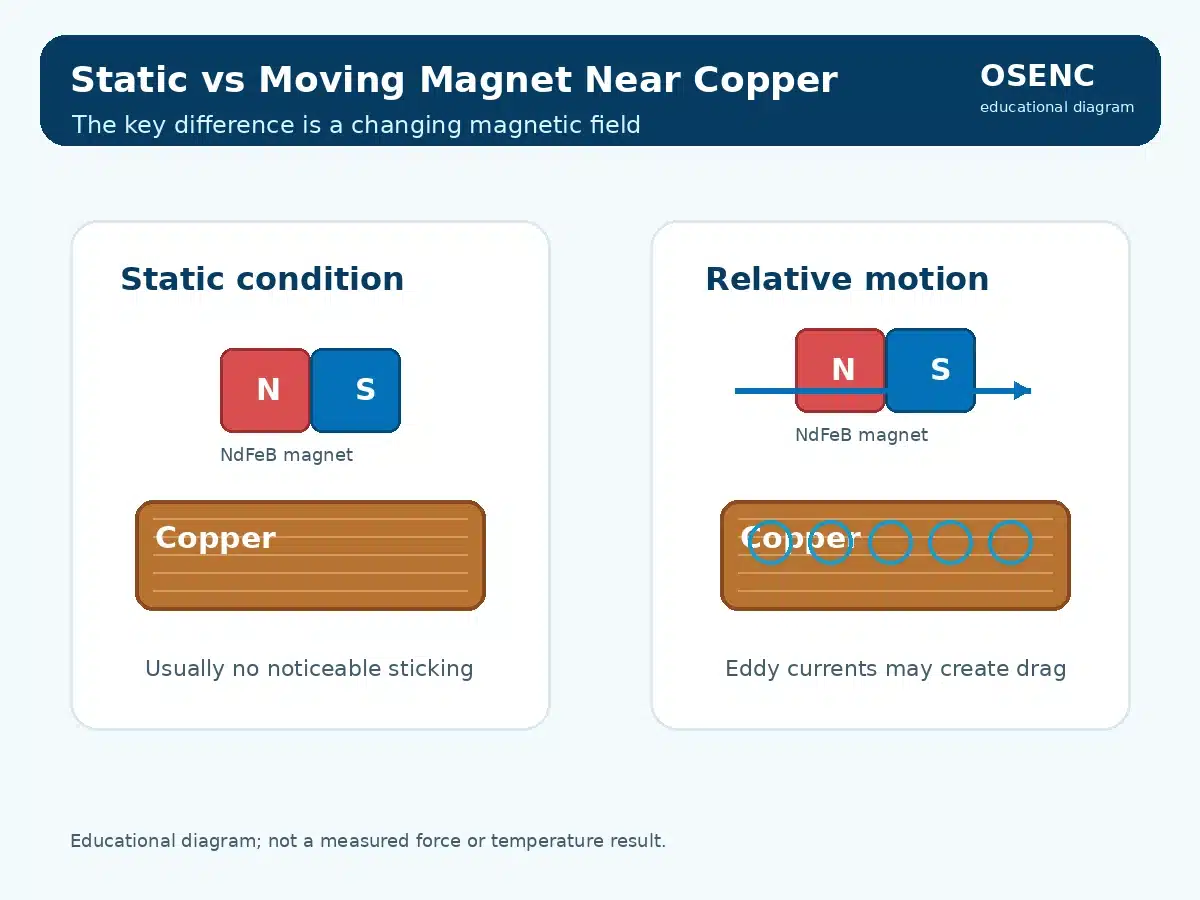
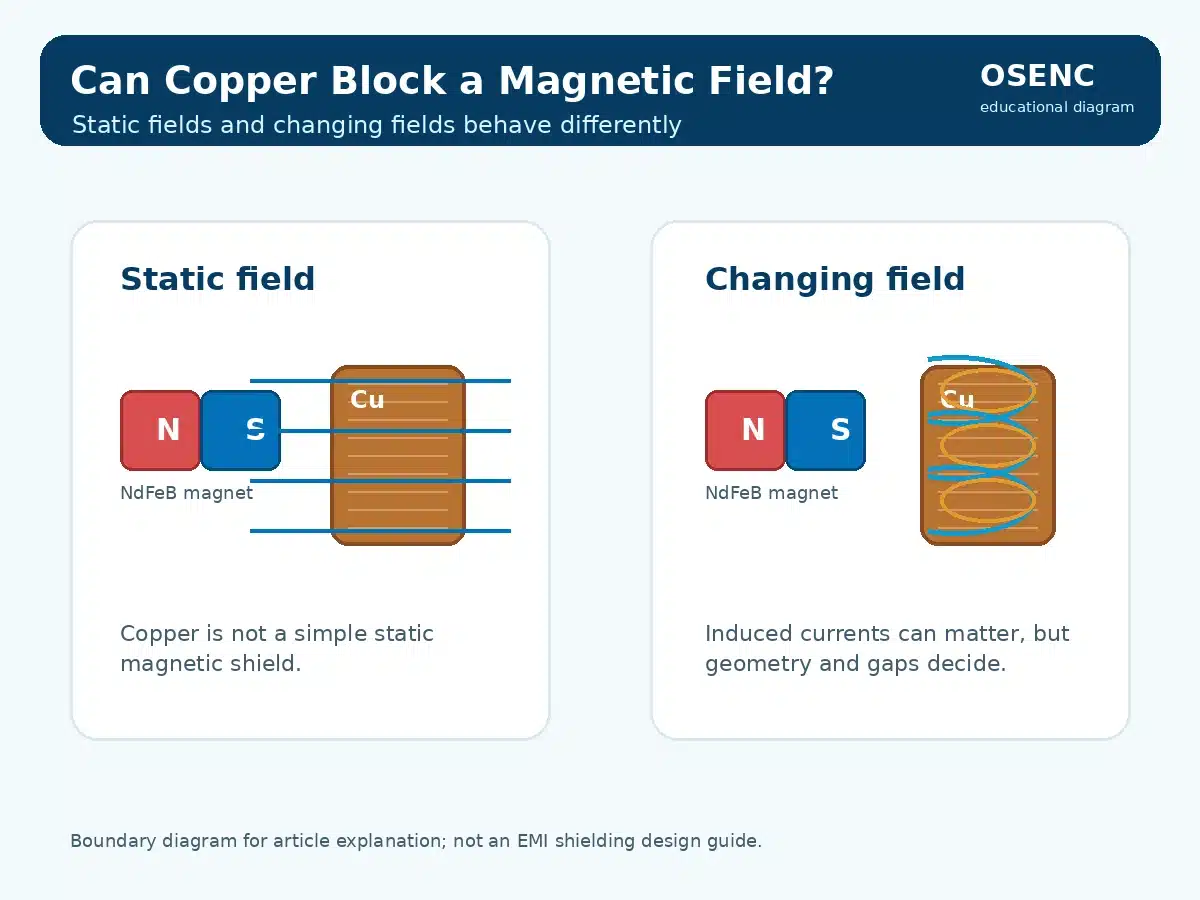
자석이 구리 근처에서 움직이거나 구리가 자기장을 통과해 움직이면, 변화하는 자기장으로 인해 구리 내부에 순환 전류가 유도될 수 있습니다. 이러한 전류를 와전류라고 합니다.
이러한 와전류는 자신을 유발한 변화를 방해하는 방향으로 자체 자기장을 형성합니다. 이 때문에 강한 자석은 플라스틱 관보다 구리관이나 알루미늄관을 통과할 때 더 천천히 낙하할 수 있습니다. 자석이 구리에 붙는 것이 아닙니다. 자석의 움직임으로 자기장이 변하고, 이에 따라 유도된 전류가 그 움직임을 방해하는 것입니다.
| 상황 | 일반적으로 나타나는 현상 |
|---|---|
| 구리 근처에 놓인 정지 상태의 자석 | 일반적으로 눈에 띄는 인력은 없습니다. |
| 구리 옆을 미끄러지듯 지나가는 자석 | 와전류로 인해 항력 또는 감쇠가 발생할 수 있습니다. |
| 구리관 내부로 낙하하는 자석 | 유도 전류가 운동을 방해하므로 낙하 속도가 느려질 수 있습니다. |
| 자기장 속을 이동하는 구리판 | 와전류 제동 또는 감쇠가 발생할 수 있습니다. |
| 전류가 흐르는 구리선 | 전류는 전선 주위에 자기장을 형성합니다. |
| 고정 대상물로 사용되는 정지 상태의 구리 부품 | 구리는 강철처럼 자석 흡착에 유용한 대상물이 아닙니다. |
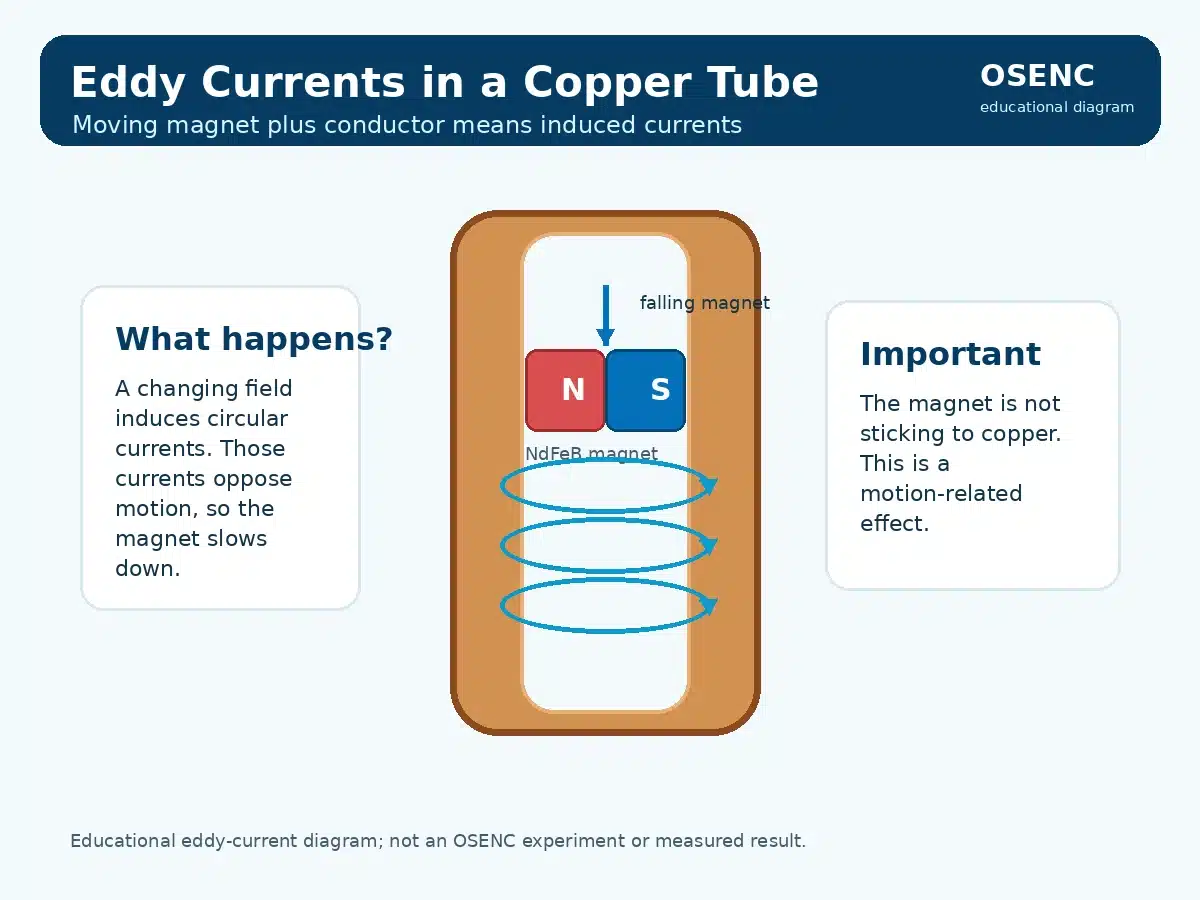
제품 설계 시 구리가 자석에 붙지 않는다는 이유만으로 구리의 영향을 무시해서는 안 됩니다. 중요한 것은 구리를 기준으로 자기장이 변하는지 여부입니다.
자석 어셈블리에서 구리가 영향을 미치는 경우는 언제입니까?
구리는 움직임, 자기장 변화 또는 전류 흐름이 있거나 자석 근처에 연속적인 도전 경로가 있을 때 영향을 미칠 수 있습니다.
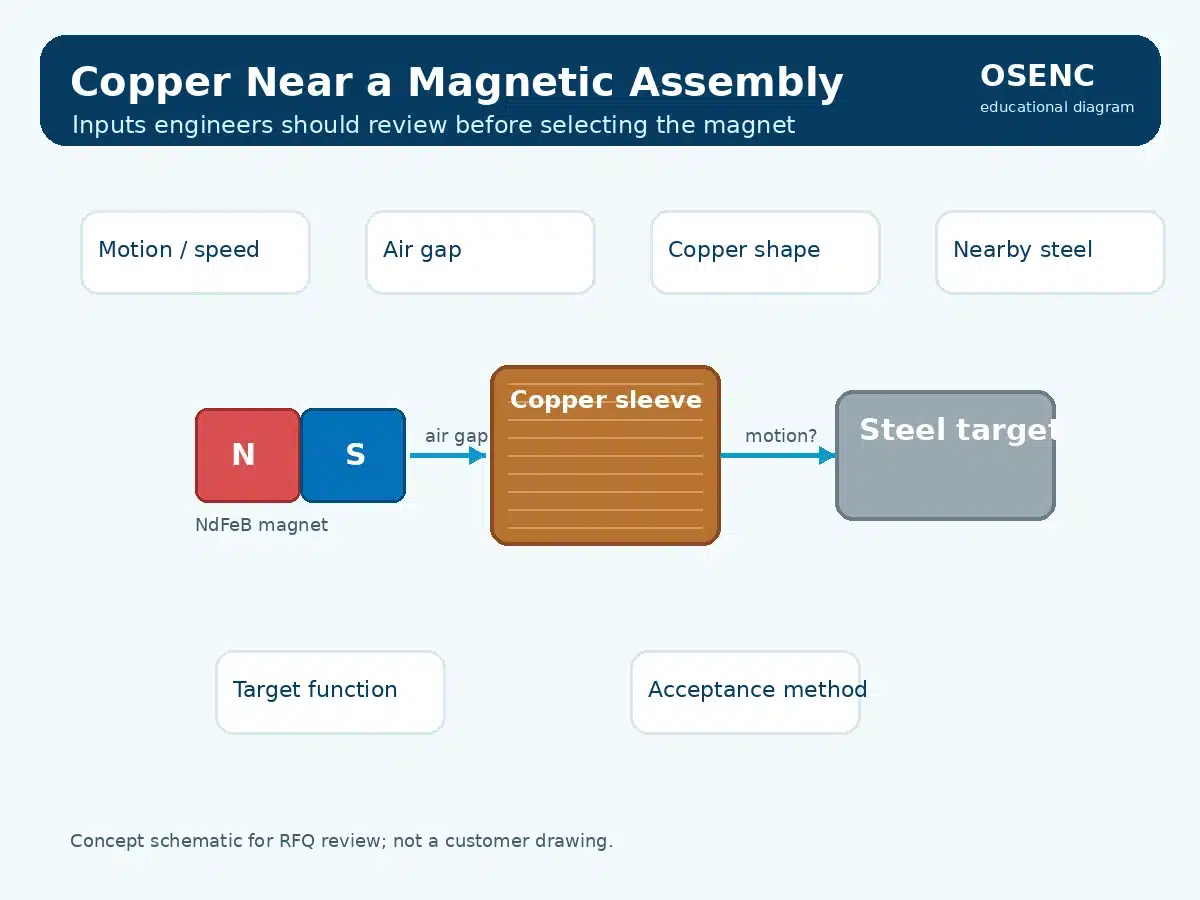
일반적인 예로는 회전하는 자석 주변의 구리 슬리브, 이동하는 자석 주변의 구리 튜브, 모터 또는 액추에이터의 구리 권선, 센서 또는 자기 엔코더 주변의 PCB 패턴, 그리고 자기 커플링, 로터 또는 Halbach 방식 어셈블리 인근의 도전성 부품이 있습니다.
이러한 경우 설계상의 우려는 구리가 일반적인 자석의 흡착 대상이 된다는 것이 아닙니다. 우려되는 점은 형상과 작동 조건에 따라 구리가 감쇠, 전기적 거동, 원치 않는 발열, 센서 동작 또는 시스템 효율에 영향을 미칠 수 있다는 것입니다.
| 설계 질문 | 중요한 이유 |
|---|---|
| 자석이 구리에 대해 상대적으로 움직이는가? | 움직임으로 와전류가 유도될 수 있습니다. |
| 자기장이 시간에 따라 변하는가? | 변화하는 자기장은 도체에 전류를 유도할 수 있습니다. |
| 구리 부품이 폐회로, 슬리브, 튜브 또는 대형 판재인가? | 연속적인 도전 경로는 더 강한 와전류를 형성할 수 있습니다. |
| 구리와 자석은 얼마나 가까운가? | 간극이 작을수록 자기장 상호작용이 증가할 수 있습니다. |
| 속도 또는 주파수는 얼마인가? | 변화가 빠를수록 와전류의 영향이 커질 수 있습니다. |
| 주변에 강철 또는 철 부품이 있는가? | 강자성 부품이 자기 회로를 지배할 수 있습니다. |
| What is the function? | Holding, sensing, damping, torque, or positioning require different review paths. |
This is where an application drawing becomes more useful than a simple material name. “Copper near a magnet” is not enough information. The relative motion, distance, geometry, current path, and target function decide whether copper is important.
When Usually Does Copper Not Matter Much?
In many ordinary static holding applications, copper is not a useful magnetic target because it does not provide the strong attraction that steel or iron can provide.
For example, if a customer wants a neodymium magnet to hold onto a copper sheet, the magnetic holding force will normally be poor unless there is steel or another ferromagnetic material behind or inside the structure.
Copper also should not be treated as a magnetic return path. If a design needs a strong magnetic circuit, steel or another suitable ferromagnetic material is usually the material that provides the return path, not copper.
Copper may be less important when the magnet and copper are both static, the air gap is large, copper is not part of a loop or sleeve, nearby ferromagnetic materials dominate the magnetic circuit, or copper is only a decorative nearby component.
What Should Engineers Check Before Choosing a Magnet Near Copper?
If your magnetic design includes copper, the RFQ should include more than magnet size and grade.
For Osenc or any magnet engineering review, the most useful information is:
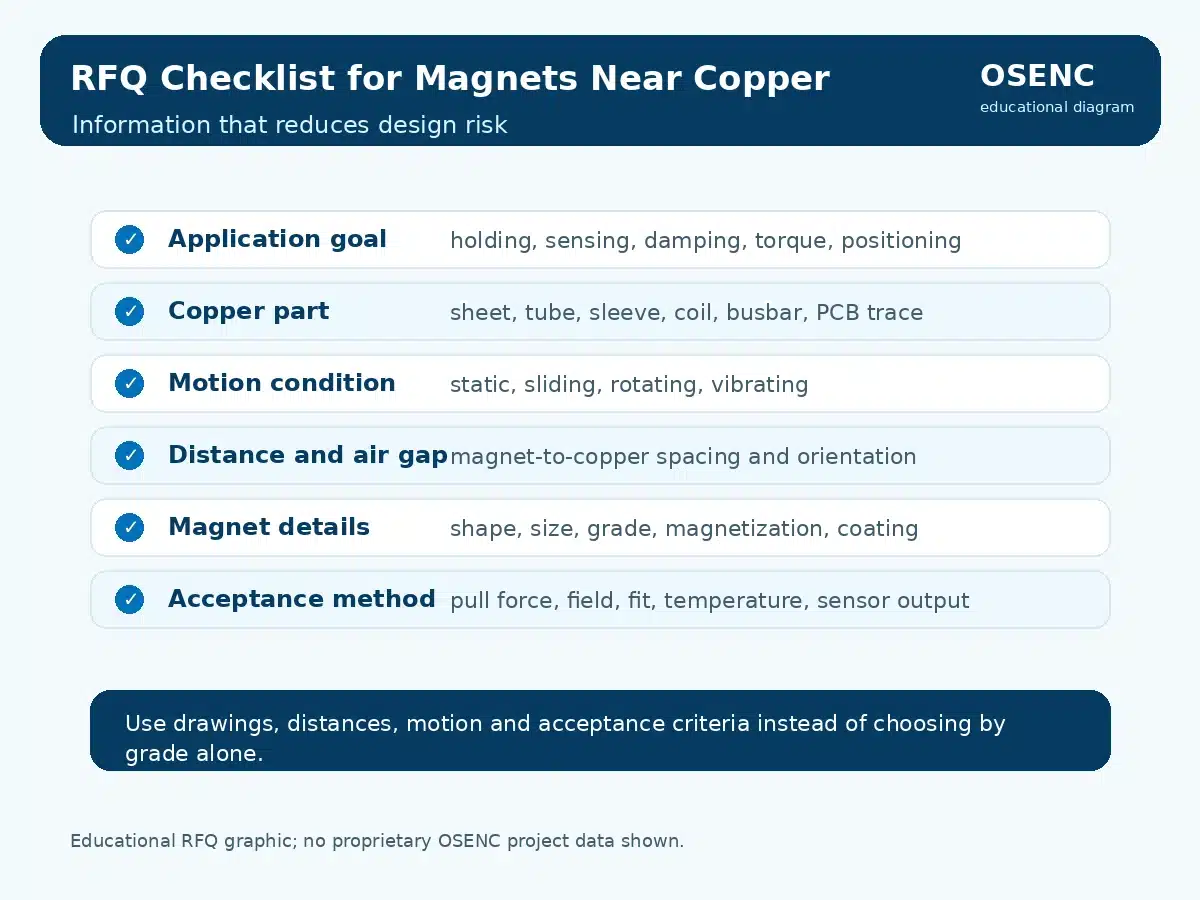
| RFQ 입력 정보 | What to Provide |
|---|---|
| 적용 목적 | 유지, 감지, 감쇠, 토크 전달, 위치 결정, 제동 또는 기타 기능. |
| 구리 부품 유형 | 판재, 튜브, 슬리브, 와이어, 코일, 버스바, PCB 패턴, 링 또는 가공 부품. |
| 구리 치수 | 두께, 폭, 직경, 길이 및 관련 공차. |
| 자석 위치 | 구리와의 거리, 공극 및 방향. |
| 운동 조건 | 정지, 슬라이딩, 회전, 낙하, 진동 또는 왕복 운동. |
| 속도 또는 주파수 | 해당되는 경우 상대 속도, rpm, 펄스 주파수 또는 작동 사이클. |
| 도전 경로 | 구리가 폐루프, 슬리브, 튜브 또는 넓은 연속 표면을 형성하는지 여부. |
| 자석 세부 정보 | Size, shape, grade if known, magnetization direction, and coating requirement. |
| Nearby materials | Steel, stainless steel, aluminum, plastic, brass, or other parts near the magnet. |
| 온도 조건 | Ambient and working temperature near the magnet and copper. |
| Acceptance method | Pull force, surface field, motion feel, sensor output, temperature rise, fit, or assembly test. |
This information helps avoid a common mistake: selecting a magnet only by grade. Grade matters, but real performance also depends on working distance, magnet shape, magnetization direction, target material, assembly structure, and operating conditions.
For a 맞춤형 네오디뮴 자석 or magnetic assembly, Osenc can review drawings, sketches, samples, or application requirements to help evaluate magnet size, grade, coating, magnetization direction, air gap, and assembly structure. For complex magnetic assemblies, simulation, sample validation, and testing may be considered where suitable.
Common Mistakes About Copper and Magnets
| Mistake | More Accurate View |
|---|---|
| “Copper is not magnetic, so magnets never interact with it.” | Static attraction is weak, but moving or changing magnetic fields can induce eddy currents. |
| “If a magnet does not stick, the part must be pure copper.” | A magnet test cannot prove purity or alloy grade. |
| “Copper-colored means copper.” | Copper color may come from plating, coating, alloy color, or surface finish. |
| “A stronger magnet will stick to copper.” | A stronger magnet does not make copper act like steel. |
| “Copper can replace steel in a magnetic circuit.” | Copper is not a high-permeability magnetic return path. |
| “Copper blocks all magnetic fields.” | Copper is not a simple static magnetic shield. Shielding depends on field type, frequency, geometry, thickness, and gaps. |
These details are important because many design mistakes begin with a simple material assumption. In magnetic products, the surrounding parts can affect real performance as much as the magnet itself.
How Osenc Can Help With Magnet Designs Near Copper
Osenc’s main role is not to sell copper. Osenc helps customers evaluate 네오디뮴 자석 and magnetic assemblies when surrounding materials, geometry, air gap, motion, coating, magnetization direction, or assembly conditions affect the result.
If your design includes copper parts near a magnet, Osenc can review the drawing or sketch, magnet size, copper part location, air gap, movement direction, required force or sensor behavior, temperature condition, and coating requirement. If the magnet needs environmental protection, the 네오디뮴 자석 코팅 choice should also be reviewed with the final assembly conditions.
This is especially useful for motors, magnetic couplings, rotors, sensors, encoders, small mechanisms, and custom magnetic assemblies where copper may be nearby but not acting as the magnetic target. Quality checks such as dimension inspection, surface field checks, pull-force tests, coating inspection, or other validation steps can be discussed through Osenc’s 품질 관리 process when they are relevant to the project.
No copper-specific Osenc customer case, test record, or simulation result has been added here because no confirmed project data was provided for this article. If such data becomes available, it should be added only after confirming what can be published.
자주 묻는 질문
구리는 자성을 띠나요?
구리는 일상적으로 말하는 자석에 끌리는 성질이 없습니다. 정확히는 반자성체이므로 자기적 반응이 매우 약하며, 철이나 강철과는 다릅니다.
구리는 자석에 붙나요?
아니요. 순수 구리는 일반적으로 자석에 달라붙지 않습니다. 구리색 부품에 자석이 달라붙는다면 강철, 도금, 오염, 숨겨진 배면 재료 또는 다른 자성 부품이 있는지 확인하십시오.
자석이 구리관 안에서 천천히 떨어지는 이유는 무엇입니까?
움직이는 자석은 구리 파이프에 변화하는 자기장을 만듭니다. 이로 인해 와전류가 유도되고, 와전류는 자석의 운동을 방해하는 자기장을 생성합니다. 자석의 속도는 느려지지만 구리에 달라붙는 것은 아닙니다.
구리는 자기장을 차단할 수 있습니까?
구리는 정자기장을 단순히 차폐하는 재료가 아닙니다. 유도 전류를 통해 변화하는 자기장에 영향을 줄 수 있지만, 차폐 특성은 주파수, 두께, 형상, 거리 및 간극에 따라 달라집니다.
황동은 구리처럼 자성을 띠나요?
일반적인 황동은 주성분이 구리와 아연이므로 일상적인 의미에서 자석에 끌리지 않습니다. 다만 자석 시험만으로는 정확한 합금 종류를 확인하거나 내부에 숨겨진 자성 부품이 없다고 단정할 수 없습니다.
자석 시험으로 부품이 순동인지 확인할 수 있습니까?
아닙니다. 자석 시험은 대략적인 선별 단계일 뿐입니다. 합금 식별이 중요하다면 공급업체 문서나 PMI, XRF, OES와 같은 적절한 재료 식별 방법을 사용하십시오.
구리 도금이 자석의 부착력에 영향을 줍니까?
구리 도금 자체만으로는 표면이 자석에 강하게 끌리는 대상이 되지 않습니다. 도금된 부품이 자석에 붙는다면, 일반적으로 도금층 아래의 소재나 다른 자성 부품에서 인력이 발생합니다.
네오디뮴 자석 근처에 구리가 있어도 괜찮습니까?
단순한 정적 배치라면 대개 크게 고려할 사항은 없습니다. 그러나 움직임이나 회전이 있거나 전류가 흐르는 경우, 자기장이 변하는 경우 또는 자석 근처에 구리 슬리브, 튜브, 코일, 플레이트가 있는 경우에는 설계를 더욱 면밀히 검토해야 합니다.
Sources and Evidence Boundary
This article uses external technical references for material magnetism, eddy currents, conductive shielding boundaries, and material identification. It does not present Osenc copper-related customer cases, measured test records, or simulation results.
Custom magnet engineering review
Need Help With a Magnet Design Near Copper?
If your design includes copper parts near a neodymium magnet, send Osenc the drawing, copper part position, air gap, movement condition, target function, and acceptance method.
Osenc can help review whether the issue is magnet size, grade, coating, magnetization direction, working distance, nearby steel, assembly structure, or validation method.
Contact Osenc for a Magnet Review